Secret Sunshine (2007)

Secret Sunshine opens with a shot of the sky. A few clouds drift by, but otherwise, the bright blue background dominates. The film closes with a shot of a dirt patch. Garbage circles the perimeter, but otherwise, the dark brown background dominates.

It wouldn’t be incorrect to infer a downward movement in the film from this description. But just how is it downward? Lee Chang-dong’s 2007 film (not in general release in the U.S. until 2010) is interested primarily in what makes human beings tick. What gives our lives purpose or meaning? The film uses as its subject a young, recently widowed mother named Shin-ae who experiences even further tragedy as the story progresses.

Burdened by her suffering, she turns to an Evangelical church for answers. Thoughtful film blogger Darren Hughes called the film “the truest depiction of evangelical Christianity I’ve seen on film,”[1] a description not far from my own estimation. Not only does the film treat its religious characters and their services with respect, it manages to engender a great deal of sympathy for an Evangelical perspective. Now, it’s best to know as little as possible going in, so if you’ve not yet seen the film, let me ask you to stop here, see the film, and then finish the piece. And comment, of course.

The sympathy for the Christian characters comes through Lee’s willingness to film them in their element. He gets the details right—both in their language and their practice. The film would never work narratively if Lee had not filmed them in the best possible light. The church needs to be a compelling safe harbor for Shin-ae, providing her some answer and sense of comfort as she deals with the tragedies of her life.

However, unsurprisingly, showing Evangelicals in a true light is a double-edged sword. For while the church offers Shine-ae some measure of relief, their approach is decidedly “heavenly” rather than “earthly.” The people offer her a sense of belonging to something greater than herself, yet their responses to her suffering seem designed to subdue it rather than engage it. When Shin-ae presses one church member over why God would allow such suffering to occur in her life, the Christian attributes it all to God’s will. Simple answers like this provide initial comfort, but on further reflection seem empty and void of any real salve for the wound. So while the Evangelicals provide an initial dose of hope for Shin-ae, they eventually prove unable to truly engage with her where she is.

That said, Lee doesn’t take the easy road here. These Christians are, in most cases, good people. Even one of them who fails late in the film is given some measure of compassion as his guilt is palpable. But Shin-ae’s journey from an isolated widow at the film’s opening takes her downward, ironically past those who claim the Incarnation, to a place of raw humility and brokenness bordering on insanity. Her anger at God in the film’s final third is unmistakable, and yet, at the film’s conclusion, a spark of something good and true and beautiful still remains in her life.

The downward movement, then, takes the lead character from heaven to earth, from the abstract to the concrete, and from isolation to connection. In other words, Secret Sunshine shows us something of what it means to be human. Maybe it’s something just a little lower than we tend to think.

City Lights (1931)

Charlie Chaplin’s City Lights (1931) presents a portrait of humanity that expands and challenges even the most savvy viewer. The story follows Chaplin’s Little Tramp character, a man without material resources, yet who shows himself to be the most resourceful character in the film. Early on, he meets a blind flower girl and falls in love with her. They have very little in the way of conversation, but she mistakenly believes him to be a rich man. He doesn’t correct her, enjoying the idea of living well, even if only in the fantasy of another person. Eventually the Tramp learns that she and her family are in dire financial straits and through a friendship with a wealthy man, the Tramp is able to help the girl with her troubles and even help her to regain her sight when he pays for an operation.

In the final scene in the film, the Tramp reveals himself to the girl for the first time. He is vulnerable and unsure of what she’ll think of him as a poor man. She is about to receive knowledge that will change her world forever. Upon seeing the Tramp with her newly seeing eyes, she no longer sees in him what she wants to see. Instead, she sees what actually is—a poor man who sacrificed a great deal that a blind girl he barely knew might see. This moment of revelation challenges each of them to live in the world that is, rather than the invented one they had enjoyed.

In this film, the revelation works on a dual level. The characters in the film receive their own challenging disclosure as they reveal themselves to one another. But the audience sees as well. The final sequence begins some months after the Tramp provided the money for her operation. They have not seen each other since. The first shot is of the girl busily working in a flower shop, arranging flowers in a pot, checking her hair in a mirror, and talking with a woman in the shop. The image is all life and joy, the girl’s brisk movement contrasting so strongly with her relative stillness before she could see.

The film then cuts to a long shot of the Tramp. His torn pant legs are clearly visible. A busy street in the background contrasts strongly with the lonely sidewalk he meanders down. He stands in the spot where he used to meet the girl, where she sold her flowers. Earlier in the film, when he encountered her there, the image was warm, immediate, and joyful. Now, with only he and the imposing stone and iron fence, the image is cold, distant, and isolated.

The film then returns to the shop, where a rich man in a top hat walks in. The flower girl’s face lights up with the prospect that this may be the man. Seeing the loneliness and longing is different than hearing about it. There is less limitation in the image than if she had also voiced her thoughts. Without those words, the film invites the audience to fill in the girl’s thoughts and feelings. We become participants in this moment, bringing our thoughts and feelings to bear on this encounter that’s about to happen. In these ways, the film is disclosing something to us about the way the world is, a truth that simply cannot be communicated through mere propositions in dialogue.

Finally, the two come together, first with a lengthy sequence out in front of the shop while the Tramp still doesn’t know the girl works there. Chaplin keeps the Tramp turned away from the shop, and while shooting in a wide shot with the girl in the background watching him, audience expectation rises. Now, for the first time, we sense a palpable hope for their future that before had seemed little more than a distant dream—for who would ever marry a Tramp? On more than one occasion, it looks as if the Tramp will walk by without ever turning to see her (only he knows what she looks like), Chaplin playing this moment for maximum effect.

As the Tramp turns and sees her for the first time, he stands speechless for some time while she offers him a flower, and then money (due to his poor appearance). As she gives him the flower and then the coin, she takes his hand. It is only then she sees, using one of the senses that was available to her prior to her operation—touch. As this reunion takes place without the benefit of hearing the words, the film points the viewer to focus exclusively on their faces. Chaplin’s keen sense of rhythm allows him to build a sense of anticipation and eagerness. Further, he brings the camera increasingly closer to the action throughout this final sequence, the frame serving as a magnifying glass on this most remarkable transformation.

All true revelation sets forth a challenge. This sequence offers just such a test in its portrayal of this meeting. Of course, the challenge depends to some degree on the individual—this gets at the openness of images and their ability to speak to a variety of situations and circumstances. At its heart though, this sequence challenges the viewer to see these individuals as fully-formed human beings. The film as a whole does this as well, but here the stakes are raised. In this sequence, we see the realities of despair and loneliness, both in the Tramp as well as the flower girl. We see the awkwardness of vulnerability, the difficulty of living more openly and honestly with another human being. And finally we see love’s beauty, the power of true, selfless affection to bring people together—even people who might for some reason or another be considered “disappointing.” Chaplin and his camera bring us from the pits of despair and loneliness to the joy of loving and being loved. These two “undesirable” characters, people many might be tempted to scoff at or pass by without noticing, have become people we care about and cheer for. We talk all day about the movement from despair to love. In City Lightswe see that movement played out before our eyes in truly revelatory fashion.

A Charlie Brown Christmas (1965)

“Sure, Charlie Brown, I can tell you what Christmas is all about.”

So says Linus at the penultimate moment of 1965’s A Charlie Brown Christmas. The film follows a December day in the life of Charles Schulz’s endearing Peanuts characters. Typically, Charlie Brown gets rejected at every turn, a girl haughtily telling him that she didn’t send him a Christmas card, his friend Lucy so dazzled by money that she doesn’t listen to his problems, and finally, a group of kids laughing at his “stupid” Christmas tree. Charlie Brown’s frustration boils over as he yells to anyone who will listen: “Isn’t there anyone who knows what Christmas is all about.”

Linus answers his friend’s call in the simplest of ways: He quotes from the original Christmas story—the Bible. Luke 2:8–14, to be exact. Such a narrative move is fraught with complications, leaving the movie in danger of committing one of the cardinal sins of filmmaking: it risks subjecting the audience to a sermon, rather than allowing the film to work in subtler and more lasting fashion. However, due to certain formal choices by the director and animators, this potentially preachy piece of film ends up delivering a powerful moment of inspiration.

Director Bill Melendez uses seven shots in this sequence, covering little more than ninety seconds altogether. After Linus walks away from Charlie Brown (shot 1), we see the widest shot in the entire film, from the back of the auditorium, with Linus alone at the center of the stage (shot 2). There is little if any movement in the shot, its wideness allowing the viewer to perceive only the largest movements. The simplicity of this view corresponds with the simplicity of Linus turning to the Bible to help his friend understand Christmas. No psychologizing or gags to make him feel better—just a simple story that has proved meaningful to millions of people throughout history.

During a long zoom in, the animation cuts forward to a close-up of Linus (shot 3). His expressiveness becomes apparent during this shot. As Linus speaks the words of the angels to the shepherds, “Fear not,” he, not insignificantly, drops his blanket. Caught up in the moment, Linus also keeps his thumbs from his mouth. He is fully alive and engaged here. Melendez pulls the camera back, revealing the blanket lying next to the boy’s feet and giving us a complete view of this unique and lovable child.

The next cut shows Linus from the left, with his friend Charlie Brown, alone in the background (shot 4). This moment reminds us of the narrative purpose behind Linus’ quotation. Linus is helping his frustrated friend grapple with the loneliness that comes from being ill-used, put down, and ostracized. Is there a better example of enduring such treatment than Jesus Himself? And did not Jesus come to put an end to all of the kinds of problems Charlie Brown was experiencing?

Melendez returns to the wide angle as Linus concludes the passage (shot 5). With Charlie Brown, Linus, and all their friends visible on stage, Linus speaks the final words of the passage: “And on earth, peace and goodwill toward men.” In these sentiments we find just what has been lacking in the children’s treatment of Charlie Brown—and in their celebration of Christmas in general. With Charlie at one end of the stage and the rest of the children at the other, the visual element here underscores, or to say it more strongly, sets the tone for the words that Linus speaks.

The final two shots are of Linus on stage—the first of him silently picking up his blanket and leaving the spotlight, the second of him walking up to Charlie Brown (shots 6 and 7). The quiet ending as Linus leaves the spotlight allows for a moment of reflection. The works a bit like a visual breath, giving the audience a moment to take in what they have just seen and heard. Linus returns to his friend and says, “That’s what Christmas is all about, Charlie Brown.” A renewed Charlie heads out with his tree, a fresh spirit of vigor and liveliness within him.

This sequence wouldn’t be nearly as special as it is without the attention to detail given by Melendez and company. I for one am glad they did, as this unassuming film stands as one more reminder to me of what Christmas is all about.

Diary of a Country Priest (1951)

Increasingly I am finding disjunction as a means of producing a transcendent vision highlighted in the cinema of Robert Bresson. A recent viewing of his 1951 adaptation of Georges Bernanos’ novel, Diary of a Country Priest has strengthened my perception of this Bressonian strategy.

One of the more notable qualities of Bresson’s films beginning with Country Priest and extending throughout his career, is the largely stoic, even blank look of the actors. For many used to traditional Hollywood emoting, this can be off-putting. However, through this “oddity” in his films, Bresson creates an invitation for the viewer to look more closely, to see beyond just the face and behold the person.

Such an approach to the acting, along with certain distinctive visual choices, presents an interesting case study of disjunction in Bresson’s world. Nearly halfway through Country Priest, a film which tracks the travails of a young priest in his first parish, the titular character receives the shocking news that the local countess has died. The priest had a significant, positive spiritual encounter with this woman just prior to receiving this news, one where he blessed her with peace, his raised hand falling to her lowered head, where he made the sign of the cross over her. and he visits her home twice the day after her death.

The priest then visits her home twice the day after her death. Each of the two visits, which appear back to back, open with a brief look at the priest’s journal. In the first, he writes in the present moment, recording simply that the woman has died, thereby introducing the whole sequence. However, the rest of the dialogue in the sequence—including another brief appearance of the journal between the two home visits—is in the past tense. After an initial moment in the present then, the rest of the action follows the priest’s writing about past events. This structural disjunction prepares the way for similar contrasts in both the visual approach and the acting of these scenes.

Bresson displays the first visit in a single shot, the camera placed on the near side of the bed at the headboard and zooming in on the priest as the camera follows him to the right. The man enters the countess’ room, stops at the foot of the bed, blesses her with raised hand, and then kneels. At this moment, the camera tracks back toward its original position, leaving the priest alone in prayer before the bed.

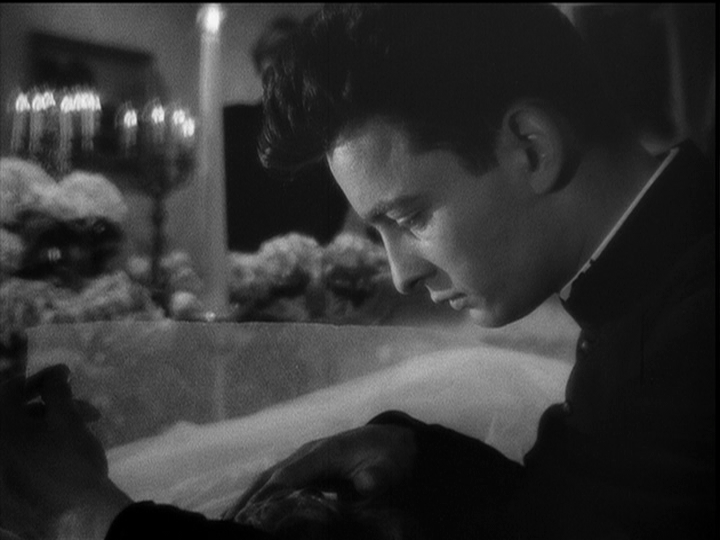
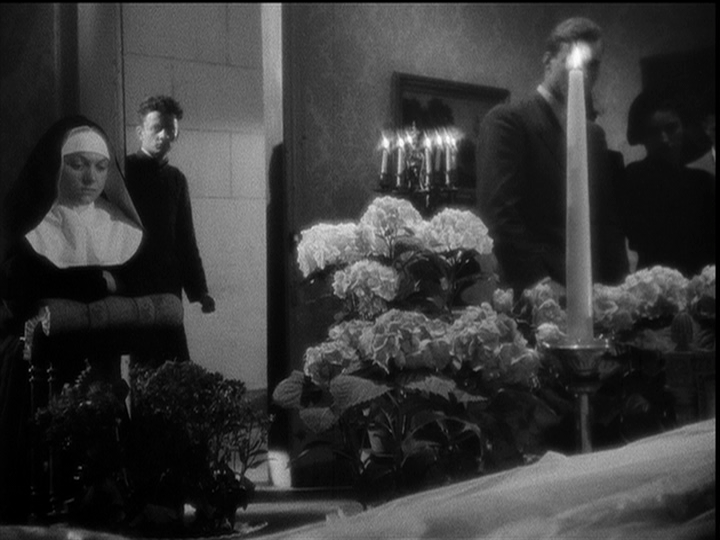
When the priest arrives in the room for the second time that day, Bresson again displays the visit in a single shot, the camera this time placed on the far side of the bed. The priest enters the room, stands at the footboard bookended by two candles, and silently prays. He then walks around to the far side of the bed and kneels into a close-up. In this case, the camera remains near the priest rather than pulling away, as it did during his first visit. The priest pulls back the muslin cover over the woman’s face, touches her forehead with his hand, gets up and walks out.

Clearly these two shots are a pair—taking place in the same room, shot in the same style, and involving the same key movements. The slight differences between the scenes bring interest to the character and highlight his tenuous situation in the film. A quick comparison might help break down the differences between these scenes:

First Visit

  • Camera placed near the priest
  • Empty room
  • Expresses himself with priestly function
  • Kneeling, prayerful act in wide shot
  • Shot ends with him kneeling 

Second Visit

  • Camera placed away from the priest
  • Room filled with guests
  • Expresses a personal loss
  • Kneeling, prayerful act in extreme close-up
  • Shot ends when he leaves the room

While the camera spends more time nearer (either by proximity or zoom) the priest in the first visit, the scene remains impersonal and abstract. He performs his priestly duty by blessing her and praying. However, before he arrives in the room for the second visit, he acknowledges the presence of a priest already there in an official capacity. This presents an opportunity for a more personal visit. Bresson keeps the camera further from him to begin, a distancing effect that seems to objectivize the moment. However, when the priest unexpectedly (at least based on his actions in the previous scene) moves directly toward the camera and kneels at the woman’s side, the situation is no longer a distant action. Here in extreme close-up, the priest once again raises his hand. But instead of blessing the countess as he did in his first visit, he brushes her face with his fingers. The moment feels intimate in a way reminiscent of his moment of blessing the countess earlier in the film—a moment she told him brought her a deep and abiding peace. And clearly, that previous encounter is on his mind, as he reminisces about ministering to her a peace he himself did not have—the miracle of empty hands, as he calls it.

The stoic figure of the priest throughout these sequences, up to and including the emotional encounter at the end of the second visit, stands at strong contrast with the words he speaks. This disjunction invites contemplation of the world within the frame. And the priest’s words suggest a world both in concert with and beyond that world within the frame. Bresson’s use of the close-up highlights this deeply personal moment. The priest’s actions through most of the sequence suggest strength and commitment to his duty as a priest. The priest’s actions at the end of the sequence suggest a deep struggle or sorrow. However, in the latter case, his face suggests nothing of the kind. In this contrast we begin to perceive hints of an unseen world of deep spiritual upheaval in the priest, an upheaval masked by his straightforward ways. This scene then is a Bressonian invitation to see the physical realm, and in seeing it clearly, to see beyond it.

The Virgin Spring (1960)

Ingmar Bergman’s The Virgin Spring stands as something of an anomaly in his career—one of the few films he directed but did not write. Yet despite this outlier status, the film feels much of a piece with Bergman’s other work, particularly that series of features beginning with The Seventh Seal and ending with The Silence. These works each deal explicitly with either existential or theological questions, The Virgin Spring focusing especially on the latter.

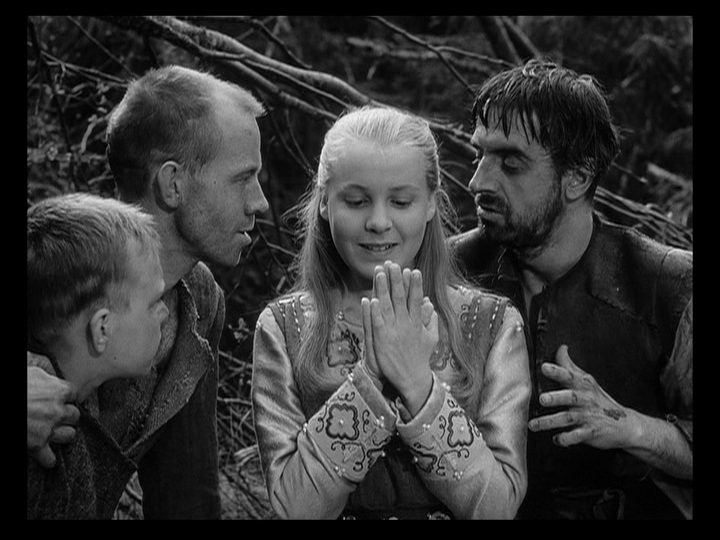
A beautifully realized tragedy, the film follows a 13th century farmer, Töre (Max von Sydow), and his household in the lead up to and their actions in response to the brutal death of Töre’s teenaged daughter, Karin (Birgitta Pettersson). The family themselves are devout Christians, with Töre’s wife Märeta (Birgitta Valberg) practicing a punishing form of asceticism. The woman’s harshness extends to others as well, most notably her housemaid Ingeri (Gunnel Lindblom). Such ill treatment drives the servant to call upon the Norse god Odin to punish the beautiful and flirtatious Karin. However, Karin’s rape and murder come as an unexpected shock—rather than answered prayer—to Ingeri, who eventually leads the stricken parents to the body after they have exacted vicious revenge on the killers. The film culminates with a heart wrenching prayer, followed by a glorious miracle.

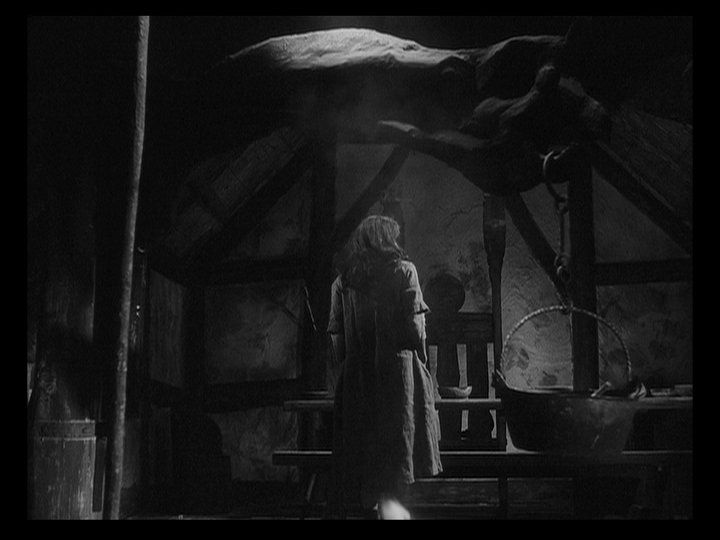
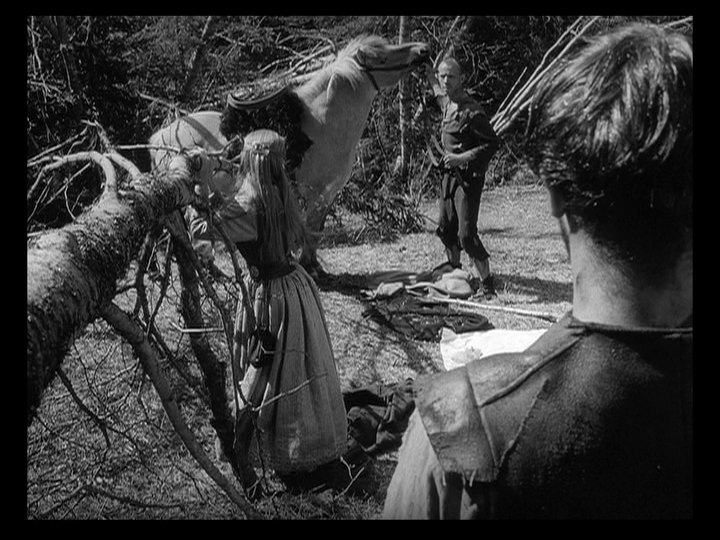
The black and white photography from Nykvist sparkles, while Von Sydow appropriately looks cut from an ancient religious icon. The film is built on a visually-oriented language that highlights shadow and closed spaces. Oppressive walls loom in the background. Tightly bunched people pray before a hovering crucifix. Dirty faces invade personal space. A fallen tree limits movement. A tall fence bars entry to undesirables. A barred door prevents escape.

Only in the final moments, when Töre awkwardly collapses in front of the stream, do we get any real sense of freedom of movement. The stream bubbles across and away from Töre into a grove of trees. Töre’s body crumples to the ground as the weight of his daughter’s death presses him downward. Bergman even adds a sound element—the chirping of birds—to bring an openness to the final sequence.

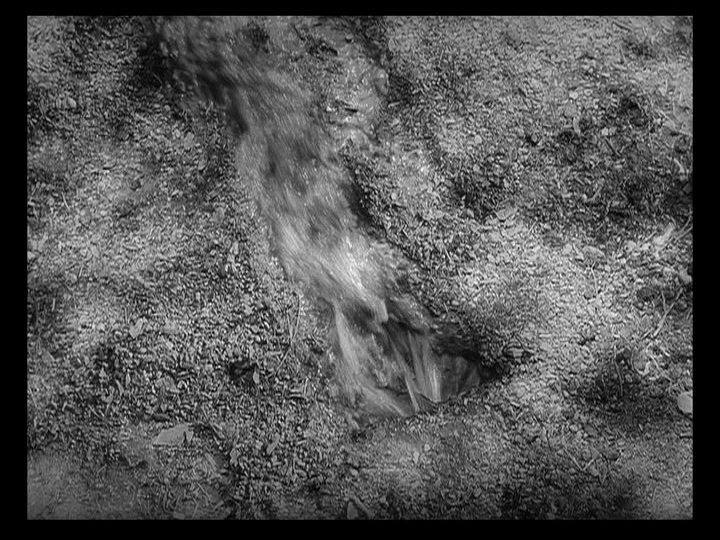
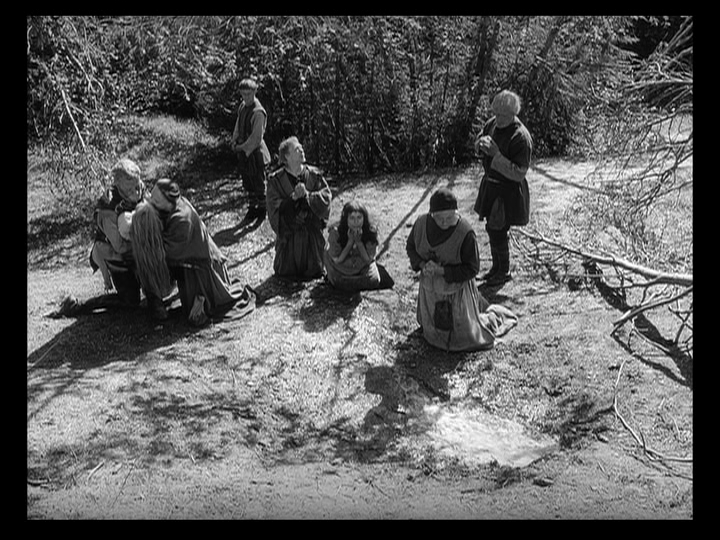
The penultimate visual testimony to freedom comes as the spring breaks free from the gravelly ground and rushes down the slight incline, in and among the members of Töre’s household. As the camera frames this small group of witnesses from above, each of them in a posture of reverence, they again look confined against the landscape. But they are also being viewed from above, and seem to see beyond their immediate context, visual hints at an even greater openness and freedom beyond physical sight.

This Land is Mine (1943)

When a movie engages in propaganda, we see in it a power play, often a desire on the filmmaker’s part to bend the audience member’s opinion through dishonest and/or manipulative means. We see this most regularly in religious films, and widely in war or politically-themed works (think Riefenstahl’s Triumph of the Will). Jean Renoir’s 1943 wartime film, This Land Is Mine, has been called “propagandistic” with a screenplay that consists of “pure jingo” from no less a critic than the estimable Dave Kehr.[1]

And yet, despite a personal aversion to such tactics, This Land Is Mine offers a surprising dose of humanity in its brisk 103 minutes. This is due in no small part to Renoir’s gentle, even playful, touch with a number of the characters, making them more people with opinions and tendencies rather than mouthpieces spouting hard and fast ideology. The German Major von Keller, for instance, plays against the typical Nazi type, a man preferring to negotiate with and persuade the occupied instead of dominating them with a brash show of force. Von Keller remains evil—perhaps appearing even moreso with his gentler ways. In this spirit, von Keller’s most effective weapon turns out to be a flower, rather than a gun.

Laughton’s Albert Lory serves as the prime example of Renoir’s deft handling of his characters. To merely recount the arc of this character would lead one to affirm Kehr’s casting the screenplay into the classic Hollywood jingo-bin. However, while the character undergoes a remarkable transformation in an absurdly short amount of time, the film and the performance are so compelling that the abruptness of the transition is lessened.

Ultimately, the sequence that makes the film work appears in the film’s final third, as Lory offers two speeches in the courtroom that bookend a crucial few moments in his cell. None of these scenes will win awards for their distinctively cinematic qualities, but small and significant touches work to visually play off of the more straightforward ideas in the script. Most significant among these are the abrupt cut away from Lory’s friend Professor Sorrell, just before the latter’s execution. Renoir leaves him in mid-wave, effectively cutting off our last view of the great man too quickly. The cut serves to heighten our loss of this admirable character, one cut down far too soon.

Further, in Lory’s second courtroom address, immediately following the execution, Renoir alternates his camera between a medium shot of Lory himself and the faces of those in Lory’s hearing. This effectively minimizes the focus on the star—who, by the way, brilliantly delivers the speech—and places the “audience” in the midst of a dialogue of sorts—those who are hearing the speech and will have to respond to it.

This interplay between word and image doesn’t allow the film to avoid its propagandistic label—or the naïve liberalism of the final, anti-climactic classroom scene. But with his focus on faces, witnesses to this persuasive speech, Renoir injects something universally human into the proceedings—the portrait of a weighty choice: how to respond to the often conflicting messages and feelings we receive and have during our most trying times.

25th Hour (2002)

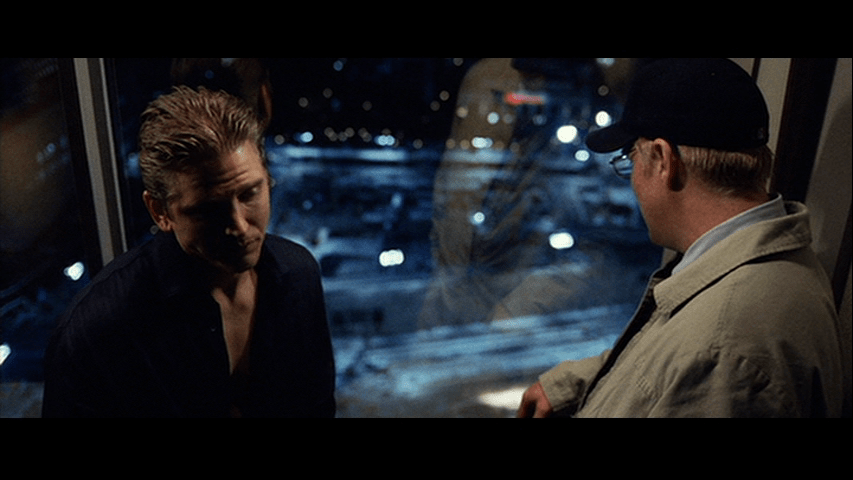
Spike Lee’s 25th Hour (2002) offers a fine example of a film bringing a material context to the screen through its visuals. The film follows New York City drug dealer Monty Brogan the day before turning himself in for a seven-year prison sentence. He spends the day reflecting on how he’s arrived at this place in his life, walking through his old neighborhood and school, visiting with his father, spending quiet moments with his girlfriend, and eventually joining his closest friends for an evening out. Before heading out to meet Monty, the dealer’s two best childhood friends—Jacob and Frank—meet at Frank’s Manhattan apartment for a beverage. The two eventually move to the window, the camera moving in to capture the two men and the chilling view of Ground Zero in the blue light below.

The shot, which lasts for more than five minutes—an eternity for an American movie featuring major stars—stands as one of the visual centerpieces of the film. As the camera tracks in to capture the men in a medium shot, they fall out of focus while they (and we) look at the massive cleanup effort ten or twenty stories below. After a few comments related to the sight before them, the men come back into focus for a conversation about the night ahead with their friend. They recognize the enormity of the moment, offering little more than pat answers to the tragedy that Monty will experience by going to prison. Frank goes so far as to state his belief that Monty will never return from this experience—once he goes to prison, their friend will be gone forever. As their conversation ends in frustration, sadness, and confusion, the camera pushes in toward the window and points down, bringing ground zero back into focus. Lee finally cuts away from this extended shot, with a series of eight four to five second close-ups of ruins and workers on the ground zero site.

The visual element of this scene dominates. And that’s saying something with the presence of sharp writing from David Benioff, effective music from Terrence Blanchard, and keen performances from two great actors, Barry Pepper and Phillip Seymour Hoffman. But think back for a moment and place this scene in context. The United States and New York City in particular had experienced devastating tragedy on 9/11. This film was shot a year later and released in December 2002. For viewers, this scene marked the first time they had seen ground zero on film. In some movies of that period, the towers were removed or obscured. Lee chose instead to use the wreckage, showing us New York in its current state, looking at the effects of evil straight on.

What a poignant use of this shot, then, as a man’s life as he and his friends know it is about to end. The scenario has already been set up in the film, so as the camera pulls forward to that window and ground zero comes into focus that first time—bathed in a depressed blue light—we could mute the film at that point and still know exactly what was going on. In this scene we see the destruction that Monty has wrought in his life and to a lesser degree, the lives of his friends and family. This is film in its purest form, showing the viewer a tragedy that words cannot adequately describe.

Werckmeister Harmonies (2000)

How mysterious is the Lord that he amuses himself with such strange creatures!  –Janos, Werckmeister Harmonies

Bela Tarr’s magnificent Werckmeister Harmonies offers a beautifully bleak portrait of the narrowness of modern life. The film opens with Janos in a barroom at closing time, prepared to illustrate for the drunken men the workings of the cosmos. Using the men as models, Janos shows them how the earth rotates around the sun while the moon at the same time orbits the earth. The scene’s oddity is strangely moving, as the single shot serves to unify the disparate group and strengthens the coherence of their actions. Tarr brings the camera both near and far, allowing us access to the men but also retaining the fundamental strangeness of the scene.

The simplicity of the scene endears the viewer to the men, yes, but more so to Janos. What kind of man would think up such a scheme? As the film follows Janos through his travels in the village over the following two days, we quickly discover a man captivated by a sort-of-circus that has come to town boasting the “largest giant whale” in the world. For Janos, this whale represents the creative possibilities of God (the quote above being Janos’ response to seeing the creature), and as such he encourages people to see it. Indeed, in the whole of the village, Janos seems to be the only one who actually sees the animal.

Janos seems to possess a quality that no one else has: reverence. When he sees something grand, he humbles himself before it. As such, we see him constantly on the move, serving other people, older people who he seems to respect and appreciate. Tarr’s typically lengthy “walking shots”—where a character or characters simply walk in an extended tracking shot—underline this fundamental aspect of Janos’ character: his reverence for the O/other has profound implications for how he lives his life.

That Tarr’s film ultimately illustrates the ways in which the abuse of power in the modern world—either through destructive riots or draconian rule—squelches such reverence makes the portrait no less beautiful. Indeed, the tragic ending draws us back to that opening sequence. As Janos directs the three drunken men in their “Dance of the Cosmos,” he suddenly stops them, the moon directly between the sun and the earth—an eclipse. Darkness has come, but only for a time, Janos tells them. The light will come again, and bring life with it.

This is, after all, the natural order.

Les anges du péché (1943)

Redemption stories are everywhere. Take a character down on her luck; watch her stagger through the mud of life for two hours; then rejoice as she comes out clean on the other side of her trials. Such stories are common because they reflect a deep desire in human beings to rise above the temporal cares and tribulations of life and grasp onto to something pure and real and true.

Filmmakers have been exploring and capitalizing on this universal human desire since the cinematic medium was invented. But few have explored redemption with as much formal interest, and, in certain cases, rigor, as Robert Bresson did in his first feature, Les anges du péché (The Angels of Sin).

The story follows a group of nuns as they bring two new members, Anne-Marie and Thérèse, into their family. This particular community of nuns specializes in serving imprisoned women while they are in prison, and offering them a place in the convent when they are freed. Anne-Marie comes to the sisters from a bourgeois life. With no prison in her background, she stands apart from most of the nuns. Thérèse on the other hand, begins the film as the most feared inmate in the prison. Only through Anne-Marie, an instrument of grace in the film, does Thérèse finally find her redemption. What makes Bresson’s film both interesting and excellent is not in his choice of tales, but rather in how he executes this telling of that old redemption story.

Undergirding Anne-Marie’s redemptive function is a maxim she receives, the maxim being a short quotation that each nun will seek to embody throughout the year. Anne-Marie’s maxim comes from Catherine of Siena, who wrote, “If you hear the word that ties you to another human being, do not listen to any others that follow—they are merely its echo.” The redemption in Les anges du péché only occurs when, as in the quote from Catherine, one person is tied to another. Redemption requires identification and union. Bresson illustrates these requirements in numerous ways throughout the film, but one scene stands out from among the rest (at least until the ending, which I won’t give away here, but which certainly underlines and continues what Bresson sets up in the following scene).

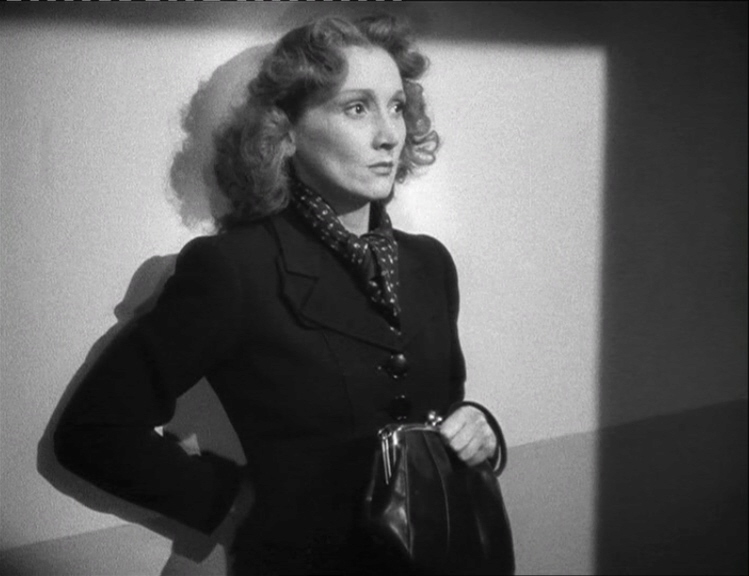
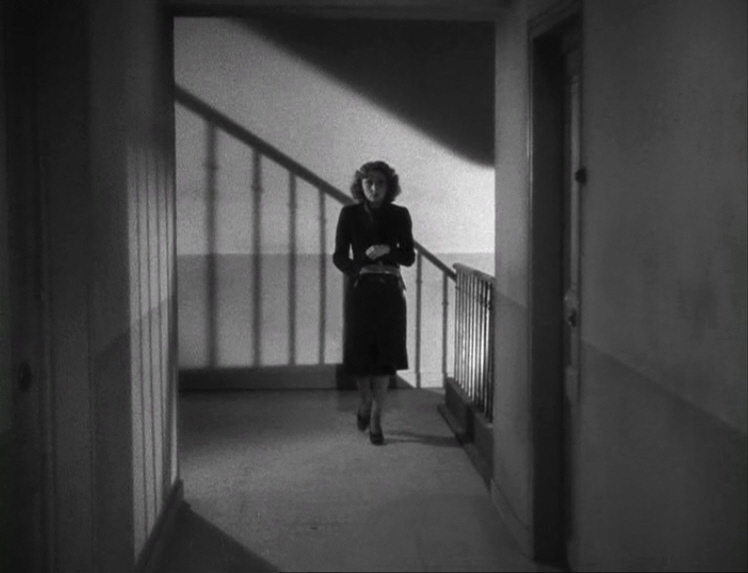
The scene in question takes place nearly halfway through the movie’s run time. The connection between Anne-Marie and Thérèse has already been established, the former somewhat pridefully, though genuinely, expressing her desire to raise up Thérèse from her lowly state. Only Thérèse has unexpectedly—at least as far as Anne-Marie is concerned—rejected the offer of help. Anne-Marie returns to the convent undaunted by this setback, and enters the chapel to pray that her desires will be fulfilled. The screen captures below offer a sense of the two shots following the close-up of Anne-Marie’s prayer, a wide shot of Anne-Marie bowing to pray in the chapel, and a well-designed tracking shot of Thérèse in a hallway, on her way to kill the man who wronged her.

Bresson’s mise-en-scene connects these two women beautifully. The echo of the banister in the first shot appears in shadow in the second. This visual element sets up the tension between the women, at once connecting and distinguishing the women. Could the use of shadow in the second shot indicate that Thérèse’s state is somehow lesser than Anne-Marie’s? Bresson heightens the contrast between the women by the difference in setting, rich and comfortable in the former, barren and stark in the latter. Yet even with this contrast, Bresson manages, at the same time to frame it with an underlying unification between the women, as Thérèse moves into the stairwell to occupy the exact space in the frame that Anne-Marie occupied in the previous shot.

At once distinct from and identified with one another, Anne-Marie and Thérèse occupy drastically different places in their lives, though despite that, their fates are inextricably linked one to another. Bresson makes this formal connection in the most significant scene of the movie (at least until the ending), the scene that will determine the ultimate fate of both of these women, a moment of life and death. Redemption will ultimately occur through this union, and because of it. In this darkest of moments for Thérèse, she shares a deep connection with Anne-Marie, even if, at this point, Thérèse has not reciprocated. In this brief sequence, we see a prayer being answered; we see the deep meaning of Christian love and concern for another person; and we see grace on the move, even as a woman guns down another human being. Both the mystery and the clarity of redemption are on full display in these two shots—a microcosm of the entire film, and of life.

Inglourious Basterds (2009)

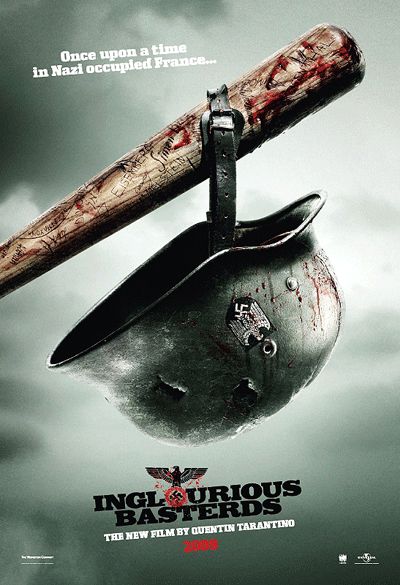
Inglourious Basterds follows the exploits of a fictional squad of U.S. soldiers appointed to kill Nazis behind enemy lines during World War II. Each of the Basterds happens to be Jewish-American, giving the film the feel of a kind of revenge fantasy. The story bears that out, as the Basterds move through France on their way to Paris, where they participate in an attempt to take out all of the Third Reich’s highest officials at a movie premiere.

Without a doubt, the movie entertains. Its accessible storyline, inviting locations (especially the movie theater), and flashier moments (like the shot that drops below the floorboards in the first scene) consistently engage. Christoph Waltz also turns in a fun performance as the Nazi “Jew Hunter,” while nearly all of the film’s characters get their share of comedic moments. Director Quentin Tarantino clearly loves the movies, and there’s a heightened cinematic feel to all of the action, a stylized presentation that means to consciously push viewers out of the real world and into Tarantino’s more cartoonish vision of reality.

Due to the consistently ironic tone of the film, Inglourious Basterds possesses a certain measure of falsehood. Film critic James Agee offers a helpful comment in his 1943 review of The Moon is Down, a Nazi film based on a novel by none other than John Steinbeck:

I respect Steinbeck’s insistence that both the Nazis and their enemies are human beings, but too many things get in the way of any proof of the fact. . . . Irony, I am told, comes from eironikos, which could be translated as false naiveté. Steinbeck’s ‘little people’ use it so much that they become false and naïve out of all conscious proportions. So the irony itself becomes unpalatable, and the people become dehumanized victims of a well-intended, unconscious patronage. Worse still they become stagy . . . (Agee On Film, 18)

Agee’s particular definition of irony as false naiveté is not the case in IB. However, as a clear example of purposefully ironic filmmaking, IB leads to similar results as The Moon is Down. Each of the two male leads in IB—Christoph Waltz and Brad Pitt—play their characters in over-the-top fashion, indicating a comic tone in decidedly un-comic surroundings. This begins almost immediately as Waltz’s Nazi officer questions the French farmer in such an excessively delightful tone. After carrying this joyous attitude throughout the interview, he concludes by playfully calling for Shoshanna as she runs in terror from the home, her family just murdered before her eyes.

The same is true for Pitt’s character, though in a slightly different manner. Whereas Waltz’s Nazi comes off almost as a comic madman, Pitt infuses his character with a cowboy quality—including a ridiculous Southern accent—that seems ignorant of or apathetic toward the moral seriousness of his squad’s brutality. He revels in the revenge his squad perpetrates on those “Naa-zees,” mixing both comedy and bloodlust in his pursuit of the enemy.

These two characters set the ironic tone for the film. We enter this world through their eyes and experiences. And because Tarantino lays it on so thick and so consistently throughout the movie, the characters become, in the words of Agee above, “dehumanized victims,” and “stagy.” The characters in this cartoonish world are something less than human. They exist not as individuals who make their own choices in recognizably human fashion, but as puppets that exist to provide a thrill or a laugh—often both at once. This end reality doesn’t set Tarantino’s film apart from much else that comes out of Hollywood these days. But because of the way he gets there and because of the unique setting of this film, the use of such an ironic seems problematic at best.

Director Quentin Tarantino has stated that he thinks his ending undercuts the revenge fantasy, believing that in the final reckoning the dying Nazis morph from their status as evil incarnate to simple human beings. As he says,

I set up scenes and I jerk you off to have a climax. And in this movie I jerked you off and I fucked with the climax… At some point those Nazi uniforms went away and they were people being burned alive. I think that’s part of the thing that fucks with the catharsis. And that’s a good thing.

It may be true that on a purely narrative level, the climactic scene in the movie theater subverts any bloodlust the audience might have had for Nazis as they rooted for the Basterds. The Basterds mow down the high-ranking Nazis with machine guns. Fire consumes those hoping to escape in the other direction. Bombs explode and obliterate the rest. This is cold-blooded killing, and on a grand scale.

In my view, the turn Tarantino thinks his film makes is not actually present. Maybe it would have been, had any other group taken the place of the Nazis. But the weight of the overwhelmingly ironic presentation, along with the cultural baggage that comes with Nazis in the twenty-first century, is just too heavy to throw off with a simple narrative turn in the last few minutes of a film.