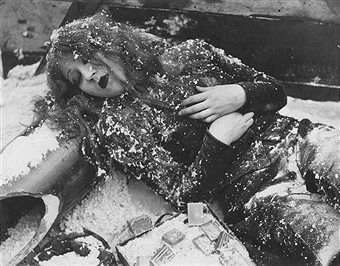
The Little Match Girl (1928)

Sometimes, the best way to perceive the nature of a thing is to place it in contrast to a radically different object. Jean Renoir adapts Hans Christian Anderson’s fairy tale in such a way as to highlight the harsh realities of poverty. He achieves his purpose through a sharp juxtaposition of opposites.

In the 33-minute film’s first half, a figure that appears only in shadow forces the poor match girl, Karen, out of her shack and into the blustery night to sell her wares. As she walks through the town, Renoir employs a wide shot followed by a medium shot. People hustle by her as she spins right and left to catch their attention. The movement looks something like a companionless dance, graceful and fluid yet empty. Furthermore, not a single person looks at her until she stops, worn out and depressed from her lack of success.

When a man in need of matches sees her, a glimmer of hope lights the film. But some friends quickly usher him into a nearby restaurant. Just before, she had peered through the window of a car to get a better look at his friends. After the man enters the restaurant, she presses her nose to the window, an outsider to the comfortable world within. Two boys also see her, but only as a target for their snowballs.

When she finally shuffles away from the restaurant, a policeman takes notice, and they spend a few minutes looking in a toy store window together, admiring a collection of figurines in a miniature town filled with joy and peace and order. The encounter is pleasant, but Karen and the policeman have something in common—they both stand outside that wonderful world in the toy store window. When she departs, she can’t bring herself to go home without a sale. So she sits under a lamp in the snow and lights matches to keep warm. Her grueling world offers her no comfort, no solace, and no justice.

At this point, Karen’s hunger and chill lead her to hallucinate that she is in a toy store where everything is life size. Dolls, a ballerina, and a giant beach ball populate this strange place. Renoir blurs the image during the transition, visually indicating a movement away from the harsh realism of the film’s first half.

In the store, Karen finds a jack-in-the-box who happens to be the same policeman she had seen on the street. She also spies out the commanding officer of a group of toy soldiers, the same man who needed matches, the same man who held with him the promise of taking her to another kind of world. She runs to him, where he declares his love for her and provides her with a table full of food. Her dreams are coming true.

When the jack-in-the-box approaches them and identifies himself as Death, the officer and Karen jump on a horse and ride into the heavens, hoping that there they will escape. But Death finds them even there. When Death finally lays a lifeless Karen under a cross, the symbol of suffering morphs into a flowering bush. As the petals drop on her dead face, Renoir brings us back to reality, snowflakes falling instead of petals. No one knows of the beautiful moments she had in her last bits of consciousness, seeing only the foolishness of keeping warm with matches.

The abrupt shift from the vision back to reality has the effect of highlighting the painful realities of Karen’s poverty. It’s in the contrast with fantasy that we see the reality clearly, especially because reality actually breaks into Karen’s fantasy and ends it. Renoir is kind to Karen in that final moment, though, closing the film with an out-of-focus close-up of her face. Renoir reminds us of her fantastical vision of a world that, at least for a moment, carried with it some measure of hope. The tragedy of the film is that people like Karen have no hope of elevating their circumstances. But the beautiful desire for something better—for joy and peace and justice—that lies in the most desperate of hearts serves to ignite in us a glimmer of hope as well.

Top Ten of 2016

The Oscars serve as something of an official end point to the annual film year, so I have made a habit of compiling a top ten list in the week leading up to the show each year. This has the benefit of giving me a couple of extra months to catch up on a whole host of films that either never made it to my area, or that I simply wasn’t able to see during their theatrical run.

This year I saw interesting and, in some cases, very good films from filmmakers I’ve enjoyed in the past (Linklater, Coens, Malick, Herzog) as well as exciting entries from newer or first-time filmmakers (Robert Eggers’ The Witch, Kirsten Johnson’s Cameraperson, and Zachary Treitz’s Men Go to Battle). I was also grateful for a number of films that tackled important themes such as otherness (Moonlight), injustice (13th), and family tension (Our Little Sister).

In addition to these, there were ten films that especially caught my eye this year.

10. The Innocents (dir. Anne Fontaine)

Unlike it’s namesake (1961’s The Innocents, starring Deborah Kerr), this film doesn’t fit neatly into the horror genre. But a horror film it is, as we see on display these nuns falling to the temptation to preference laws over love, principles over people, and guidelines over grace. The results are painful, but even in Fontaine’s dark world, glimmers of light shine through.

9. Pete’s Dragon (dir. David Lowery)

I take great joy in sharing movies with my kids, and it is a rare treat to see a new film together that we all love. Lowery displays a sure hand at guiding a major studio project, but does so in a way that doesn’t avoid the messiness of reality, that appreciates the wonder of childhood, and understands the human need to believe in the unseen.

8. Silence (dir. Martin Scorcese)

I first read Endo’s novel, SIlence, 20 years ago when I heard Scorcese wanted to film it. Little did I know it would take so long to find the screen. The film reflects poignantly on the nature of suffering and martyrdom, particularly as they express themselves in the context of Christian faith. This film is an especially hard sell to American evangelicals, who tend to frame faith fundamentally in the context of joy and victory.

7. Mountains May Depart (dir. Jia Zhang-ke)

Jia is experimenting a bit here–moving toward greater emotional accessibility, using English for a significant portion of the film. I liked the first two acts better than the third, but Jia brings the film around by the end, showing us that once again the personal and political are not so far apart.

6. La La Land (dir. Damien Chazelle)

Exuberant. Chazelle’s film speaks to the dreamers in all of us. In some ways, he mimics the 60s work of French filmmaker Jacques Demy, yet giving us a more “realist” portrait than Demy’s more polished offerings–neither Gosling nor Stone are exquisite singers or dancers. But this, it seems to me, is part of the point–the musical breaks into real life, on par with Woody Allen’s Everyone Says I Love You.

5. Manchester by the Sea (dir. Kenneth Lonergan)

Lonergan’s strength throughout his career has been his writing, and that continues in Manchester. The film is in many ways overwhelmingly sad, but Lonergan manages to work in plenty of levity that gives shape and definition to the sadness. I most appreciate the attention to psychological and emotional details. Oh, and Michelle Williams. Good night does she make an impression in limited screen time.

4. Aquarius (dir. Kleber Mendonça Filho)

Best I can tell, I haven’t seen Sonia Braga in a film since the not-very-good Eastwood film, The Rookie, which happened more than 25 years ago. I am happy to report that not only is she still working, she is radiant in this Brazilian film about an aging music critic hanging on desperately to the past. This is the second Filho directed film I’ve seen (after 2012’s Neighboring Sounds), and with Aquarius‘ reflection on memory, physical culture, and capitalism, there is much to chew on here.

3. The Fits (dir. Anna Rose Holmer)

The formal work on display here is top notch–confident, rich in detail, and complementary to the narrative. I especially appreciate Holmer’s eye for framing and color, and so many of her formal choices make for a fascinating complement to the film’s story–I got a serious Claire Denis vibe. Of course, the central performance from Hightower is fantastic, relying as it does not just on her quiet persona, but on a kind of physical movement that deeply informs the characterization she offers. The film speaks powerfully to the invisibility that young black women face, and the ways an encounter with mystery might impact that reality.

2. Love & Friendship (dir. Whit Stillman)

Biting dark comedy, this is. So much so that at times I found myself wondering if the film would ever come up for air. Stillman eventually gives us a breath here and there, even as he deftly avoids cheap sentiment. The real star here, however, is the verbal repartee, whether it’s the edgy contributions of Kate Beckinsale’s Lady Susan, or the varied responses of those around her which serve to throw Lady Susan’s approach to life in sharp relief.

1. Arrival (dir. Denis Villeneuve)

This is science fiction done well. This is filmmaking done well. It’s comfortable with silence and dialogue on a lower register. It doesn’t need explosions to advance its ideas. Because it has ideas, and it connects those to the lived experience of human beings. This is a film about choosing connection rather than destruction, life rather than death. This is a film that dares to envision a world of cooperation and harmony, a world marked by transcendent vision rather than limited perception. Even in its melancholy, this is a film that is as life-affirming as anything I’ve seen in recent memory.

The Look of Silence (2015)

In 1965, the Indonesian army along with many civilians “cleansed” their country of “communists,” leaving more than 1 million people dead and countless families shattered. Joshua Oppenheimer’s The Look of Silence tracks one of these personal stories, that of a forty-four year old man named Adi, a traveling optometrist who seeks to engage his customers in conversations about the country’s past.

Adi’s story is simple: his older brother, Ramli, was brutally executed in the genocide by men known in the home village, some three years before Adi was born. Adi’s parents are still living, though his father, 103 years old, is blind and has largely lost the use of his legs. As Adi moves through the villages that surrounded his family’s home in 1965, he inevitably meets a number of older people who respond to his historical queries with equal measures of denial, misinformation, and righteous indignation in support of the cleansing. Most of all, however, these villagers—whether observers, perpetrators, or victims—simply encourage and/or threaten Adi to discontinue his line of questioning about the past. The past is in the past, they say. In other words, leave it there, and let the injustice continue.

The quiet determination that Adi carries into his conversations about the genocide stands as a call for justice in the face of what almost seems unbelievable injustice. Not only has his brother been executed, but those most responsible have not just avoided punishment. These executioners have lived comfortable lives, gaining their wealth from political favors or from entering government and making their living on the backs of the people for three or more decades. Adi, a simple tradesman, has no means to bring those responsible to justice. He brings with him only his doggedness to expose and confront the evil that has long lay dormant all around him. That no one—neither victims nor perpetrators—has any interest in pursuing justice suggests the depth to which the genocidal wickedness has done its work.

Taking a quieter approach than Oppenheimer’s previous film on the same historical subject (2012’s The Act of Killing), this film examines the contours of the personal cost for the victims and their continuing powerlessness in the face of communal silence. Adi’s courage to speak with this cast of killers serves to humanize both the victim and the killers. Scene after scene places Adi face to face with these brutal men. These men deny or soften their crimes, or they threaten Adi. But these he accuses are most certainly men.

One affecting scene late in the film finds Adi visiting a man and his adult daughter. The man begins by bragging about his crimes in graphic detail. But once Adi tells his story, the man’s daughter admits she knew nothing about these things, and describes these killings as ‘sadistic.’ As Adi leaves their home with a familial embrace from the daughter, one cannot help but hope for some measure of reconciliation among the next generation.

But the reality is probably much different. If there is hope it is likely only a glimmer. Most others of Adi’s generation and older remain stubborn in their silence, firm in their refusal to even listen to a description of the crimes of their fathers. Further, the string of “anonymous” names in the end credits testifies to a continuing fear among the people. And this is the reality: Evil has bred that fear. The people’s fear has birthed isolation and silence that leaves the community enforcing and extending the injustice of prior generations.

This isn’t a land of freedom or democracy, despite the claims of the Indonesian government officials. Far, far from it, in fact.

Hail, Caesar! (2016)

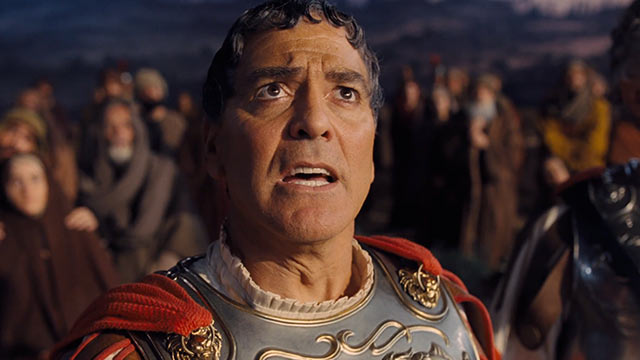
The latest film from the Coen brothers was actually the result of an idea brewing way back in 2005, intended to complete what star George Clooney called his “idiot trilogy,” including his previous Coen efforts O Brother, Where Art Thou? and Intolerable Cruelty. Whatever changes have occurred in the script since then, I don’t think there’s any doubt that in Hail, Caesar!, Clooney’s Baird Whitlock could (and should) be considered an nothing less than an idiot.

That probably sounds harsh as a description, but it should be noted that the Coens seem to have a real affection for the characters they’ve created in this film—including Baird Whitlock. Admittedly, not everyone in the film is especially agile-minded. Many are consumed with their own projects and lack the ability to empathize with others.

Standing out from the pack is one Eddie Mannix (Josh Brolin), a studio executive tasked with keeping a host of cinematic plates spinning—a stuffy, high-minded drama, a singing cowboy western (with a director that looks suspiciously like John Ford), and a couple of energetic musicals. The film opens with Mannix in a confessional, seeking absolution for lying to his wife about cigarette smoking. It seems a small thing, and that’s just the point: Mannix is conscientious when it comes to his responsibilities to and relationships with others.

Indeed, this opening scene bestows on Mannix a religious bearing. That the film returns Mannix to the confessional in its final minutes, forming a bookend with the earlier visit, only serves to undergird the identification. As the film plays out with Mannix in the midst of every narrative thread, it gradually becomes clear that the Coens have fashioned this studio head a priest of the secular realm.

First thing every morning, Mannix calls a “higher power” (New York) on the phone to report on the business at hand. He then spends his days mediating between prickly directors and overly sensitive or entitled actors. He makes sacrifices to cover the sins of his people. And he seeks to bring encouragement, guidance, and vision to his flock of misfits and idiots. All the while, none of it is appreciated. None lauded. It’s simply expected that he will be there, someone to rely upon when disobedience and sin seem ready to undermine this society-in-miniature.

And yet, I cannot help but wonder whether the Coens have laced their film with a strong dose of irony. For while the overarching purpose of Mannix’ priestly character serves to align religion and film—suggesting inherent significance for the latter through the connection with the former—the fact that the movie studio (as portrayed in the film) is undoubtedly filled with misfits and idiots seems to raise for the Coens a light-heartedly asked, but nonetheless important question: How significant can film be with this cast of clowns running the operation?

Such a question cuts back the other way as well: How significant can the church be with its own cast of clowns running the operation? I suspect the Coens are exactly right in linking religion and film for the way their respective stories can elevate the human condition. And while I don’t expect that the church or film art is going away anytime soon, I do expect that their lasting contributions to the world will be connected to the degree which they are able to bring humanity into contact with beauty, goodness, and truth.

Mr. Hulot’s Holiday (1953)

Mr. Hulot’s Holiday introduced Jacques Tati’s droll title character to the world. The film is about nothing more than what the title indicates—a beach vacation taken by one Mr. Hulot (Tati never gives us his first name). The sense of formality in providing only his last name plays off of Hulot’s ungainly gait and ‘all-elbows-and-knees’ bearing. As Hulot interacts with his fellow seasiders over the course of several days, his air of formality brings a warmth of humanity to his character, even as his clumsiness creates difficulties for others—not to mention plenty of laughs.

That sense of humanity in Mr. Hulot only grows over the course of the film, particularly when we see him in relationship to the vacationers around him. This group of people operates on a strictly regimented schedule, moving like a herd of cattle every time the hotel’s meal bell rings. One couple always finds themselves in the restaurant a bit early, apparently unable to find anything else to occupy them beyond that most basic urge to eat. Cattle, indeed.

One recurring gag involves the lights in the beachside inn coming on in reference to one of Hulot’s nighttime escapades. While everyone else has dutifully made it to bed at a “proper” hour, Hulot finds himself out and about, exploring and adventuring. Where the group predictably files into the restaurant for lunch or sits quietly in the lobby every afternoon, Hulot leaves muddy footprints in the lobby or disturbs the quiet by leaving the door open on a windy day. Time and again Tati emphasizes the distinction between Mr. Hulot and the rest of the vacationers. True humanity looks quite different from the humdrum habits of most people.

This fundamental contrast suggests to us that of all the vacationers (save, possibly, a mysterious young woman) only Hulot has found the freedom that people so desperately seek both in vacation and in general. Hulot’s bumbling nature and the many laughs it produces becomes something of a stand in for individuality, freedom, and, most importantly, human warmth. Ironically, though filled with an attentiveness to others, Mr. Hulot generally remains beyond the touch of any other person. This sense of physical isolation provides something of a dark counterpoint to the inventive gags.

Even as Tati joyfully portrays the title character with a wry blend of formality and flailing limbs, Hulot remains beyond the reach of true human companionship. Indeed, it is the man’s difference from the crowd that makes him such a compelling figure. That Hulot never seems to find the companionship enjoyed by virtually everyone around him is not so much an indictment on his freedom and sense of wonder as it is on the rest of society’s rigidity and predictability.

Drums Along the Mohawk (1939)

A few years ago, Quentin Tarantino offered this blunt assessment of Irish-American (not Anglo-Saxon) John Ford:

One of my American Western heroes is not John Ford, obviously. To say the least, I hate him. Forget about faceless Indians he killed like zombies. It really is people like that that kept alive this idea of Anglo-Saxon humanity compared to everybody else’s humanity—and the idea that that’s hogwash is a very new idea in relative terms. And you can see it in the cinema in the Thirties and Forties—it’s still there. And even in the Fifties.[1]

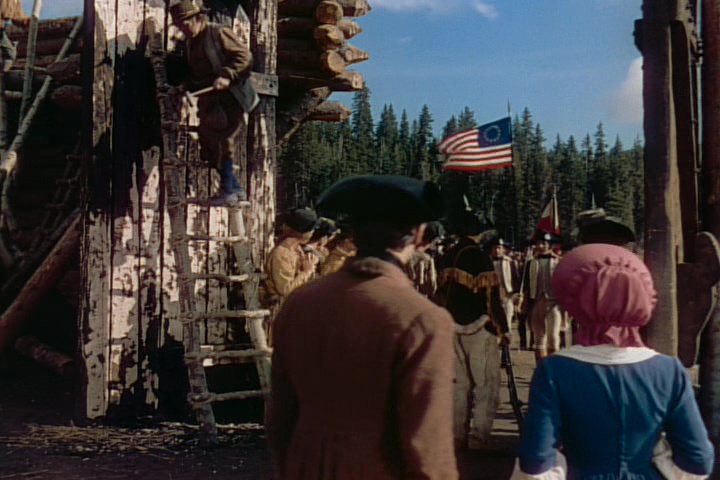
John Ford’s Revolutionary War-era drama Drums Along the Mohawk—made in 1939—is among his films that include “faceless Indians” and in this way serves as one helpful means of examining Tarantino’s view regarding Ford’s racism.[2] Tarantino isn’t alone in his assessment of Ford’s work, but I find Ford’s films, including his Westerns, to contain a rich and varied portrait of figures of all kinds, colors, and genders.

When it comes to uncomfortable scenes with racial overtones, I won’t deny there are several in Ford’s oeuvre. Drums contains one especially egregious scene recently examined by Mike D’Angelo, where two drunken natives mean to burn down a house, and end up rescuing a bed inside when an old woman protests their actions. Ford’s comic sensibilities don’t always land near my own—he tends toward the broad and the slapstick—and this scene certainly illustrates that tendency well.

However, Ford does something else in this film that complicates the picture of Tarantino’s vision of Anglo-Saxon superiority. And this more complicated picture better reflects the American experience of race through my own lenses—a mixture of good and bad, of outreach and insensitivity, of helping hands and murderous ones.

The film opens with a Northeastern U.S. wedding among colonists of some means. The house, the décor, and the dress all highlight the fact that these people expect to live according to certain standards. The people have gathered to witness the nuptials of Gil Martin (Henry Fonda), who recently built a home on the frontier of Mohawk Valley, and Lana (Claudette Colbert), daughter of high colonial society.

The film follows the Martins through their early years as settlers in the Mohawk Valley. More importantly, however, Ford proceeds to throw obstacles at the naively haughty Lana throughout the course of the film. It turns out that “wonderful” Anglo-Saxon upbringing yielded Lana few frontier survival skills, with all its emphasis on obtaining the elemental things of life—food and shelter most importantly. While Gil puts his back into his work, Lana loses her expensive and impractical possessions and discovers that there’s more to life than the latest fashions from Europe. When Lana stoops to nurse soldiers injured in a Revolutionary War battle, we get the sense that her transformation nears completion.

The final sequence of the film completes an excellent bookend with the opening wedding scene. The European settlers have to fight off a band of Native Americans (led by a pro-British European no less). Lana is among the group of settlers in the local fort, and during the fight, she even picks up a weapon and shoots a man. Not only has she lost all outward claims to gentility that she brought to the frontier, she has lived with the settlers through their darkest moments, where all become equals in the face of imminent death.

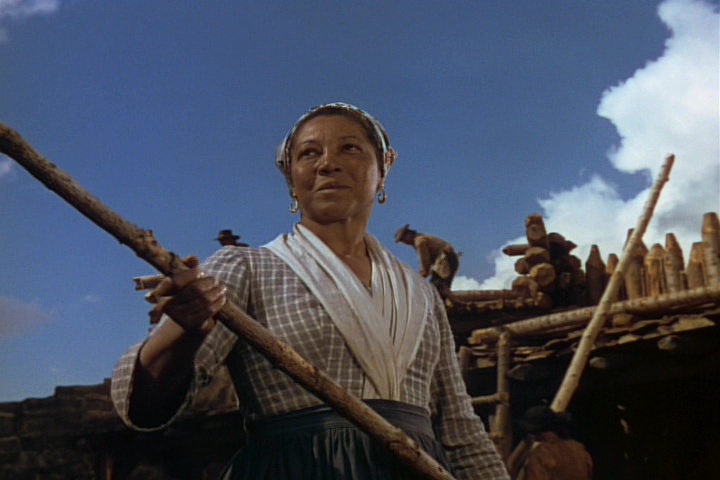
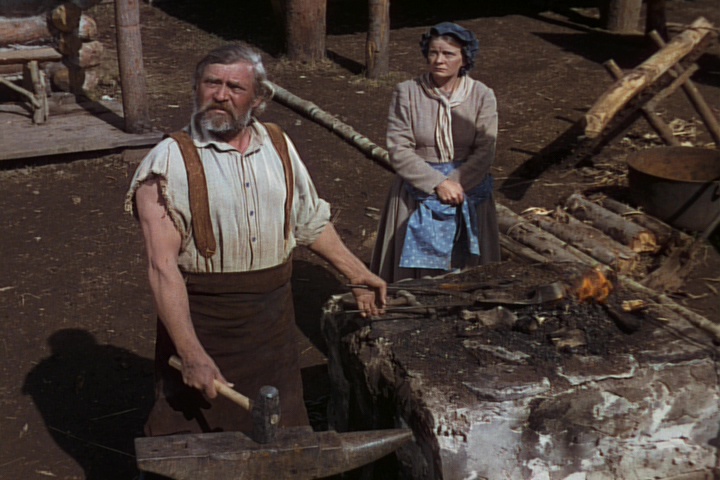
Soon after this battle, Gil and Lana visit the fort, which the settlers have set to repair. Here they discover that the Revolutionary War has ended, and someone mounts the flag atop the church steeple (the highest point within the fort). As this occurs, Ford cuts to four separate, still shots of people gazing upon the flag that stands for newfound freedom: a black woman, a blacksmith and his wife, a Native American, and finally, Gil and Lana.

vlcsnap-2015-04-26-17h00m28s253 vlcsnap-2015-04-26-17h00m37s380 vlcsnap-2015-04-26-17h00m50s577 vlcsnap-2015-04-26-17h01m04s670

Interestingly, Ford shoots both the black woman and the Native American from below, attributing to them something like hero status. With the camera pointed upward, Ford makes these people seem larger than life, emphasizing their place in this land of freedom. Of course, these two shots aren’t without irony—as these people would have had nothing like the freedom enjoyed by the blacksmith and by Gil and Lana. In this way, this final montage has a multivalent effect—it celebrates the victory for freedom; it chides the victors for their unbalanced or incomplete views of freedom; and it reveals a yearning for something more, seeing as winning the revolution most certainly did not mean freedom for all. There’s a poignancy to these images that the Tarantino’s of the world don’t seem to count in their reckoning of Ford on race.

The last of the four shots, the one of Gil and Lana, closes the film. It also includes the only lines in this brief sequence, and in it we see the final transformation of the elite as they take on the qualities of the everyman. Gil turns from the flag to his wife and says, “I reckon we’d better be getting back to work. There’s going to be a heap to do from now on.” They no longer have the luxury of leisure. Work beckons, just as it does to many, many others who hope to have a roof over their heads or food on their plates. In the end, Ford presents Gil and Lana as equals with everyone else under the new American flag, an equality borne out of shared suffering, shared surviving, and shared needs.

[1] You can find the original interview here.

[2] Kent Jones has already offered a cogent response to Tarantino, though Jones doesn’t consider Drums. See also Richard Brody’s recent introduction to a Ford retrospective playing this summer.

Siddharth (2014)

Siddharth, Richie Mehta’s recent film set in India, follows an impoverished chain-wallah (zipper repairman) named Mahendra as he deals with the aftermath of his 12-year old son’s abduction. Mahendra has a measure of guilt over the situation because he had sent the boy off to another city to work in a factory. Despite modern child labor laws and access to government-funded schooling, Mahendra continues to operate on an older model of family life: school is fine for a while, but when the child comes of age, he or she needs to begin contributing financially to the family.

However, when the boy doesn’t return home in a month’s time as expected, Mahendra and his family grow worried. They eventually discover that the boy had “run away” some two weeks prior, though they were never notified. With little more information than this, Mahendra begins a search for his son. His impoverished condition means he lacks the resources and the connections to take off work and simply devote himself to the search. In this, Mehta highlights Mahendra’s powerlessness in the face of a largely indifferent society. Stop working and Mahendra will find he and his family without food or a place to stay.

One moment in particular crystalizes the dynamics of power that surge just beneath Siddharth’s surface. At this point, Mahendra only knows that the boy has been taken to a place unfamiliar to him called “Dongri.” So as Mahendra travels through Delhi repairing zippers on bags, pants, and purses, he asks everyone he meets if they know where to find Dongri. No one knows, but Mahendra perseveres in asking.

Finally, Mahendra stops to fix a woman’s purse, and asks her the same question he has been asking for days: Have you heard of a place called Dongri? She answers the same as everyone else. But then she punches the word into her smart phone and a map comes up instantly. This hard working, albeit poor man has little access to the tools most of this film’s western audience take for granted.

Now, possessing a smart phone with internet access won’t make one poor man “powerful.” Nor will it necessarily deliver him his missing son. However, by placing Mahendra in the completely hopeless and helpless situation of having his son abducted, director Mehta offers his western and affluent audience a humanizing connection to the poverty that too often dehumanizes people like Mahendra. This, for me, is the great success of Siddharth. The film challenges dominant western notions of the poor (they’re lazy, stupid, or immoral), and instead draws us into the narrative through a situation that is universal. Any parent—rich or poor—would do anything to find their missing child. And through this, Mehta shows Mahendra as a person with all the dignity of any other human being.

Song of the Sea (2014)

Song of the Sea, Tomm Moore’s follow-up to the beautifully animated Secret of Kells, begins with a memory. A mother, her belly swollen with baby, tucks her son, Ben, into bed just after giving him a special gift—a nautilus shell outfitted to play as a musical instrument. Though Ben’s mother dies that very night giving birth to his sister, Saoirse, he cherishes the shell even as six years pass.

The children’s father raises them in their lighthouse dwelling, but problems lurk just beneath the surface. Saoirse still hasn’t spoken a word by her sixth birthday. When her grandmother finds her washed up on the beach in the middle of the night, she decides to take the children from their seaside home to a “better” life in the city. However, Saoirse has a secret that she only just discovered herself, something she inherited from her mother: Saoirse is a selkie—human on land, but a seal in the sea. Removed from her natural habitat, Saoirse will die.

The threat of death coming to this little girl drives the action of the film, but it’s the death of her mother, which opens the film, that hangs heavy over the proceedings. Furthermore, as the children escape their grandmother’s home in the city and head back to the sea, death becomes an even more significant theme. The children—especially Ben—slowly awaken to the reality that their mother’s death is actually part of a much larger reality in the world—magical creatures such as selkies and fairies are dying at an alarming rate. Only Saoirse has the power to change the course of extinction for this magical world.

Death. Loss. Suffering. Grief. Creatures the world over have become acquainted with circumstances such as these. When the loss occurs with someone especially close—such as within the immediate family—coping can be a puzzling and altogether frustrating experience that leads to a life lived in fear of unknown dangers that lurk just beneath the surface of our otherwise controlled lives.

Indeed, this response of fear and control seems to be Ben’s typical (and natural) response to losing his mother. Though living on the seashore, he sees the ocean as a danger to be avoided—nothing more. Furthermore, anxiety plagues his relationship with Saoirse. Ben constantly expresses his concern that she might leave his sight, even to the point of attaching a leash to her so that she will not wander off.

And while Ben cherishes the gift from his mother—the nautilus shell that plays such beautiful, haunting, and mysterious music—the boy has lost all connection to the magic in the world that his mother would share with him through her stories and songs. In one scene, Ben scares Saoirse by telling one of his mother’s stories, only to proclaim that the story isn’t actually true. Death has removed the magic from Ben’s world. His vision of what’s possible in the world narrows. Fear takes the place of mystery.

The brilliance of Song of the Sea—without even mentioning its splendid 2D animation—is the way in which it gives Ben’s fear no quarter. Indeed, the story presents an approach to death and suffering that’s reminiscent of something poet Christian Wiman calls mystery mastering fear.”[1] As Ben slowly awakens to the mystery and magic in the world—through his little sister, no less—he sees that so much more is possible than he could have ever imagined. As he recognizes his smallness, his finitude, he allows and even encourages his sister to use her gifts to bring freedom and renewal into the lives of many. Empowering others to be who they were made to be, the film seems to be saying, is the ideal response to death, for it is the only response that answers death not with limitations, but with life.

[1] Christian Wiman, “Love’s Last,” in Once in the West, pg. 48

The Last of the Unjust (2014)

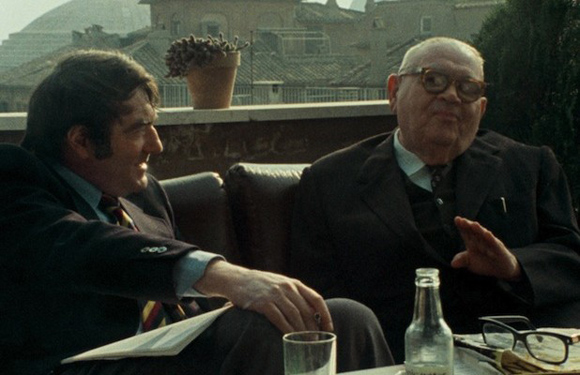
I had a provocative moment during my viewing of Claude Lanzmann’s The Last of the Unjust, his portrait of Benjamin Murmelstein, former elder of the Jews at the Theresienstadt ghetto in 1944-45. Early on in the film, Murmelstein tells Lanzmann: “you have convinced me our conversation is important.” For decades, Murmelstein had been reluctant to speak about the past, due, no doubt in part, to the pain it brought as well as the controversy his own role raised. At the moment just after Murmelstein uttered the above quotation, the disc in my DVD player simply froze without explanation. I couldn’t turn off the player. I couldn’t eject the disc. The image of Murmelstein’s frozen face—before he could really tell his story—lit up my living room. Maybe, this pregnant pause seemed to ask, the past is better left in the past?

Once I got the film restarted, I carried that question with me throughout Lanzmann’s extensive, more-than-three-hour interview with Murmelstein. Seeing as Lanzmann recorded the interview in 1975, the film seemed to pose the same question at a formal level as well. Numerous times throughout the film, Lanzmann’s camera or even Lanzmann himself introduces or interrupts the historical interview, instead wandering through the clean streets, emptied rooms, and beautiful synagogues that once bore witness to innumerable terrors. These places now carry largely unnoticed markers of remembrance, if anything at all.

The film shifts between old footage and new—most directly in the old footage of Lanzmann compared with the recent footage of Lanzmann—visually and formally mark history itself as a character. Indeed, as we try and suss out an honest response to Murmelstein’s admittedly fascinating stories of working for Holocaust organizer Adolf Eichmann and running the Theresienstadt ghetto, Lanzmann’s film foregrounds the question of historical perspective.

The film does this by taking this controversial “middle man” of the Holocaust era and giving him the dominant voice in the film. Lanzmann doesn’t seek to set up “gotcha” moments, but generally sits quietly as Murmelstein meanders through his tale. Indeed, Murmelstein’s gift of gab is apparent, even as he tends to, at times, drift far from his original point with asides and contextualizing. Lanzmann occasionally questions him, but those questions usually mean to clarify rather than challenge or debate.

The resulting film is masterful as the singular voice of Murmelstein plays off of the contrasting shots of past and present. Time passes. History accumulates. And Murmelstein’s voice resonates through it all. This combination suggests a question: How does time change the impact or estimation of that unchanging footage of a man from forty years ago? Hearing Murmelstein’s words—spoken in 1975—for the first time today reminds us of our distance from the past, as well as our difficulty of assessing the past in the present.

The specific reality of Murmelstein’s story is stark: He was the only surviving elder at Theresienstadt. The others suffered execution at the hands of their Nazi captors. Does his survival indicate a failure to protect his people or honor his identity? On its own his survival indicates no such thing. However, when we learn that Murmelstein followed Nazi orders to clean up the ghetto in order to make a show for the outside world that life in the ghettos was acceptable, skepticism about his explanations and reasoning takes root. Is this a man who would defend his personal interests at all costs?

Or maybe it’s more complicated than that . . . does Murmelstein’s personal interest align to a significant degree with the interests of the people, as he argues? The film is compelling precisely because Murmelstein’s claims cannot be easily cast aside. In this way, the film takes us into an issue, a time, and a character, giving us the opportunity to debate and wrestle with the claims we hear.

And it is that recognition that helps to answer my original question. Is the past better left in the past? Is history better left to history? My answer is unequivocal: no. We need history precisely for the purpose of entering into conversation about the whos, whats, and whens of our world. For it is in that debate that real community is forged and stabilized. Without important monuments and acts of remembrance that inspire conversation and debate—monuments and acts such as The Last of the Unjust—we will be left to powerful people wielding shadowy “truths” in the “service” of the people; we will find ourselves building and living and dying in modern-day Theresienstadts.

Boyhood (2014)

Richard Linklater has been making films for more than 25 years. And while his isn’t exactly a household name—despite his more popular collaborations with Jack Black (School of Rock and Bernie)—he has carved out a niche for himself in the world of American independent cinema with the seminal Slacker, the innovative Waking Life, and his affecting Before trilogy. Linklater’s most recent film, Boyhood, fits well into the ethos of those latter films. Heavy on dialogue and light on plot, Linklater’s “smaller” films privilege character, atmosphere, and ideas over story, events, and flashy set pieces.

Linklater’s work connects with the world in often profound and surprising ways. His films have regularly explored “people in time.” The Before trilogy is probably the best example of this as he has tracked Jesse’s and Celine’s relationship over the course of nearly 20 years—though we might also add the drama-in-real-time of Tape, along with sections of Slacker and Waking Life. Indeed, the middle entry in the Before trilogy, Before Sunset, is a film that virtually plays out in real time—the characters spending about 90 minutes together. Thus, that Linklater has played with time in a different way in Boyhood is hardly surprising.

My own interest in Boyhood tangentially revolves around this notion of time’s passage. While the film’s form—a series of twelve segments filmed over twelve consecutive years—clearly projects this particular thematic concern, the film isn’t simply interested in charting time’s passage. No doubt, this formal conceit is remarkable, as we see a boy go from six to eighteen in a little over two hours. However, it’s what the film wants us to do with the passage of time in the life of Mason and those around him that I find most interesting.

Every one of the film’s segments features Mason. Therefore, the action in each segment usually happens to or at least around Mason. In other words, Boyhood’s boy doesn’t initiate a great deal of the action—he most often receives it from his older sister, his parents, or his friends. While this could be criticized as a misstep, leaving the film with something of a blank slate for its central character, I think it works in a couple of important ways.

First, it feels realistic. Kids end up receiving far more than dictating the action of their lives. Parents take children places. Older siblings tell younger siblings what to do. Kids often simply go along with whatever their friends want to do. That Mason models these behaviors makes him more authentic as a character, and helps the audience get into the mindset of what it’s like to be a child.

Second, and more significant, however, has to do with my view that the Mason’s character embodies the way the film operates. The film opens with the image of the sky, as Mason watches the clouds roll by after school one day. The film closes with another scene of Mason gazing at the sky, this time a sunset in Big Bend National Park. Mason carries with him both an attentiveness to and an appreciation of the world around him. He is always watching, always seeking understanding, all the while refusing to judge and dismiss those people and events around him that are outside his typical experience or beyond his comprehension.

While Mason experiences frustration (generally directed at his father or stepfather), he never rejects. Even in one of the more painful sections of the film, as Mason deals with a break-up from his girlfriend, he can’t just dismiss her. He still remembers the good times they had and believes her to be, at heart, a good person.

Mason’s refusal to judge and dismiss people from his life seems to mirror the way Linklater approaches the primary characters in this film (especially Mason, Mom, and Dad). The director affords us the opportunity to observe these characters without him pushing us to dislike them because of their foolish behaviors or poor choices. Indeed, the film is at its weakest in scenes with the stepfathers, men we’ve no real connection to or sympathy with. As a result, these scenes feel stacked against those characters. Maybe this is by design, to place us in the shoes of the stepson thrust into relationships with these men. Regardless, those scenes stand apart from what is otherwise a consistent approach to characterization that takes people at face value—the good with the bad.

The overall lack of judgment toward its characters, taken in the spirit of Mason appreciating the world around him, is, in my view, one of Boyhood’s great achievements. It points out the value of appreciating people, experiences, and moments, and does so through the eyes of a child. Such a childlike vision of the world prompts us to be open and vulnerable to the world around us. It recognizes that such an approach will certainly yield pain, but not just pain. In the character of Mason, Boyhood gives us the eyes to see the beauty around us, to relish those moments of overwhelming grace or exciting opportunity that seize us and will not let us go. It is because of that spirit that I am most grateful for Boyhood.