2005 has been a year of changes for me – most significantly, the birth of my son, who has pretty much rearranged all my priorities. I now am less able to get to the theater, which means I see less that’s current. That results in a pretty minuscule list. Yet (and this is one of the other changes), I was noticing that even before he was born, my wife and I were less interested in the theater anyway, and not because I don’t like the theater. I list watching a film in a crowded theater as one of the more pleasurable activities in life.
Instead, as I reflected on our reasons for avoiding the theater, I hit on a single thing that dampened our enthusiasm: the dearth of interesting options available to us here in Dallas. First, neither of us gets too enthusiastic about big blockbuster, epic kind of films any more. Neither are we generally interested in the weekly horror, action, or comedy offering. Thus, we tend to seek out more complex fare. Let me illustrate our problem: in the city limits, we have three “arthouse” theaters (two Landmark, one Angelika). Currently, one of the Landmark theaters is screening Narnia on two of its screens, with The Producers on the third. The other has Brokeback Mountain on three, Capote on one, and Good Night, and Good Luck on one. I cannot see how any of these films justify Landmark’s little opening, played before every film (“The language of film is universal”). Rather, it appears the language of film is English. The Angelika is not faring much better, currently showing the likes of Munich, Casanova, Pride & Prejudice, and Match Point, all of which can be found at the local megaplex (which is not to say any of these films isn’t necessarily worthy). But where’s the unique programming? What about traveling retrospectives, classics, smaller films, or a steady diet of important contemporary international film? These are too few in such a big and diverse metropolitan area.
All of which leads to my year end list. It’s going to be shorter than in years past, reflecting the fewer number of films I’ve seen. But I note it includes three heavily dramatic pieces (1, 3, and 6), along with four films that have a strong comedic sensibility (2, 4, and 5). Finally, to compensate for the shorter list, I’d like to offer a list of older films I’ve seen for the first time, all of which surpass virtually everything new I’ve seen this year. The rankings in both lists are not meant to reflect quality, or which film is “better” than another, but rather, which films I am most looking forward to revisiting and spending some quality time with.
2005 Favorites:
1. Saraband: Bergman’s final (?) film, and easily the best thing I’ve seen this year, a sequel to his earlier Scenes From a Marriage. I was struck by two things: First, Bergman’s attention to emotional detail. Second, the surprisingly hopeful and brilliant ending. It both ties the rest of the film together thematically, and provides some basis on which to go forward. Beautifully done.
2. Funny Ha Ha and Mutual Appreciation: Funny Ha Ha, like Saraband, is actually a couple of years old, but received a theatrical release just this past year. Writer/Director Andrew Bujalski injects his film about an aimless 23 year old college graduate with humor, dramatic conflict, and a kind of pathos that really is endearing. The latter film is actually Bujalski’s effort from this past year. Shot in b&w with the same intimacy as his previous effort, Mutual Appreciation builds on the earlier work in humor, characterization, and his excellent taste in music.
3. The New World: Malick’s creation is one of my favorites from this year. It has all of the lyrical quality I’ve come to expect from him, but this one offers a subtle critique of the Eden presented early in the film. It’s almost as if the film grows from adolescent to adult before our eyes.
4. Look at Me: Co-Writer/Director/Star Agnès Jaoui has improved upon her debut, The Taste of Others. She has a way of taking a pretty standard story and giving it great dialogue, an emotional core, and the subtlest of pointers toward what might be a better way of being.
5. Howl’s Moving Castle: Miyazaki’s glorious film, which is visually so inventive and interesting that I can’t help but include it here. And yet another heroine for us to connect with.
6. Capote: Subtle and conflicted, with a standout performance by Phillip Seymour Hoffmann, long a favorite of mine. The rest of the acting is top-notch, and I especially appreciate director Bennett Miller’s willingness to give the film a more meditative quality.
Other 2005 Films I Enjoyed: Up and Down; Broken Flowers; 2046; Good Night, And Good Luck
Still to See: L’Enfant, Caché, Trilogy: The Weeping Meadow, The Best of Youth, The Wayward Cloud, The Death of Mr. Lazarescu, Tristram Shandy, Hell, Hawaii Oslo, Tony Takatani, The World, Grizzly Man, The White Diamond, Duma, 3-Iron, Me and You and Everyone We Know, L’Intrus, The Squid and the Whale, Wallace and Gromit, A History of Violence, Syriana, Munich…
Older Films I Loved:
15. Close-Up (1990): Kiarostami’s half drama, half documentary. The interplay here between truth and reality was fascinating, though the director wisely keeps us connected with the central character.
14. More Miyazaki [Nausicaä (1984)/Porco Rosso (1992)]: I finally caught up with these older works of my favorite animator. I loved in ingenuity of Nausicaa, and the central characters in Porco Rosso.
13. The Flowers of St. Francis (1950): Beautiful, strange, funny, and heartfelt. Simple faith on display.
12. All or Nothing (2002): Mike Leigh at his best, intimate family drama. Wonderful stuff.
11. Sanjuro (1962): Maybe the funniest Kurosawa film I’ve seen, not to mention clever, and Mifune at the height of his powers.
10. The Searchers (1956): John Ford and John Wayne, maybe the best Western I’ve ever seen.
9. The films of the Dardennes [La Promesse (1996)/Rosetta (1999)]: Caught up with some of their earlier work, which is wonderfully rewarding, especially Rosetta. I’m still waiting for a chance to see their newest effort, L’Enfant.
8. Time of the Wolf (2004): Disturbing, (mostly) restrained apocalyptic vision from director Michael Haneke.
7. A Renewal of My Appreciation for Alfred Hitchcock [The Wrong Man (1956)/The Birds (1963)/The 39 Steps (1935)]: Caught a few of his films this year, and these were all wonderful. I’m learning to love the power of suggesting inherent in his films.
6. More Ingmar Bergman [Fanny and Alexander (1982)/The Virgin Spring (1960)/Scenes from a Marriage (1973)/Persona (1967)]: I especially connected with the first couple here, though I appreciate all of them on different levels.
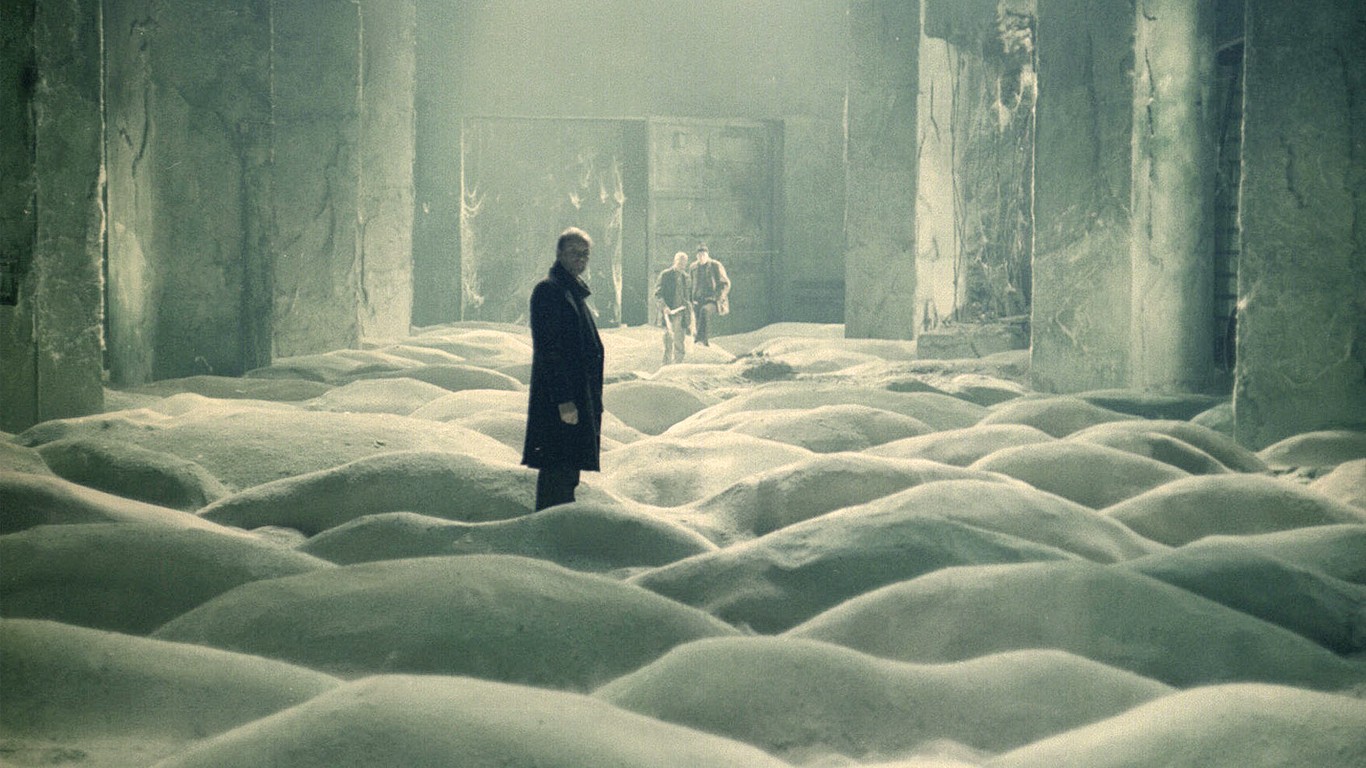
5. Stalker (1979): Having seen most of Tarkovsky’s work once, this is the one I connected with most on a first viewing. I was mesmerized all the way through. The rest of his work is in need of another go around.
4. The Films of Tsai Ming-liang [Rebels of the Neon God (1992)/What Time is it There? (2000)/The Skywalk is Gone (2002)/Goodbye Dragon Inn (2003)]: I’m guessing Tsai’s films are going to become even more significant for me in the years to come. The meditative pace is refreshing, and Tsai seems to have his finger on where modern society is or is headed. Looking forward to seeing his other stuff – Vive L’Amour is next.
3. The Apu Trilogy [Pather Panchali (1955)/Aparajito (1957)/The World of Apu (1959)]: Beautiful series of films from the late Satyajit Ray following the life of Apu, from boyhood, through adolescence, to adulthood. Sensitive, moving stuff.
2. Late Spring (1949): Just saw this film from Japanese director Yasujiro Ozu. It’s such a beautiful portrayal of family, getting older, and post-WWII life in Japan. The complexity of the emotional content snuck up on me as I neared the end. Wonderful.
1. Werckmeister Harmonies (2000): This is another of those disturbing apocalyptic visions, but is filmed in stunning black and white. The music sets the tone for what really amounts to film as poetry for director Bela Tarr. It’s enigmatic, troubling, and wondrous. One of the best films I’ve seen in the last several years.
Other Older Films I Enjoyed (in no particular order): The Twilight Samurai (2002); The Adventures of Prince Achmed (1926); Gertrud (1964); The Great Dictator (1940); Cool Hand Luke (1967); Buffalo ’66 (1998); Control Room (2004); The Lost Weekend (1945); Dersu Uzala (1974); Days of Heaven (1978); Open City (1946); At Five in the Afternoon (2003); The Elephant Man (1980); Crimes and Misdemeanors (1989); Sansho the Bailiff (1954); Metropolitan (1990); The Celebration (1998), Born Into Brothels (2004), Intimate Strangers (2004)
 Gladsome Morning