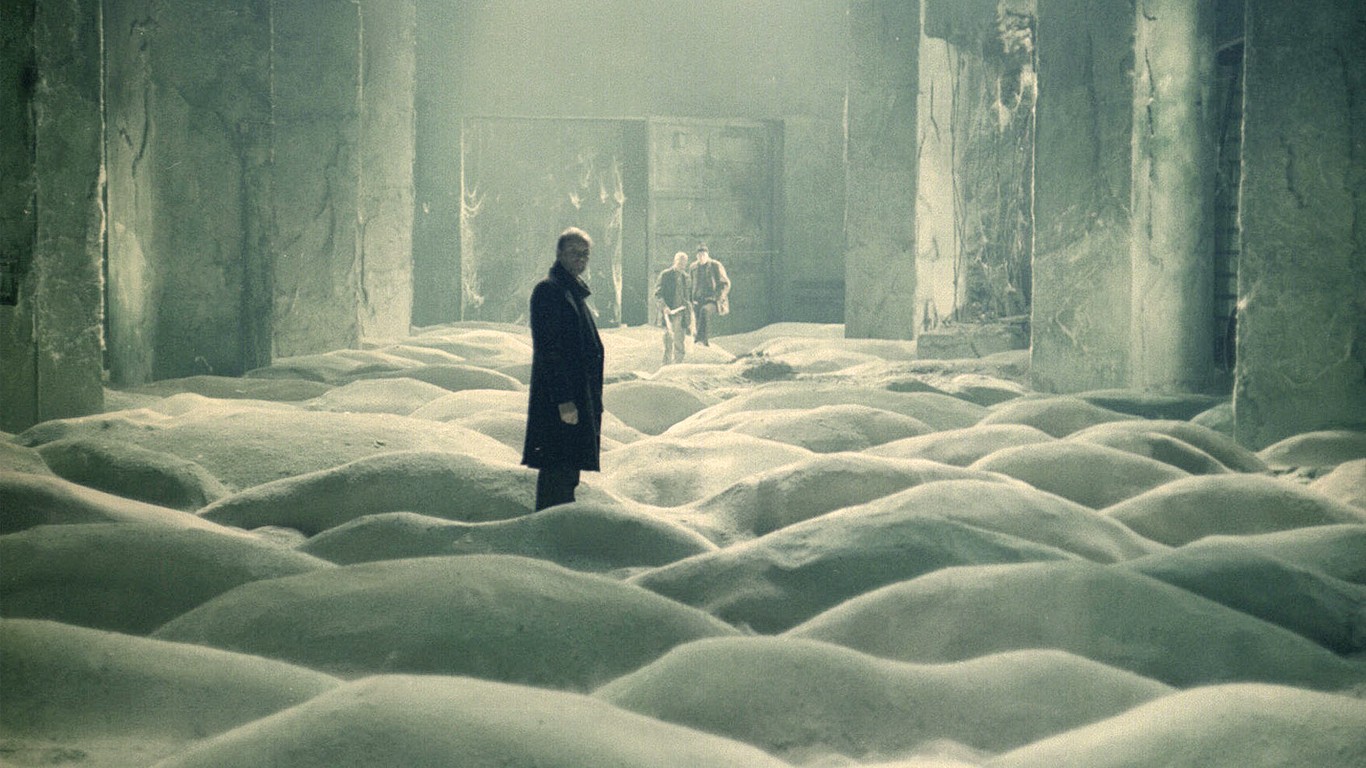
Stalker (1979)

In the last act of Andrei Tarkovsky’s classic, Stalker, the titular character utters these arresting words: “When a man thinks of the past, he becomes kinder.” As a historian, I am never not interested when someone is saying something positive about the discipline of turning our minds toward what has come before. What is Stalker communicating here?

For a little context, Stalker follows the journey of three men into The Zone, an area of mysterious power and even more mysterious origins. Due to unexplained loss of life and birth defects, the government has closed the area entirely to both the residents and any visitors. However, rumors of a Room within the zone where one’s greatest wish will come true brings seekers looking to get into The Zone. In Stalker, the lead character sneaks two others—the Professor and the Writer—into The Zone to lead them to the Room.

Their journey is marked by dilapidated beauty (many of Tarkovsky’s and cinematographer Aleksandr Knyazhinskiy’s images are among the most beautiful ever filmed), confusing turns, and occasional conversations that reveal both Professor and Writer as deeply skeptical of the supernatural or alien power that is supposed to be present in The Zone. Their views stand in stark contrast to those of Stalker (he is never given another name), who repeatedly exhorts his charges toward belief and trust in whatever or whomever rules The Zone. The Professor and the Writer, while sometimes scared into grudging respect for whatever is going on in The Zone, are not really inclined to give their trust to this mysterious power.

This tension has been building throughout the film when Stalker points the Professor and the Writer to the past. As the group nears the Room, both men have revealed the depths of their skepticism, which reads to me as deeply modernist, albeit in different ways. The Professor, who works in the sciences, believes in the power of rationality to solve problems. The Writer, who is more connected to poetic truth, but he has looked within himself for that truth and found it wanting. In both cases, these men have thought-patterns that lead them toward dark, deeply pessimistic, and death-oriented ways of being.

Into this context, Stalker exhorts them to look to their past. In the moment, he seems to be encouraging them to think of their personal pasts. But the line lingers, pointing toward a larger and more significant way of conceiving of the past beyond simply the personal. Stalker’s point, it seems to me, is to get out of yourselves in this moment, to find that “other you” from decades ago. Both men suffer from an acute case of solipsism. Part of the beauty of history (personal or otherwise), is that it forces you out of your current moment and into the life experience of someone else somewhere else—even if the someone is you and the somewhere is more or less where you are now. In other words, Stalker is pointing to the reality that the one constant related to time is change. And change, when properly acknowledged as not only inevitable but fundamental to the human experience in the created world, keeps one from hardening and rusting into a useless antique on the verge of being discarded.

So, yeah, maybe looking to the past and noting the changing of the times and appreciating where I (or others) have been and how far I (or they) have come, makes me kinder precisely because it pulls me out of myself and into the lives and circumstances of those who have come before.

The Mirror (1975)

It’s difficult to know where to start with this film. It contains only the loosest of narrative frameworks, and it seems as if the narrative is not the point. Instead what we are presented with is a series of loosely connected images, with faces that become familiar as the film goes along, but we are often uncertain both of the relationships between characters within scenes and of the scenes to each other. In this way, the film then strikes me more as a poem, with tons of loosely connected images that together form something unique, puzzling, and beautiful.The thing I was struck by most strongly initially was the fluidity and assurance of Tarkovsky’s camera. There was a very safe kind of feeling in this, because I instinctively knew that I was in the hands of someone who knew what they were doing, the kind of confidence one gives to their doctor or dentist. The shots themselves are often complicated, with movement up and down, left and right, forward and backward, zooming in or zooming out. I think here of the final shot, which stays with the mother and boys across the field, onto the road, and as they walk, the camera retreats back through the trees as they fade from our vision. It was as if we had joined them on their journey for a time. We are with them, and then we are not.

Time seems significant in the film as it darts back and forth, from the past to the present and vice versa. Memories become jumbled up. Certain images from the present meld themselves back into the memory of the past. I think here of the off camera speaker who tells his (ex?) wife that he pictures her as his mother whenever he thinks of the past. I wonder also if other characters experience this same transformation, though not explicitly stated. But this darting back and forth, this melding of past and present seems to indicate something about the nature of our lives in this world. It seems that wherever we are and whatever we find ourselves doing, the past is always with us. The past is always informing who we are. Or maybe I should say our memory of the past is doing the informing. Of course, all this talk about the past has me thinking of that line from Magnolia, “We may be through with the past, but the past ain’t through with us.”

I am also reminded of what struck me as one of the stranger scenes in the film…the first scene of the television program. No doubt this has significance in the film, but it is more disconnected with the events and characters of the film than pretty much anything else (even if this is a program Ignat is watching). Basically, it involves a young man who has a stuttering problem, and the healing he receives from a doctor or nurse of some sort. As I think about it now, the healing was strangely reminiscent of some of the odd things Jesus does when he heals people, such as covering the eyes of the blind man with mud. She touches his head, makes him lose his balance a couple of times, and makes him hold his hands steady. And then, somehow, he is healed of his problem.

Two things seem important about this scene: First, it is unexplainable. There doesn’t appear to be any kind of scientific method she uses. It is coming through some sort of hypnosis or other tradition used to cure such ills. Or maybe something supernatural is going on. Whatever the case, it isn’t him taking some pills or going through some kind of speech therapy. And this seems to parallel a bit the situation near the end of the film when the man is in the hospital, and there isn’t certainty about what is wrong with him. Second, the emphasis at the end of the scene is definitely on speech, on being able to speak clearly and strongly. I was struck by it, but am not sure how it might inform other elements of the film.

In the end, the image of a mirror is at least in part a means for us humans to look at ourselves, both in a personal and a collective sense. Each of us viewing the film see ourselves in mirrors everyday, but are we really looking? But we also, through the film, have the opportunity to see others, as the camera dwells on many mirrors throughout. Sometimes those mirrors contain people or objects, sometimes not. Part of what it seems Tarkovsky is doing here is offering an opportunity to look at humanity in general, and ourselves more specifically. So as I leave this film, I am left with questions, and not many answers, on these issues. Who am I? Who was I? Who are we collectively? How do those things that have touched us, taught us, and scarred us, make us who we are today?