Hit Man (2024)

Richard Linklater has been making feature films for over thirty years, and from the beginning the writer/director has shown a predilection for having his characters wax philosophically on the nature of our existence as humans. So, it should come as no surprise when Linklater’s most recent film, Hit Man, opens with a professor enthusiastically quoting Nietzsche to his students:

“The secret for harvesting from existence the greatest fruitfulness and the greatest enjoyment is: to live dangerously! Build your cities on the slopes of Vesuvius! Send your ships into uncharted seas! Live at war with your peers and yourselves!”

The idea, a student surmises, is to live life with abandon; to pursue one’s passions, even if it means living dangerously. Except the professor doesn’t live this way, which brings in a second philosophical issue: can people change? In many ways, Linklater’s film—where Professor Gary Johnson poses as a fake hit man for the New Orleans police—is an examination of these two ideas, via a genre mash-up of screwball comedy, edgy rom-com, and film noir. Should we live dangerously and can we change ourselves to get there?

Something else Linklater has come back to regularly in his career: he questions the rules, has his characters press up against the edges of things and see whether there’s any there there. And this draws out a third question: if we answer ‘yes’ to the first two questions, then how can we make it happen? What is the cost?

On this point of questioning the rules, I am reminded of Linklater’s best work: the Before trilogy. In each case, Jesse and Celine question the rules. Can two strangers spend one night in Vienna and build a meaningful and lasting connection? When Jesse and Celine reconnect in the second film, what role does Jesse’s marriage play in the continuation (or not) of their relationship? And in the third film, does their marriage bind them in any way going forward?

In Hit Man, the genre mash-up is one way of testing the rules: by bringing these genres together, which genre rules predominate? Screwball says anything goes. Romance says guy gets girl. Noir says there will be justice. Or maybe the mash-up means there are new rules that need to be discovered? Linklater and his co-writer Powell take the story in strikingly strange directions: In the first act, Powell’s professor leans way into his fake hit man persona, researching his “clients” and becoming the hit man character they “need”—screwball. In act 2, the professor/hit man falls for one of these “clients,” getting himself entangled in a surreptitious and steamy romance with a woman who tried to hire him to kill her husband. Act 3 draws in the noirish elements alongside the screwball and romance, as the two protagonists find the world of rules and justice closing in on them, until it doesn’t.

It’s this last bit that makes the film such a puzzle. Up to the third act, the movie breezes along, light and airy. And the movie at least plays like we should live dangerously and we can change who we are. However, when the bodies start dropping and the protagonists get away scot-free, one cannot help but question what Linklater is up to, question the cost that these characters have to bear to find, in Nietzsche’s words, their “greatest enjoyment.” There are probably more ways to take the conclusion, but I can think of three major options:

  • Played straight, this is a comedy about people who kill the problem people in their lives, get away with it, and live happily ever after. This is living dangerously to the fullest. There are no absolutes (and therefore, no justice).
  • A second version is slightly different than the first: this, too, is a comedy. It recognizes some limits and lines, but if there is justice here, it is individually determined.
  • A third version makes what appears to be a comedy into an abject tragedy: here we take the ending, which unfolds in the future, in a completely ironic way, seeing the protagonists entirely as anti-heroes who have bought into their fantasy world and will play pretend in their community and even with their children for the rest of their lives (or as long as they can).

None of these readings is entirely satisfying—the first because it is basically amoral and a nonsensical way of being in the world; the second because it seeks to define morality only individually, which runs into major problems once you realize you necessarily live in relationship with others; and the third because its tragedy is deeply painful given the now-involvement of children.

Based on what unfolds in the movie, I am inclined to advocate for the third view as the most sensible reading, based on an exchange repeated three times in the film: “How’s the pie?” “All pie is good pie.” The first two times this phrase shows up, it indicates an entrance into a fantasy world, where Johnson is a hit man and the person asking him the question is going to hire him for a job that will never take place. When Linklater brings this back for the final scene, it indicates that Madison and Gary, now married with children, remain ensconced in a fantasy—this time them married with two kids. They are as disconnected from reality as they have ever been, doomed to live as actors and never revealing their true selves. The problem is, outside of that line, nothing in the film really points toward a tragic tone—everything is in a comic register.

Whichever way we take the ending, something about this project feels off. Whether it’s the moral logic, the tone, a combination of both, or something else entirely, I am left seeing Hit Man as a confused, albeit interesting, failure. So, while it is certainly true that “All pie is good pie,” Hit Man tells me that Linklater’s filmmaking instincts, close to pie as they might be, are undercooked here.
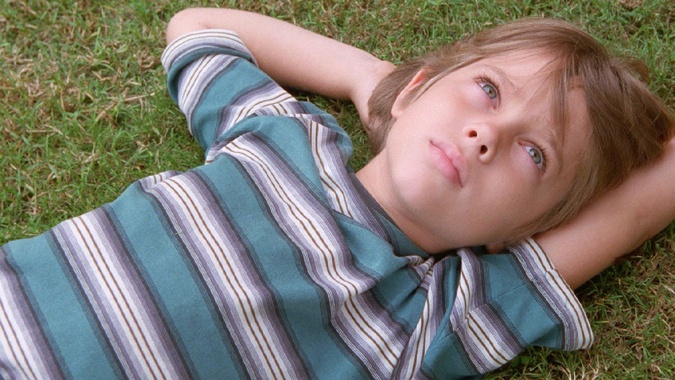
Boyhood (2014)

Richard Linklater has been making films for more than 25 years. And while his isn’t exactly a household name—despite his more popular collaborations with Jack Black (School of Rock and Bernie)—he has carved out a niche for himself in the world of American independent cinema with the seminal Slacker, the innovative Waking Life, and his affecting Before trilogy. Linklater’s most recent film, Boyhood, fits well into the ethos of those latter films. Heavy on dialogue and light on plot, Linklater’s “smaller” films privilege character, atmosphere, and ideas over story, events, and flashy set pieces.

Linklater’s work connects with the world in often profound and surprising ways. His films have regularly explored “people in time.” The Before trilogy is probably the best example of this as he has tracked Jesse’s and Celine’s relationship over the course of nearly 20 years—though we might also add the drama-in-real-time of Tape, along with sections of Slacker and Waking Life. Indeed, the middle entry in the Before trilogy, Before Sunset, is a film that virtually plays out in real time—the characters spending about 90 minutes together. Thus, that Linklater has played with time in a different way in Boyhood is hardly surprising.

My own interest in Boyhood tangentially revolves around this notion of time’s passage. While the film’s form—a series of twelve segments filmed over twelve consecutive years—clearly projects this particular thematic concern, the film isn’t simply interested in charting time’s passage. No doubt, this formal conceit is remarkable, as we see a boy go from six to eighteen in a little over two hours. However, it’s what the film wants us to do with the passage of time in the life of Mason and those around him that I find most interesting.

Every one of the film’s segments features Mason. Therefore, the action in each segment usually happens to or at least around Mason. In other words, Boyhood’s boy doesn’t initiate a great deal of the action—he most often receives it from his older sister, his parents, or his friends. While this could be criticized as a misstep, leaving the film with something of a blank slate for its central character, I think it works in a couple of important ways.

First, it feels realistic. Kids end up receiving far more than dictating the action of their lives. Parents take children places. Older siblings tell younger siblings what to do. Kids often simply go along with whatever their friends want to do. That Mason models these behaviors makes him more authentic as a character, and helps the audience get into the mindset of what it’s like to be a child.

Second, and more significant, however, has to do with my view that the Mason’s character embodies the way the film operates. The film opens with the image of the sky, as Mason watches the clouds roll by after school one day. The film closes with another scene of Mason gazing at the sky, this time a sunset in Big Bend National Park. Mason carries with him both an attentiveness to and an appreciation of the world around him. He is always watching, always seeking understanding, all the while refusing to judge and dismiss those people and events around him that are outside his typical experience or beyond his comprehension.

While Mason experiences frustration (generally directed at his father or stepfather), he never rejects. Even in one of the more painful sections of the film, as Mason deals with a break-up from his girlfriend, he can’t just dismiss her. He still remembers the good times they had and believes her to be, at heart, a good person.

Mason’s refusal to judge and dismiss people from his life seems to mirror the way Linklater approaches the primary characters in this film (especially Mason, Mom, and Dad). The director affords us the opportunity to observe these characters without him pushing us to dislike them because of their foolish behaviors or poor choices. Indeed, the film is at its weakest in scenes with the stepfathers, men we’ve no real connection to or sympathy with. As a result, these scenes feel stacked against those characters. Maybe this is by design, to place us in the shoes of the stepson thrust into relationships with these men. Regardless, those scenes stand apart from what is otherwise a consistent approach to characterization that takes people at face value—the good with the bad.

The overall lack of judgment toward its characters, taken in the spirit of Mason appreciating the world around him, is, in my view, one of Boyhood’s great achievements. It points out the value of appreciating people, experiences, and moments, and does so through the eyes of a child. Such a childlike vision of the world prompts us to be open and vulnerable to the world around us. It recognizes that such an approach will certainly yield pain, but not just pain. In the character of Mason, Boyhood gives us the eyes to see the beauty around us, to relish those moments of overwhelming grace or exciting opportunity that seize us and will not let us go. It is because of that spirit that I am most grateful for Boyhood.

Waking Life (2001)

I watched this again recently, and the more I see it, the more I see in it. Though having said that, while the film continues to hold together better and better on repeated viewings, there is still something dreamlike and fuzzy about my thoughts on it. In an effort to articulate a couple of those thoughts, I thought I’d write a bit. Of course, this will be grossly simplified, but hopefully can be the beginning of me sketching out some concrete things about this movie I have enjoyed and been puzzled by every time I’ve seen it.It seems that Linklater is, at least in part, using the dream imagery in contrast to reality to bring out a couple of points. First, we should not be sleepwalking, or dreaming, through life. The idea here is that too many people just sort of stumble through their existence, without giving it much reflection or thought. One good example here is near the end of the film, when Wiley runs into the girl in the stairwell, and she then starts up a conversation between them. One of the first things she tells him is that she doesn’t want to be an ant. She doesn’t want to just go through life doing her job and going from here to there. She expresses the need for connection, for something real and vibrant. Also on this point I think about the scene in the middle of the film, in the room with three men. The third man Wiley talks to (also the first time Wiley talks to anyone outside of the phone) says this: “It seems everyone’s either sleepwalking through their waking state or wake-walking through their dreams.” He says this as a caution to Wiley, essentially saying that he needs to learn to control his dreams.

The second point in this “dreams versus reality” contrast can also be connected to Wiley’s time in that room. In his conversation with the Uke player, Wiley receives some important advice. He needs to combine his waking rational abilities with the infinite possibilities of his dreams. This is built off of the previous point, and is sort of the “how-to” of the film. Part of what the film is doing, is to show us the odd connections and one might even say randomness of the dream world – to show us these infinite possibilities. This is really the essence of a waking life. However, the genius of the film is that the more you watch it, the more the paradox between this randomness with the growing sense that this is all connected somehow. And what I love is that this connection is not drawn out for us in some all-explaining closing scene. The sense of connectedness is there, but the mystery of how it actually connects remains.

One final point: the final scene of dialogue, which is given by Linklater himself, is a striking way to close the film. The necessity that is borne out of that scene, and its connection to God’s imminence is quite effective. And Linklater’s use of the Bible reminds us of all the places within its pages that speak of the end being near – not in any kind of predictive sense, but as a way to encourage people to live and believe well. We have less time than we think. Thus, as Linklater says in that scene, God is making an offer, an offer that we come to accept through life. If only we will just wake up.