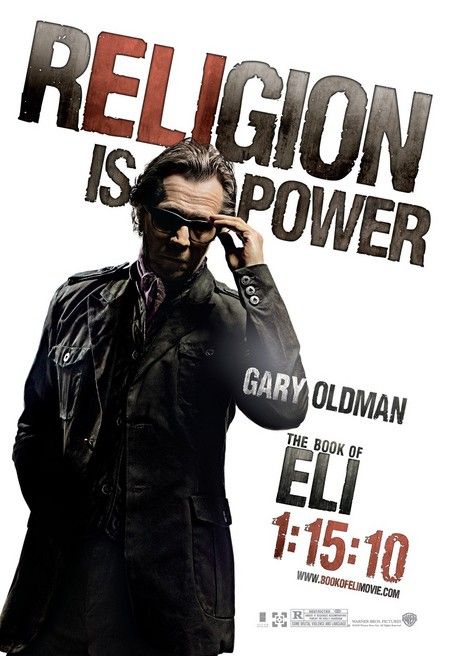
The Book of Eli (2009)

The Book of Eli stars Denzel Washington as a well-armed man carrying the last existing Bible across the United States to a mysterious place of safety. The film sports three slick action sequences, two excellent performances from Washington and Oldman, and one flat-out preposterous twist. Added together, Eli makes for an enjoyable evening, though one that requires either muddled thinking or an exorbitant amount of good will to follow its narrative turns throughout.

The film, marketed heavily in religious circles, is most interesting to me for its treatment of the Bible. Oldman’s villain, Carnegie, says the most about it, often referring to the power of its words to demand control and allegiance of the common people. Washington’s character doesn’t talk about the book as much as illustrate how he uses it—reading it every night and displaying the ability to recite biblical passages from memory. Eli wants the words of the book to have an impact on his own actions, even going so far as to express regret at one point that he hasn’t followed the Bible’s teachings more closely. For one man, the Good Book is a tool to exert power over others; for the other, it serves as a tool for the empowerment of self and others.

Despite this contrast in perspectives between the two main characters, the film presents a unified, Protestant-leaning vision of the role of this book, one that eschews both the importance and the goodness of institutional religion and sets up the individual as the sole arbiter of truth. The only discussion institutional religion comes from the villain, Carnegie, who wants to set up franchises of his degenerate town in other parts of the country. He needs the book to accomplish his plan, but this hierarchical vision is looked down upon. No doubt that derives largely from Carnegie’s evil intentions. But it is of interest that Eli provides no contrasting group, guided by goodness.

Instead, Washington’s hero, Eli, represents a more organic form of spirituality, one that walks the road alone, occasionally meeting with others and experiencing some form of community through random acts of kindness or out of mutual interest. It also matters that the book doesn’t end up with a religious body with an interest in disseminating the book for its spiritual value. Rather, it lands in an institution that seeks to disseminate important texts of all kinds, religious or not.

Watching the film and seeing this more individualistic mentality played out on the screen, I was reminded of a passage from an ancient Christian text, written by Irenaeus:

For [the Church] is the entrance to life; all others are thieves and robbers. On this account we are bound to avoid them, but to make choice of the thing pertaining to the Church with the utmost diligence, and to lay hold of the tradition of the truth. For how stands the case? Suppose there arise a dispute relative to some important question among us, should we not have recourse to the most ancient Churches with which the apostles held constant intercourse, and learn from them what is certain and clear in regard to the present question? For how should it be if the apostles themselves had not left us writings? Would it not be necessary, [in that case,] to follow the course of the tradition which they handed down to those to whom they did commit the Churches? (Irenaeus, Against Heresies 3.4.1)

Irenaeus’s point here is a simple one: the Church is the arbiter of truth, for she protects the message of the book. The Church helps the individual read the book well. The Church reminds the book’s reader that it was not written in a vacuum. Striking out on one’s own leads to danger and misinterpretation. Or worse, to becoming a thief or a robber. Irenaeus understood that just having the book, or even reading the book, was not enough. Those who love the God of the book need the protection of the institution, of the Church, to keep them on track.

My fellow Protestants might rejoice when they see the book saved, which would be, in such a hypothetical world, a good thing in and of itself. But the victory, for this believer, rings somewhat hollow without the institution of the Church to disseminate the message.
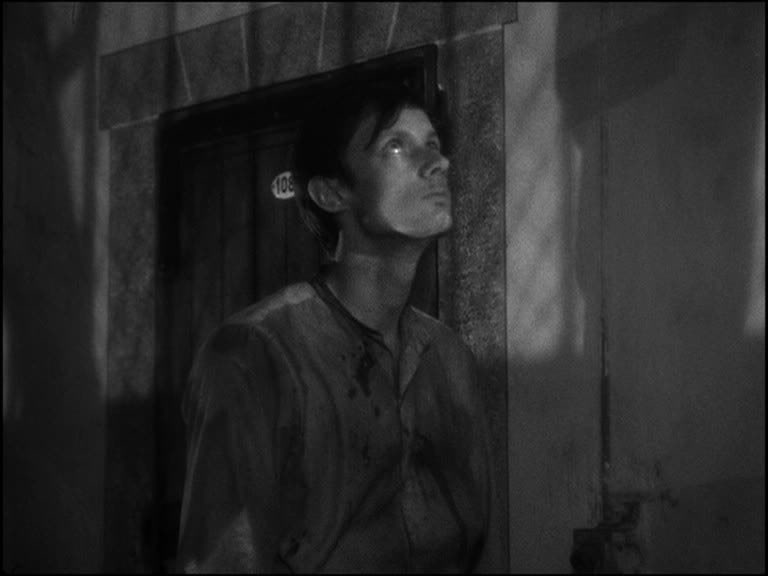

A Man Escaped (1956)

Susan Sontag, in her essay, “Spiritual Style in the Films of Robert Bresson,” argues that “All of Bresson’s films have a common theme: the meaning of confinement and liberty.” A Man Escaped develops this theme more explicitly than in any other of his works, making it the best entry point into Bresson’s oeuvre.

The film details the imprisonment of a Free French rebel in World War II and typical of Bresson’s style, it contains lengthy sections of wordless action—the prisoner Fontaine plotting escape alone in his cell, leaving his cell for a meal, or waiting in line to dump his waste bucket. Bresson punctuates these scenes with evocative sound; the intense focus on physical and mundane tasks compels the viewer to look within the characters to understand.

But there Bresson places a second roadblock. In A Man Escaped, as in all of his films after Les Dames du Boulogne, the actors do not emote. Blank looks and unemotional responses populate the characters in the prison. Bresson resists the temptation to allow his characters to explain their deepest feelings and motivations. Such psychological speculation is simply out of the question.

By making these kinds of stylistic choices, Bresson drives the viewer to grapple with the spiritual realities of the narrative. In other words, as the main story focuses on the mundane, leaving the characters opaque, Bresson invites the viewer into spiritual contemplation. Rather than dictating particular thoughts or feelings to the audience, A Man Escaped opens a space for the viewer to interact and engage with the profound mysteries of human life, of our desire for freedom, and of the presence of God amid our struggles.

Lord, Save Us from Your Followers (2008)

Christians can be jerks sometimes. Or judgmental. Or hypocritical. Or unjust. Or prideful. The list goes on. Some will read the preceding statements and get defensive. Others will think it’s not stated strongly enough.

Wherever you find yourself on the spectrum in your regard for Christians, Dan Merchant, an Evangelical Christian himself, couldn’t get around the negative impression so many seem to have about Christians these days. Public debate and comment involving Christians speaking out on social, political, and economic issues has left behind the more collegial attitudes of yesteryear and replaced them with what can only be termed a toxic atmosphere.

That’s the impetus behind Dan Merchant’s film, Lord, Save Us from Your Followers, which was originally released in the months leading up to the 2008 presidential election in the United States. Merchant acutely points out that people on both sides of the broader cultural debate going on in our country feel oppressed and cornered by each other. As an Evangelical himself, Merchant spends most of his film focusing on Christians, reminding viewers of such foolishness as Pat Robertson’s claim that Hurricane Katrina was a result of the extra-sinful people of New Orleans or Fred Phelps and his demeaning and destructive “God hates fags” campaign.

Merchant is ashamed of the activity of many Christians in the public square, and rightly so. The film seems fuzzy and scattered in its first half as Merchant details the problems, bouncing from scholars to famous personalities to average people on the street. However, the focus narrows in the second half as Merchant advocates for Christians to take a different approach to the world at large. His logic goes like this: If Christians are followers of Jesus, and Jesus was characterized by humility and grace and compassion for all people, then maybe the followers of Jesus should take on a more humble, gracious, and compassionate posture toward all people, especially those that disagree with them.

Merchant peppers the latter half of his film with examples of Christians actively working out this approach in the world today, people like Rick Warren and the lead singer of U2, Bono, who both give a great deal of time and money to various humanitarian works in Africa; a local group of Christians in Portland, Oregon who provide basic services and clothing for the homeless every week; and the filmmaker himself, who sets up a “confession booth” at a festival for gay and lesbian people.

Ironically, Merchant uses his confession booth not to hear the confessions of people at the festival, but to confess his own sins, and the sins of the church at large. The apologies start off a bit awkwardly, but the act of humbling himself through apology provides Merchant the opportunity to have conversations with those who visit the booth. These are revealing moments—two people facing one another in a room by themselves. While Merchant received a variety of responses, his act of humility was clearly moving to many who entered the booth. Fears and trials and hurts bubbled to the surface as human beings shared their hearts with one another.

The last half of Merchant’s film shows Christians communicating and connecting with people. It shows Christians treating people like people, regardless of race, economic status, gender, or sexual orientation. Merchant’s film advocates for a more compassionate approach from a group of people who should know better, but who too often do not.

Christians can be jerks sometimes. Maybe the existence of Merchant’s film in the world will make that a little less common. I hope so.

The Song of Bernadette (1943)

The Song of Bernadette, Henry King’s 1943 film about a young woman who believes she has visions of a mysterious lady in a grotto, has much to recommend it—the technical nuance, the less-sentimental-than-expected portrayal of miraculous events, and a fine performance by the lead actress, Jennifer Jones.

That said, let’s state up front: this is a film about a saint. As such, the dramatic conflict comes less from within Bernadette, and more from the resistance she meets outside herself. I say less because while a saintly figure, Bernadette is also a young woman, and as such is given to bouts of frustration. But in spite of her youth, after seeing the vision she never doubts it, she always answers in perfect concert with the mysterious lady’s intentions in mind, and she carries a kind of tranquil manner about her.

In the events and characters that swirl around Bernadette, the film goes to great pains to create doubt, whether by the filming of certain events, or by the incessant questions raised by the bishop and certain government officials. This works to a large degree in keeping the narrative engaging, though cutting ten or twenty minutes from the 140+ minute-film wouldn’t hurt.

Without a doubt, the film is straight-up hagiography, which is not at all meant as a criticism, but rather as a descriptive term. Personally, I don’t tend to go in for these kinds of stories, but in the case of Bernadette, the film wore down most of my defenses. The key factor in this has to be the innate simplicity that Jones brings to the role of Bernadette—there’s an appealing naivete about the young woman that engaged me.

The world I live in has too little simplicity in it. Everything’s complicated, so some say. Well, yes and no. Everything is complicated, but like that very statement—and depending on how you look at life—many things are simpler than they seem. Bernadette was a nice reminder of what a simple life lived in simple faith might look like.

Meshes of the Afternoon (1943)

In 1943, Maya Deren and Alexander Hamid made a 14-minute experimental film called Meshes of the Afternoon. While the scenes play out in mysterious and elliptical fashion, the title presents at least one clear direction for the film: the woman who stars in the film—played by Deren herself—walks around her neighborhood and home on a sunny afternoon, but is trapped, or enmeshed, in the domesticity of suburban life.

With abrupt cuts, repeated images, and bold symbols, the film addresses questions of traditional gender roles, ossified social structures, the isolation inherent in society, and the deep fears that threaten to overtake us all. The opening scenes of the film, following the woman as she walks down her street and into her home, refrain from showing her entire body or face. Instead we get glimpses of a flower she carries, her feet as she walks, her hands as she swings them, or her shadow as it flits across blank walls.

Deren shows us a woman not fully in the world—a mere shadow in the walled and isolated environment in which she finds herself. When a man eventually appears in her home, he is more a stranger or intruder than he is a comfort or companion. One recurring image makes the struggle of the heroine clearest: from outside her window, the camera watches her as she stares through the glass. But across the window in reflection are the branches and leaves from a tree just outside. Even here, in a moment of mental escape from the domestic snares laid for her, the woman remains trapped.

Told with dream logic, including repeated scenes of the woman dozing in an overstuffed chair, the film presents a terrifying portrait of her gradual breakdown. Long before Freddy Krueger used nightmares to kill teenagers in the real world of cheap slasher flicks, Deren and Hamid showed their audiences that the dreamy existence of 1940s suburban life was far more dangerous than it appeared. Meshes of the Afternoon questions humanity’s ability to continue to exist in a world built to isolate us from one another, where fear has become the primary means of relating to one another and death the only avenue of escape.

100 “American” Movies

What is America? How would I describe it if the only language I had were the movies? These were the questions put to me recently by a friend. These same questions led me to compile the following list of 100 movies that I would use to introduce an outsider to the United States. To complete the list, I wanted a multiplicity of voices from different eras. I wanted movies that represented a variety of genres, in particular making an effort to include comedy. Sometimes you know a place or its people best when you can begin to appreciate their comic rhythms.

Of course, this list is far from perfect, limited in particular by what I’ve actually seen. But it’s a starting point. In light of that, the question that interests me most involves you: What movies do you think serve as an introduction to America? Come up with a title or ten and leave a comment. I’d love to see what you suggest.

1. Birth of a Nation (Griffith, 1915)
2. The Immigrant (Chaplin, 1917)
3. Greed (von Stroheim, 1924)
4. The Gold Rush (Chaplin, 1925)
5. The Crowd (Vidor, 1927)
6. The General (Keaton, 1927)
7. I Am a Fugitive from a Chain Gang (LeRoy, 1932)
8. Steamboat Round the Bend (Ford, 1935)
9. Modern Times (Chaplin, 1936)
10. My Man Godfrey (La Cava, 1936)
11. Make Way For Tomorrow (McCarey, 1937)
12. Gone with the Wind (Fleming, 1939)
13. Mr. Smith Goes to Washington (Capra, 1939)
14. Young Mr. Lincoln (Ford, 1939)
15. Grapes of Wrath (Ford, 1940)
16. Sergeant York (Hawks, 1940)
17. Citizen Kane (Welles, 1941)
18. The Magnificent Ambersons (Welles, 1942)
19. The Ox-Bow Incident (Wellman, 1943)
20. Meet Me in St. Louis (Minnelli, 1944)
21. Mildred Pierce (Curtiz, 1945)
22. They Were Expendable (Ford, 1945)
23. The Best Years of Our Lives (Wyler, 1946)
24. It’s a Wonderful Life (Capra, 1946)
25. Paisan (Rossellini, 1946)
26. Red River (Hawks, 1948)
27. Ace in the Hole (Wilder, 1951)
28. High Noon (Zinnemann, 1952)
29. Shane (Stevens, 1953)
30. The Sun Shines Bright (Ford, 1953)
31. Night of the Hunter (Laughton, 1955)
32. Rebel Without a Cause (Ray, 1955)
33. On the Waterfront (Kazan, 1956)
34. The Searchers (Ford, 1956)
35. The Wrong Man (Hitchcock, 1956)
36. 12 Angry Men (Lumet, 1957)
37. The Incredible Shrinking Man (Arnold, 1957)
38. Sweet Smell of Success (Mackendrick, 1957)
39. West Side Story (Wise, 1961)
40. The Manchurian Candidate (Frankenheimmer, 1962)
41. To Kill a Mockingbird (Mulligan, 1962)
42. Dr. Strangelove or: How I Learned to Stop Worrying and Love the Bomb (Kubrick, 1964)
43. Bonnie and Clyde (Penn, 1967)
44. The Graduate (Nichols, 1967)
45. Salesman (Maysles, 1968)
46. Easy Rider (Hopper, 1969)
47. M*A*S*H (Altman, 1970)
48. Patton (Schaffner, 1970)
49. Dirty Harry (Siegel, 1971)
50. McCabe & Mrs. Miller (Altman, 1971)
51. The Godfather (Coppola, 1972)
52. American Graffiti (Lucas, 1973)
53. Blazing Saddles (Brooks, 1974)
54. The Conversation (Coppola, 1974)
55. The Godfather Part II (Coppola, 1974)
56. All the President’s Men (Pakula, 1976)
57. Harlan County U.S.A (Kopple, 1976)
58. Network (Lumet, 1976)
59. Taxi Driver (Scorcese, 1976)
60. Killer of Sheep (Burnett, 1977)
61. Apocalypse Now (Coppola, 1979)
62. Manhattan (Allen, 1979)
63. First Blood (Kotcheff, 1982)
64. The Right Stuff (Kaufman, 1983)
65. Scarface (DePalma, 1983)
66. Tender Mercies (Beresford, 1983)
67. The Natural (Levinson, 1984)
68. Places in the Heart (Benton, 1984)
69. Red Dawn (Milius, 1984)
70. Stand By Me (Reiner, 1986)
71. Wall Street (Stone, 1987)
72. Hoosiers (Anspaugh, 1988)
73. Platoon (Stone, 1988)
74. Bill & Ted’s Excellent Adventure (Herek, 1989)
75. Christmas Vacation (Chechik, 1989)
76. Do the Right Thing (Lee, 1989)
77. Goodfellas (Scorcese, 1990)
78. Miller’s Crossing (Coen, 1990)
79. Boyz n the Hood (Singleton, 1991)
80. Dazed and Confused (Linklater, 1993)
81. Groundhog Day (Ramis, 1993)
82. Rudy (Anspaugh, 1993)
83. Safe (Haynes, 1995)
84. Dead Man Walking (Robbins, 1995)
85. L.A. Confidential (Hansen, 1997)
86. The Last Days of Disco (Stillman, 1998)
87. The Straight Story (Lynch, 1999)
88. George Washington (Green, 2000)
89. Zoolander (Stiller, 2001)
90. 25th Hour (Lee, 2002)
91. In America (Sheridan, 2002)
92. Spellbound (Blitz, 2002)
93. Take Out (Baker, 2004)
94. Good Night and Good Luck (Clooney, 2005)
95. Grizzly Man (Herzog, 2005)
96. The New World (Malick, 2005)
97. United 93 (Greegrass, 2006)
98. When the Levees Broke (Lee, 2006)
99. Taxi to the Dark Side (Gibney, 2007)
100. Milk (Van Sant, 2008)

Metropolis (1927)

Upon its release in 1927, Fritz Lang’s Metropolis was cut to pieces by editors who thought it too long for audiences. For the past eighty-three years, the film has been in a seemingly never-ending rebuilding process, one that has approached completion with the newest restoration, just broadcast in Germany by the Murnau Foundation. I say approached because, even after more than eight decades, the film is still missing the entirety of one key scene—a fight late in the film between Frederson and Rotwang. However, with this newest restoration, two entire subplots have been added back into the film, bringing the film as close as it’s ever been in modern times to Lang’s original, majestic vision.

The plot concerns the life of Freder, son of the man who runs the entire city. Early on Freder becomes captivated with the world of the workers below ground and gradually morphs into a savior of sorts for the city, healing the long-standing division between the rich and the poor, the powerful and the powerless. Several subplots revolve around the central narrative, the most compelling of them involving Rotwang, a man who has created a robotic woman that can take whatever form he gives it, and who has designs of his own on the city. The 2010 restoration also restores two other subplots that give coherence to the overall plot—one involving a worker’s life above ground after Freder trades places with him, and another involving The Thin Man, a stooge sent by Freder’s father to keep tabs on the young man. None of this added material feels extraneous, as Lang’s film remains expertly paced.

What has always been most impressive about Metropolis is its grand vision of a futuristic world, one where humanity has achieved great heights of technological progress while at the same time has sunk into the depths in its treatment of one another. Lang reproduces this apparent paradox quite literally, conceiving of giant skyscrapers reaching into the sky and virtually blocking out the heavens, as well as multi-level skyscrapers entirely below ground whose foundations dig deep into the earth.

Everything in the world of Metropolis has a touch of the human creative spirit in it. Even a garden from an early sequence looks constructed and manicured. The world that has been created is certainly majestic, but it is also threatened with destruction because of the deep division that exists among its people. The world has turned in on itself, and finds itself in need of some recalibration.

In hope, Lang envisions a world where both powerful and powerless can come together in a spirit of unity and mutual benefit. But how does the film portray these people breaking out of this strictly human existence? Lang uses religious symbolism in significant ways to bring about the change that eventually occurs, envisioning machines as devilish gods or temples, making the heart of the rebellion come out of Christian meetings that take place below the lower city, or staging the final dramatic conflict in and around a towering cathedral in the midst of the city. All of these point to a reality beyond that of the tangible inventions that make up the Metropolis. For these people, peace comes not through human ingenuity and progress, but through the willingness to sacrifice and a mutual embrace of humility in the face of something greater than themselves.

Eighty-three years on and Metropolis remains a vital film. Its vision of the future, its understanding of human nature, and its nod to the importance of the transcendent ensure that it will be around for another eighty-three years to delight and challenge viewers in each new generation.

Make Way for Tomorrow (1937)

Leo McCarey’s Make Way for Tomorrow has been one of those Holy Grail type films—a movie with an excellent reputation, but one that has been completely unavailable on home video in the U.S. That’s all changed thanks to the recent Criterion release of the film on DVD. It looks fantastic, but even more importantly, it lives up to the hype.

Married for fifty years with five children, Barkley and Lucy Cooper have been caught in the throes of the Great Depression. They’ve lost their house. Calling four of their five children to them for the announcement (the fifth lives in far off California), the parents matter-of-factly deliver the news to a shocked and slightly put out group of kids. Quickly Bark gets shuffled off to one kid’s house while Lucy goes to another’s—no one seems to have enough room for both of them—in the hopes that a third child will take them both in after a few months. But that time never comes.

The film spends its first hour detailing this separation, its painful consequences for the elderly couple, and the upheavals it introduces into the lives of their children. After so many years in the presence of one another, both Lucy and Bark have developed comfortable patterns in their lives. So when Lucy, used to keeping house, tries and fails at helping out around her new home, she angers her son, his family, and even their housekeeper. When Bark takes ill for longer than usual, he becomes nearly helpless, wanting only the care of his wife to the frustration of his frazzled daughter. The kids have little time or patience for any of it. One disappears completely from the film after the announcement. Another refuses to take them both after promising to do so. The two who keep the parents never lose an opportunity to find a way to move them on to another location.

While the kids come out of all this looking worse than the parents (and rightly so), McCarey wisely avoids portraying any of them too negatively. They each possess their own flaws, the filmmakers recognizing the inherent difficulties of normal people living in confined spaces with one another. Nothing overly dramatic is needed to underline this point because this film portrays well-drawn characters that are fully alive. The conflicts, therefore, arise naturally.

However, the shift that takes place for the final half-hour moves this film from astutely observed family drama to, plain and simple, masterpiece. From a group of dour, irritated, aggravated, and impatient people living in various cities, the film brings the old couple back together in New York City for one fleeting day—Bark is soon to be shuttled off to a daughter’s house in California. Bark and Lucy enjoy several hours together without their kids and in the city, reminiscing about their last trip there—fifty years before, on their honeymoon. All of a sudden, the confined spaces of the first hour open up magnificently with a walk outdoors, a car ride, a posh hotel, and a dance that tops off the magical moment.

It is in the contrast between two worlds that the film holds its greatest power. Gone is the spirit of bitter ungratefulness; now is the time for kindness and thanksgiving. Gone is the yearning for what cannot be seen; now the object of affection is in full view. Gone is the absence of one’s greatest love; now it is completely present.

While this half-hour is certainly powerful, McCarey’s film is too smart to avoid the inevitable. Part of the power of that magical thirty minutes comes from the knowledge that it will all soon end. When it does, McCarey handles the moment with such grace and simplicity that it brings a tear even at the remembrance of it. As Lucy stares off somewhere beyond the frame at the train pulling her husband away from her, a haunting pallor spreads across her face as the hope of the recent moment fades.

What will tomorrow bring? Of that we can never be certain, the final image seems to say. And so we rely on the memory of moments now past in the anticipation that we might live to have others—maybe, we hope, even tomorrow.

The Hurt Locker (2009)

Kathryn Bigelow’s The Hurt Locker has received a great deal of praise for being the best of a recent spate of films on the War in Iraq. Outside of the praise she receives for being a woman at the helm of an action picture (praise I find insulting, by the way), most of the good notices are focused on two fronts: the complex portrayal of the psychological damage on the everyday soldier wrought by his exposure to war and, second, the technical proficiency and command on display in the film. Either of these elements, taken on its own, could undeniably contribute to a first-rate film on any war. However, when combined here, it’s my view that the second element works against the first, so that rather than creating a complex portrait of soldiers at war, we instead get a confused film that delivers a strange mixture of messages. For those who haven’t yet seen the film, be warned! Spoilers lurk throughout.

The first element of the movie receiving praise is the psychological portrait of the soldier at war. To this end, the film opens with a quotation from Christopher Hedges, former war reporter turned author and speaker, a quote that ends with the words “war is a drug.” Despite my objections to a film telling the viewer what it is about before a single image even graces the screen, thus limiting its overall impact, I am sympathetic to Hedges’ point on this issue (his book War is a Force that Gives Us Meaning has been formative for me in this regard).

The movie goes on to illustrate the psychological damage done to soldiers, even as they inflict physical damage on the landscape and people around them. It’s clear that each of the three main characters, as well as several supporting players, will have significant issues to overcome should they make it back to their old lives. In particular, the film displays the damaged psychological state of Sgt. James, a man whose proficiency at his job actually makes him increasingly reckless, violent, and disconnected from his unit. He constantly disregards procedure within his unit, participates in what looks to be a mini-Fight Club, and disobeys specific rules to pursue his own personal goals. The implication in the film is that James has come to this state because of his commitment to his extremely dangerous job as a bomb tech.

On another level, the film is an undeniable technical achievement. And while this factor is low on my list of “elements I most look forward to in a movie,” The Hurt Locker includes genuine thrills and back-breaking tension. The best example of this is a sniper scene that takes place mid-film, in which Bigelow makes expert use of contrasting sight lines, views from both the naked eye and several different scopes, revealing just enough to ratchet up the intensity and drawing out the scene in a most satisfying way. In the rest of the film, two other technical elements play a significant role: slow motion and music. The opening sequence makes ample use of the former, while the closing sequence makes a surprising use of a latter.

When an IED explodes in the opening scene, Bigelow shoots the blast from several different angles (something she’ll do throughout the film). However, much of the detonation plays in slow motion, so the audience gets the pleasure of watching the cool explosion go off. In fact, one character had even predicted how it would explode, and so when Bigelow slows everything down, we get to compare that prediction to the actual reality. Slowing down the film at this point may increase our horror at the destruction it causes, but it certainly allows us the opportunity to enjoy the show. There’s a kind of beauty even in moments of destruction, and the slow motion points our focus toward the blast in all its heinous glory. It’s a little like watching a mushroom cloud from afar: the beauty of the cloud is striking in relation to the destruction emanating from its center.

In the final sequence of the movie, Bigelow pumps up the volume of an already loud heavy metal song and plays it over several shots picturing one soldier’s return to Iraq. The song is a strong contrast to the dark and disturbing sound of one playing when we first meet Sgt. James in his room. That song sounded like a man deep in the throes of a battle within himself. The song at the end of the film, on the other hand, could legitimately be playing on a U.S. Army recruitment commercial that might hypothetically run at the theater before The Hurt Locker screened. These are powerful sequences, to be sure, but their place in the larger scope of the film is a big part of my problem with it.

On a basic level of narrative, the film works as a kind of cautionary tale about the dangers of war to our own soldiers, dangers that extend far beyond bullets and bombs. However, when put together with the technical elements of the film, the mixed message overwhelms it. On the one hand, we’re to be disturbed by the reckless behavior of Sgt. James, yet as he walks proudly off the helicopter back onto Iraqi soil, with “music to pump you up” blaring, I felt like the filmmakers wanted me to sit back and say, “Awesome!”

Disturbing or awesome. Which is it? I know Chris Hedges knows. And I know I know. I wish I had any confidence that the filmmakers knew.

Beeswax (2009)

I recently had the great privilege to attend a public screening of Beeswax followed by a Q&A with director Andrew Bujalski. For several years I’ve been an admirer of Bujalski’s work, and for the better part of the last year I’ve been anxious to take in his latest effort. What a surprise then when the film finally screened in Dallas this week (after a five-month delay from its originally publicized release date here) that Bujalski would attend a couple of screenings.

First the film: it certainly sits well within the tradition of Bujalski’s first two films. All three of his features involve characters struggling to grow up, to find a direction, and to figure out who they are. And while the twin-sister leads in Beeswax seem a bit further down that road than the characters in either Funny Ha Ha or Mutual Appreciation, that’s actually a good thing. As a result, Beeswax feels more accomplished and mature than its predecessors. It’s my favorite of his films to date.

Beeswax retains a sense of aimlessness typical of his first two features as the twins try to figure out what’s next for them. Lauren is unemployed and considering a teaching job overseas while Jeanie faces struggles with her ownership partner in a local clothing boutique. However, Bujalski often and wisely underplays the struggle for direction in the lives of these women. When Lauren goes on a job interview, Bujalski only shows us the lead up to it, rather than the actual questions from a potential boss. When Jeanie goes with her friend Merrill to drum up financial support for the business, Merrill does virtually all the talking, leaving Jeanie virtually silent in the expression of her uncertainty about the future. These choices encourage viewers to pay close attention to the faces of the women and to those “unrelated” snippets of dialogue they share with one another, in the hope of finding the clues that help us understand what makes them tick.

But in underplaying their indecision and uncertainty, Bujalski weaves another theme throughout the film: the complex, uplifting, and even painful existence of the family bond. And it’s this element in particular that gives the film a more mature feeling. Where Bujalski’s previous characters were pretty much all single (a few were dating) and separate from their families, the centerpieces of Beeswax are related to one another. The film explores this connection quietly, but it’s ultimately what’s in view in Bujalski’s most affecting ending yet.

In the Q&A that followed the screening, the relatively small crowd energetically peppered Bujalski with questions about the film, his process, and the larger world of commercial movies. He answered in a thoughtful and reflective way, treating each question as if he hadn’t already heard it numerous times and in the process endearing himself to the crowd. A few highlights:

  • In answer to a question about what dictated his move to shoot his first three films in three different cities, Bujalski talked about the lead actors in each film as being his inspiration for writing, rather than any of the cities. None of the leads in his three films are professional actors, meaning that the films developed from personal relationships with people and the charisma that each of those actors carries naturally in life. That said, Bujalski noted that the character of each city (Boston, New York, and Austin) contributed to offer the final film a distinctive feel.
  • When asked about the meaning of his film’s title, Beeswax, he offered a witty rejoinder about the many different ways that Quentin Tarantino has dodged the question about his latest film, Inglorious Basterds. If Bujalski could have remembered any of those, he said, he would have used it then.
  • I asked what attracted him to nonprofessional actors, and he responded that often, professional actors have been trained to clarify when they perform. But Bujalski’s movies are about people who aren’t clear of their motives, their futures, or even their identities, so using a professional actor would be counter-intuitive in such a film. He also added that because the faces of nonprofessionals aren’t recognizable, there’s a bit more of a rooting interest on the part of the audience—one regular person connecting with another. The mask of celebrity is pulled out of the equation, thus allowing people to negotiate with the film itself, rather than with certain preconceived ideas about this actor or that.
  • When one woman commented on the abrupt ending, Bujalski offered a knowing smile. Clearly he had heard the question many times (I suspect for every one of his films). But he offered his thoughts on what he’s trying to do with those endings, not taking the film into some kind of resolution that’s unnecessary, but to end it when he senses it’s complete. [And let me just say, I am so glad he works this way.]

I’m thrilled that the people at the Angelika Theater in Dallas were able to organize the Q&A and get the film on the screen. I hope that they continue to make commitments to showing the films of significant contemporary filmmakers like Bujalski, Denis, Jia, and the Dardenne brothers. And thanks to Andrew Bujalski, who gave of his time to come out and talk to a group of strangers about something he’s put his heart and soul into. I can’t imagine that’s an easy thing to do, but he did it beautifully. I really love this film, and encourage you to track it down theatrically if you can. If not, look for it on DVD. It’s definitely worth your while.