Downfall (2004)

Saw this film a couple of nights ago, and while I don’t love it, I find it interesting for a couple of reasons. First, I think it’s a fascinating look at how ideology shapes people. We all have things in which we believe. Some of those may push us to look beyond ourselves for answers, community, or a number of other things. Others may be much more limited. The way that different characters related to the overall ideology of Nazism was distinct from one to the next.

At one end of a spectrum, you have people like Hitler, Goebbels, and the young SS officer at the end. These folks believe so strongly in the ideology that they continually defy both logic and common decency in their desire to be good soldiers to their belief system. This seems to not even be a conscious choice for them, they are so deeply ingrained with it. The killing of the Goebbels children is the most obvious example of this. On the other end, you have people like Prof. Schenck and Frau Junge, who while trying to remain loyal to their superiors out of a sense of duty, will yet quietly question the course of action. This is mostly communicated through looks of discontent and discomfort.

In one scene, Frau Junge looks askance at Hitler’s mention of his hatred of the Jews. In another, Prof. Schenck looks on with concern as Prof. Hasse explains to Hitler the most surefire method of suicide. It seems then that for some, the structure of the ideology is so important, that their actions will flow from it, even if the ideology itself is flawed. On the other end are people who may or may not be sympathetic to the cause, yet at the same time bring themselves into the equation when it comes to making decisions. It is not simply enough to follow the letter of the law to its logical conclusion. One must constantly question oneself and one’s beliefs, to see that they align with what is true and good.

This distinction between the two groups leads to my second thought, which is that I find it interesting that the people who come out looking best in this film are the one’s who lived. Those who died are of a different breed altogether. This makes me think about the nature of truth, memory, and self-interest. It seems this film was built off of the accounts of several people in the bunker, most notably Trudl Junge. While I don’t know enough about the situation to get into specifics, I find it revealing that she comes out of the film looking downright angelic. Now, I won’t argue that she deserves to be considered in the same breath as Hitler, but the cynic (or is it realist) in me finds it hard to believe she was quite so ignorant and innocent. Everyone who related their story of these final days is being tugged at by an obvious self-interest, particularly in the years since the War, when the name Hitler conjures visions of demons and hell and evil. Who wants to be associated with any of that?

This, I think, is the great weakness of the film. While it gives a bit of complexity to the characters we consider pure evil (Hitler, Goebbels) by showing some of their more tender moments, we don’t get the corresponding complexity for the “good” characters, like Frau Junge and Dr. Schenck. This failure on the filmmakers part leaves the film coming up a bit short for me. I like it as a historical document, but I think it could have been a really interesting look at humanity. There it falls short.

Decalogue II (1988)

This has long been one of my favorite episodes of this series, initially because of the great ethical dilemma that the story gives us. However, on repeated viewings, the richness of the details has only continued to grow – leading to revelations about the characters and ever more puzzling questions. What follows is a bit of my running commentary through the episode.The initial scene of the film in the doctor’s apartment sets up two intriguing elements about his character. Kieslowski achieves all of this with a mere two lines of dialogue. First, the doctor is surrounded by living things, revealing his care for living things of all kinds. He handles a plant, clearly wondering why it isn’t thriving in his makeshift greenhouse. He wonders what he must do. Next, he flips the cover off of a birdcage, revealing his chirping pet underneath. He then moves across his room, past an aquarium full of fish. And when the doorbell rings, he does not claim the dead rabbit the porter found beneath his balcony (the only verbal exchange in this scene). The doctor then moves to his bathroom, where he leans over the steaming tub, his face in agony. Is he in physical pain? Is there some emotional turmoil that plagues him? Later, he continues a story he has been recounting to his housekeeper – a story about the death of his father, his wife, and his two children. We don’t learn the end until later, but already we see him as a man willing to share himself with others.

Contrast all this with the early scenes of Dorota. When she first appears, she stares out the window, away from the camera. She looks after the doctor as he goes to the elevator, but when he meets her gaze, she abruptly turns back to the window. Kieslowski then gives us a close-up of Dorota extinguishing a cigarette with her shoe. When the doctor returns, Dorota ignores his approach even as he waits for her to speak (she obviously wanted to say something to him earlier). Yet as soon as he goes to his own apartment, she follows him, and rings his doorbell. In their conversation, he recalls her being the person who killed his dog. He abruptly shuns her request for a conference about her sick husband anytime before Wednesday (though he later offers to see her that day), and she responds by wishing she had run over him. Back in her apartment, she listens to messages on the machine without returning the calls. She looks at a hand-written note, which she crumples without answering. After a brief meeting with the doctor in the hallway, she returns to her apartment and rips the leaves from a plant. When she tries to break the stem, she cannot, and it slowly rises. As Kieslowski lingers for a second or two on that recovering stem, we are confronted with the fact that for all our attempts to control life, we cannot.

The doctor then is a man who surrounds himself with life, who is willing to share himself with others in friendship, partly in response to his pain – presumably over the sudden deaths of his family long ago. He can also be impatient and abrupt when put on the spot, though he recovers his sensibilities fairly quickly. Dorota on the other hand is surrounded by images of death – putting out the cigarette and killing the plant. She too is in pain over something, yet her response is to isolate herself. Instead of living things, she is surrounded by cold and impersonal objects. She won’t respond to messages, she destroys a note, she later starts to respond to it but doesn’t, and she won’t address the doctor when he approaches her. She is also controlling, wanting to see the doctor on her terms, not his. She must approach him. She insists on seeing him outside his normal office hours. And in spite of all this, she looks longingly at the pictures of her husband. Does she truly miss him? Is she wishing he is okay? Or maybe she is thinking something else entirely?

This leads to the central conflict of the Episode – Dorota is three months pregnant by another man, and wants to know if her sick husband will die. If yes, then she will keep the baby. If not, then she will have an abortion. At first, the doctor does not know the back story, and he refuses to give her a definitive answer. Later, Dorota follows him home and confronts him in his apartment. She fills him in, at which time he says her husband has only a 15% chance of living. Yet when she leaves, he is grieved, mimicking the motion from the beginning of the film, placing his hands over his face and rubbing it. He then walks to his shelf and looks at the picture of his family. The doctor again agonizes over his loss, but not only that, he agonizes over someone who seems willing to throw away all that he has lost.

But something is sparked in Dorota. Before she leaves the apartment, she inadvertently lights a box of matches on fire while putting out her cigarette, a beautiful image for where this path is taking her. She has visions of extinguishing life, but despite her efforts, she is actually going to see it rekindled. She goes home to find her husband’s friend waiting at her place, with Andrei’s backpack. Clearly, he thinks death is inevitable for his fellow climber, but Dorota reacts violently, clearly believing that her husband still has a chance to live. This means, of course, that she has decided to have the abortion, which we find effectively ends her relationship with her lover.

All this talk about abortion gets the doctor looking more closely at Andrei’s case, in which he sees the disease progressing at a rapid rate. The silent observer present in many episodes of The Decalogue looks on during this scene, with a seeming faint smile of approval. When Dorota visits the hospital next, the observer notices her with Andrei, and as she expresses her love to him, the observer looks away. Is he embarrassed, like he might be intruding on a private moment of tenderness? Does he think her disingenuous? She then visits the doctor for one final update. He informs her that the situation is hopeless, Andrei will die. So she should not abort the baby. She makes him swear, which he does, even though we know his beliefs to be that he never writes off a patient. He has seen too many strange things happen.

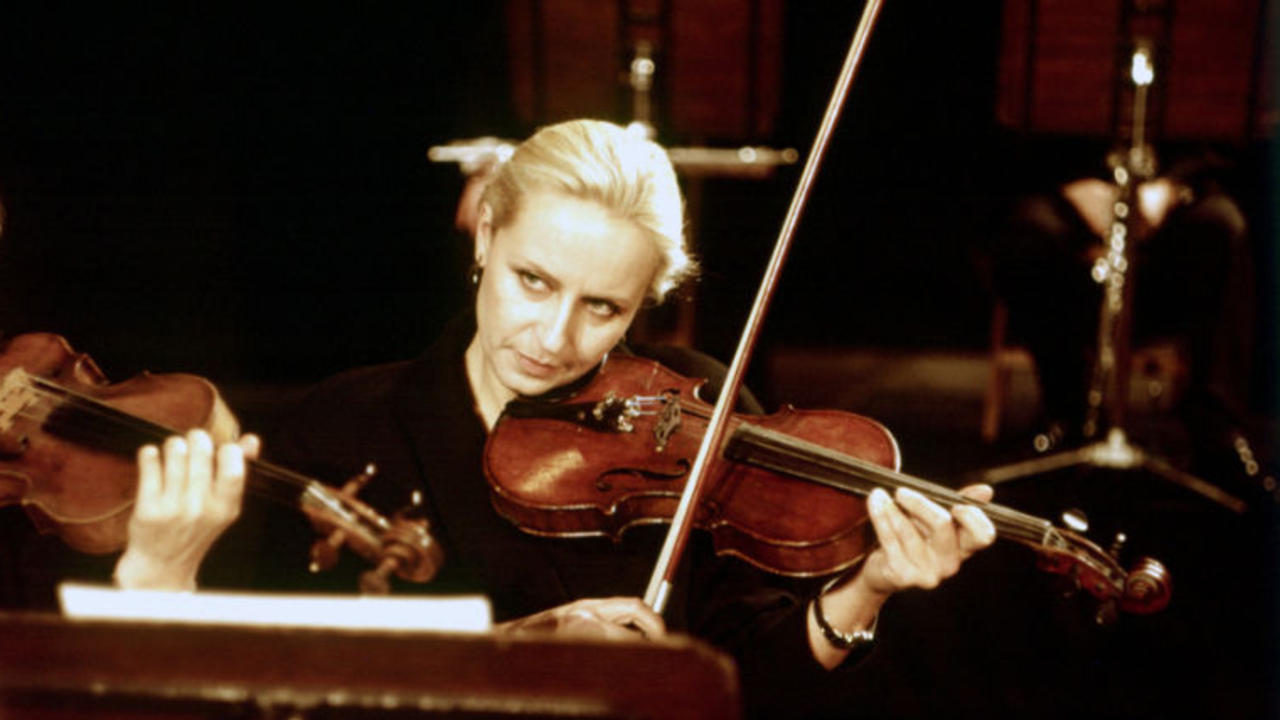
The brilliant final sequence begins with a shot of Dorota at her window. The camera is positioned below her, and as it gazes up, we feel the weight of her decision. The camera slowly descends, never cutting, down the building until it comes to the doctor’s window. He is lit in red, and the camera comes even with him. Here we enter into his mind – he has sacrificed his principles, effectively lying to Dorota so she wouldn’t have the abortion. The camera moves quickly to the right, and with a continuous motion with no evidence of a cut (thus connecting all three principles, showing their decisions are intertwined – this functions in a similar way to the apartment building through all ten episodes), we find ourselves in Andrei’s room. He awakens to see a fly struggling to climb out of a glass, which it does. We then cut to Dorota playing the violin with a faint smile, pleased that her husband has been healed. This leads to one final scene change to the doctor’s office, where he and Andrei meet. Andrei tells him that he has returned from a world that was disintegrating and ugly. It made him want to die. Yet now he has life, and his wife is going to have a baby. His question to the doctor is especially poignant: does he understand what it’s like to have a child? The doctor’s response is heartbreaking: with eyes downcast, a reflective gaze, and the look of tears coming to his eyes, he says simply, I do.

This is a tug of war between life and death. There is the tug going on within Andrei. It goes on between Dorota and the baby. It goes on between Dorota and the doctor. And in all these instances, life wins out. The doctor’s painful past reminds us that is not always the case, that death does have its day. But here, even as (and maybe because?) the doctor is forced to go against his conscience, life is the victor.
Scenes From a Marriage (1973)

Scenes From a Marriage chronicles the marriage of Johan (Erland Josephson) and Marianne (Liv Ullman), a couple happily married for ten years that sees their marriage disintegrate over the next decade. Over the course of the nearly six-hour miniseries, Bergman peels away the layers of this couple until we see them for who they are – profoundly imperfect human beings whose deepest desire is to love and be loved by another. They lie, manipulate each other, and put on masks to cover their true feelings. Yet as they move closer to divorce, that is all pushed aside in a raw and troubling climax.This is my eighth Bergman film, and while I am by no means done with his work, I finally feel like I’m getting a footing with him. Technically, the films are often simple, but expertly done, whether it be the placement of the camera, the abrupt change of scene, or the use of sound. Bergman uses all the elements to his advantage in evoking the kind of mood and feeling for which he is aiming. In terms of writing, he can tell simple stories that bring the viewers into dialogue with many of the great questions of human existence: What do we have to look forward to beyond the grave? What does it mean to be human? What is love, and can it be attained? How does overcome or live in the knowledge of their guilt? What does it mean to believe, and how can it be done? What is it that all people seek? Questions like these and others run all through his work. It is these elements that draw me to his work: a fascination with those kinds of questions and a desire to see artistic excellence on display.

And while Bergman’s answers are not always wholly satisfying, I still appreciate much of the tension he raises with his answers. We are confronted with this at the conclusion of Scenes from a Marriage. Both Johan and Marianne have suffered, come through the suffering, and have some heightened sense of themselves and who they are as individuals. They are then able to accept one another for who they are, as imperfect people who love imperfectly. There’s something about this that rings so true – it gets at the heart of what it means to love and be loved by another. We love in spite of our imperfections, and in spite of the imperfections of those who mean to love us. I am not confident I or anyone else in this world will ever attain the level of loving another truly in this life. We love in our imperfect ways, and those we love put up with our imperfections.

All this leads us back to a comment Marianne makes in the interview that begins the film. When asked to define love, Marianne hesitates, but then offers 1 Corinthians 13 as the pinnacle. Yet even then she recognizes that she cannot attain such a love, deciding that kindness, affection, tolerance, and a sense of humor can be combined to take the place of love. It’s no wonder that she and Johan couldn’t remain married. Neither of them were even pursuing the ideal, but had instead given up on it for something lesser. Yet even still, with maybe a supreme act of grace, they end up declaring their imperfect love for each other. This is a film about the terrifying death of a marriage, and its rebirth as something new and different.

Pale Rider (1985)

A long break from posting, but with good reason…the birth of my son, Nicholas on July 4th. All are well here, and hopefully I’ll get back to posting a bit more regularly.

As I started thinking about my recent viewing of Pale Rider, I was immediately reminded of Shane (1953), as well as another recent viewing: The Magnificent Seven (1960). Of course, thinking about that film got me thinking about an all-time favorite: Seven Samurai (1954).

Pale Rider seems to me a pretty clear homage/remake/knock-off of the George Stevens classic, Shane. Most striking is the lone gunman riding into town to save the poor people from the rich cattleman/miner, who buys power and influence and thuggery with his growing empire of ill-gotten gains. On top of that, the dialogue at the end of the later film is identical in places to that of Shane, with Megan crying out for the Preacher, asking where he is and that she loves him.

On the other end of the spectrum, The Magnificent Seven is an acknowledged remake of Seven Samurai, and translates the bulk of the story and characters into a film that emphasizes the “cool” of its stars and minimizes the rich characterization and intensity of Kurosawa’s Japanese original. And of course, these two films share a similar thematic structure with the previous two – they involve a group of villagers who are in need of help of getting out from under the thumb of terrorizing thugs.

What strikes me most about these four films is that while the central problem in all of them is the same, the way that problem is dealt with is quite different – at least in comparing the first two films with the second two. Pale Rider and Shane both hinge on the lone gunman who comes to town, and while preaching togetherness, ultimately needs to take down the forces of evil on their own. Most obvious here is Eastwood’s Preacher in Pale Rider, who tells the villagers of Carbon Canyon that they have no hope unless they stick together, no matter what. Yet in only a few hours, he ditches Hull (Moriarty) so that he can ride into town alone and finish the job, which he essentially does. Shane does a similar thing, as he rides into town alone to face the gunman. Eastwood’s film simply ups the ante by making him face seven gunmen.

Now, in the two Seven films there is a direct contrast, with the heroes not being lone gunmen, but a group of fighters who must not only band together, but also rely on the untrained villagers for help. I think this is one of the superior aspects of Seven Samurai, btw. We see how the samurai depend on the villagers, in spite of their pride and desire not to show it.

I think these latter films have a definite one-up on films like Shane and Pale Rider. While those films have their strong points, it seems they are fraught with an inherent contradiction that doesn’t exist in the Seven films. The Seven films have heroes who both teach togetherness and unity AND show it. Pale Rider and Shane have heroes who talk about sticking together, and then deny it by their actions.

What I find most interesting about all of this though is that the Seven films come from a story told originally in Japan. It is a story about how there is strength in numbers, and that through sticking together, people can fight back the invaders. Not without loss, mind you, but it is how the fight goes on. Films like Shane and Pale Rider are quintisentially American. They feature the lone hero that goes in on his own and takes out all the bad guys, saving the poor innocent saps who are too cowardly or inept to defend themselves. There seems to me in that an inherent pride, an arrogance that talks of trusting in others, but practically has no intention of doing so. This hero is an insulated person, self-sufficient, who can take care of himself. He doesn’t really need anyone else. This taps into a sort of mythic persona that is so closely identified with America and an American way of doing things that I’m pretty sure I miss most of its outpourings.

The obvious contemporary connection here is the critique of the US policy in Iraq, for the relative lack of involvement of anyone else with anywhere near the kind of commitment the US has made. But there are others and I think this issue runs much deeper than something as obvious as the Iraq critique. I am thinking more broadly, about an insular mindset that shrugs off responsibility to others who lie outside our inner circle. There is talk about sticking together, but is there really action? For some, no doubt there is. But is that the way of the world? I think not.

I am too consumed with my own problems, responsibilities, and friends to even notice all the people floating by. I have created my own little insular world, and while I talk all the time about the virtues of community, unity, and sticking together, I have much to learn as I strive to live it out in this life. So while I am repelled by the inherent contradictions in films like Shane and Pale Rider, when I think about it long enough, I find that I deal in those contradictions far too often myself. And then I guess that maybe, just maybe, Pale Rider hits the nail on the head in its identification of the Preacher with Revelation 6:8.

Howl’s Moving Castle (2005)

Two nights after seeing this, I find myself still captivated by the images and rhythms of this film. I’m not sure there is a filmmaker working today that better brings me to a place of wonder than Miyazaki. My mind is active in his films. I find myself thinking about what might be going on around a corner, just over a hill, or inside a random building. The worlds he creates are so utterly plausible that I can’t help but think there are all kinds of stories worth telling in and around the one he has chosen to show us.Yet I find myself asking a follow-up question: Just what exactly is so plausible about the worlds he creates? They are filled with strange creatures, wizards, witches, birds, giant babies, bouncing heads, flying dragons, and of course, the face of Studio Ghibli – totoros. So it isn’t the kinds of characters, per se. Rather, it is the characters themselves. Even if I’m not convinced that there are totoros wandering around in my backyard, the characters in Miyazaki’s films are dealing with real problems. He provides us the time to know them. There is always some kind of real life hardship that roots his stories in reality. Whether it’s Chihiro’s need to find her parents, Satsuki dealing with her mom’s illness, or Kiki finding her own way in the world of grown-ups, his films involve lone characters dealing with the real hardships of life.

Howl’s is no different. With another young female protagonist, Miyazaki brings Sophie to life as a girl who fears growing up. She receives all kinds of pressure to get out of her hat shop and do something for herself. She’d like to continue in the hat shop to honor her father who started the business, but also seems desirous of something more. She wishes she would at least be noticed from time to time.

In comes Howl, a wizard with a reputation for heartbreaking. But what follows is not the simple boy meets girl, woos girl, and gets girl, but rather a tale of them both needing to overcome significant problems in their lives. Either of their own volition or due to others forcing things on them, both Sophie and Howl are faced with the prospect of ridicule, injury, or even death.

The film is captivating, and in its honoring of the elderly, it stands unique among many films of its kind. Also, the visual inventiveness of the film never ceases to amaze and delight. For instance, so much of the comedy of the film comes in quiet, subtle moments that almost seem like throwaway moments. When Sophie first enters the castle, there’s a moment when she stops at the top of a staircase. All we see is the top of her head and her eyes just peeking over the side glancing this way and that. It lasts only a second or two, and if you blink, you’ll miss it; yet it’s so delightful in its simplicity.

There’s more to say about this film, but I’ll let it simmer for now. I’m planning on catching one of the few Miyazaki’s I haven’t yet seen in the next couple of days: Nausicaa, which is considered his first major effort with his own material. I am looking forward to it in eager anticipation.

Arts & Faith Top 100

I originally posted a version of these comments over at the discussion board I visit on occasion, seeing as the top 100 spiritually significant films list grew out of the group of people that frequent the site. I am a sucker for lists, while at the same time recognizing their limitations and constraints. No list will be perfect. Every list will be a reflection of those involved in its creation, and therefore limited to their experience and interests. That being said, I still like them, and find them an interesting way to access films and directors I may not have heard of or titles that might have otherwise escaped my attention. Lists are also a good way to see titles that are well-regarded or important in both critical or historical circles.

With my recent viewing of Tarkovsky’s The Sacrifice, I have completed at least one viewing of all 100 films on the list. Many I had seen before the list came out, so in the last year to 18 months, I have made it a goal to check out the 30 or so I hadn’t previously seen.

It’s been a varied experience. Admittedly, most of the one’s I hadn’t seen fell into the foreign language or older film categories. Some of my first viewing experiences were downright transcendent – films like Au hasard Balthazar and Stalker. Others were strange, beautiful, and wonderful – Songs from the Second Floor and Werckmeister Harmonies. Others were more difficult to process, and while I recognize the craft involved, need more time and viewings to really take them in – Ozu’s Tokyo Story or Tarkovsky’s Mirror (which I commented on below) might fit here.

Overall, I must say I am pretty pleased with the list. It is varied, and has a nice collection of world cinema, biblical films, and many titles that fall outside that sort of ‘beat you over the head spirituality’ category. If I had one critique of the list, it might be that it tends toward newer films. I know that some disagree, but I find it difficult to put very many new films (from this decade) on a list like this. That doesn’t mean I think none from this decade belong. Obviously that’s not the case, as I have some in my list of films I love. I suspect it might also could use more non-English language titles, but one would expect a group of English speakers to favor English language films to some degree.

As for specific titles, I’ll only mention those titles residing closest to the extremes (both good and bad):

Films I love: The Addiction, Au hasard Balthazar, Babette’s Feast, Bicycle Thieves, Close-Up, Crimes and Misdemeanors, Dead Man Walking, Dekalog, Dogville, Fearless, Gospel According to Matthew, Ikiru, Magnolia, A Man Escaped, The Night of the Hunter, The Sacrifice, Secrets & Lies, Shawshank, The Son, Songs From the Second Floor, Stalker, Sunrise, 13 Conversations, Three Colors, 2001, Waking Life, Werckmeister Harmonies, Wild Strawberries, Wings of Desire, Year of Living Dangerously, Yi Yi

Films I could do without: American Beauty, Bad Lieutenant, Changing Lanes, Dogma, Eternal Sunshine, Fight Club, Groundhog Day, Life of Brian, LOTR, Prince of Egypt, Star Wars

What’s missing: Winter Light for sure and possibly Picnic at Hanging Rock.

The Searchers (1956)

The Searchers begins with a door opening, providing a glorious view into Monument Valley and to the approaching Ethan Edwards (John Wayne). It ends with that same door closing, this time with Edwards retreating, back into the landscape from which he came. In between, he scours that landscape, looking for his kidnapped niece, Debbie, who has been taken as a future bride of the notorious Comanche chief, Scar (Henry Brandon).This search provides numerous instances of suspense, comedy, battle, and heroism. But beyond that, and what makes this film so intriguing, is that it provides us a look into the heart of a man (Edwards). And it provides us an opportunity to reflect on the aftermath of one of the great conflicts in US history.

When Edwards returns to the West Texas farm of his brother, he has been out of the Civil War for some three years, and rumors have been flying about just what he was up to during that time (he was probably involved in some kind of criminal activity). He fought for the Confederates, and he brings home loads of money that looks straight from a treasury. He’s probably also a racist, as his frequent comments about the Comanche Indians indicate. But when he decides to pursue the warring Indians that killed his family and kidnapped his niece, he will not bend, even if it means keeping up the chase for five years.

The thing I love about this film is that as viewers, we are forced to sympathize with a man we don’t really want to like, yet his perseverance and the honor of his task compel us to do so. He’s essentially a distant uncle to this girl, a girl that was close to a baby the first time he saw her. Yet he sacrifices himself to get to her – but here is where it gets tricky. Is he trying to save her because she’s family? Is he trying to get to her because no Comanche deserves to be with a white woman (his hate for Indians is his motivation here)? Is he going after her to see to it that justice is done?

These elements work together in him, playing off of each other, revealing themselves at different times in the film. At one moment, we think the motive is familial affection. Then we are convinced it’s the racist and vengeful impulses in him. When he shoots the dead Comanche in the eyes, the racism takes the forefront. When he tells of the way he cared for the body of Lucy, we see the feelings for his family come forth. When he eschews the “too lengthy” funeral service for the search, the motive is more ambiguous. This ambiguity appears to be the dominant theme in his character. One could interpret many of his actions in more honorable ways, but there seem to be a number of factors pointing in the other direction – toward his racism, his thirst for vengeance, and his criminal past.

All this causes me to reflect on questions that arise all the time about motives. Why do we do what we do? Do we ever do anything for purely selfless reasons, or is it more often than not that we act out of our own self-interest, out of our own desires for what we want and how we think things should be? Ford shows us a true man in Edwards, a man who is terribly conflicted (whether he knows that or not), a man who acts in heroic ways, but who may actually be something none of us aspire to.

Fanny and Alexander (1982)

As I watched the long version again (the second time in 2 1/2 months), I was struck by the utter ambiguity in the relationship between imagination, magic, and even divine intervention. The scene that got me thinking along these lines was one I had forgotten, from the final act. During the rescue of the children, after Isak has put them into the chest, Edvard makes his way to the nursery, in what we expect will be a scene where he discovers that the children are missing.Instead, what he finds are the children laying together on the floor with their mother looking over them – yet we know they have been placed in the chest. How can they be two places at once? It seems to me there are several ways of looking at this scene, which I think Bergman purposefully leaves ambiguous, as he does many other scenes like it in the film.

The options: First, it could be that somehow either Isak or Emilie snuck puppets into the house, and during the intervening moments, snuck those puppets into the room. Of course, the puppets would have originated with Aron, and either come in with Isak, or through him to Emilie in secret. Second, it could be some kind of magic or other illusion, as we see Aron talk with Alexander about the breathing mummy. Third, it could be in Isak’s imagination. As he falls to the ground, the camera focuses in on him, as if these are his thoughts at this moment. And when Edvard goes upstairs, Isak calls in the boys for outside to carry the chest. Finally, it seems this could even be an instance of divine intervention of some sort. Isak falls to his knees and looks up, as if he could be praying. And in this moment of all moments, God intervenes.

The thing about all these options, is I think there’s no way to know for sure which is which. And this is part of the greatness of this film. You see, this is where we all are with reference to what we know about God in the world. We see all kinds of strange and unexplainable things, some of these miraculous, some not so much. Some of these yield good things in the immediate, some do not. Yet much as we might like to attribute this or that to the hand of God or some other force or even our own imagination, it seems that in the end, none of us can make such a call for sure. We might like to believe it’s this way or that way, but believing is all we can do. And as finite human beings, living with this belief or faith is the tension we have to live with, it seems to me.

Bergman captures this ambiguity beautifully all through the film, with all the scenes of ghosts, imagined or otherwise, and other strange occurrences. His protagonist finds himself right in the middle of that ambiguity, and is ultimately unsure of what to do with it. Bergman as writer and director doesn’t seem to want to account for it with imagination, or God, or magic. He just leaves these things in tension, without any steps of faith in any of these directions.

The Night of the Hunter (1955)

Well-known actor Charles Laughton directed only one film. One might be hard-pressed to find a better film from one who had directed so little. Night of the Hunter centers its narrative on a couple of fatherless and kids and a shady preacher who gets in good with widows for their money. When the preacher, Harry Powell (Robert Mitchum), learns that recently widowed Willa Harper (Shelley Winters) has some cash, he wastes no time in tracking her down and marrying her. But that’s only the beginning, for it’s actually the two children who have been entrusted with the cash from their bank-robbing father. The children eventually take off down river, and end up on the farm of a Ms. Cooper (silent film star Lillian Gish), who makes a habit of taking in orphans. She takes in John and Pearl, washes and clothes them, feeds them well, and reads them Bible stories. All of this leads up to a final showdown between the false prophet and the true.A couple of elements stand out from this viewing: First, we have different versions of religion, and Christianity in particular, presented to us. From the very beginning of the film, we get dialogue about false prophets, and how you can know they are actually true by their fruit. It is the actions we have to watch – all of them. And Mitchum’s preacher does quite a bit of sermonizing about right and wrong, but he does little. Ms. Cooper, on the other hand, is virtually all action, and when she does speak, the speech points toward God and the Scriptures. One other note here: I find it interesting that all through the film, Powell talks about religion, and even sings a couple of hymns, but never invokes the name of Christ. Cooper, however, invokes not only the name of Christ, but also Moses in her short part. Hers is a religion of action that is tied to real historical events. Powell’s is religion of words that is tied to his own experience.

Secondly, the portrayal of fanaticism is chilling. As we enter the film, we have a definite perspective on Powell, and we are rightly suspicious of him. But of all the others in the town, personified in the Spoons, we have a more positive view. They appear to be kind people, who care about the widow and her children. They go to church picnics, sing hymns, and bring over food for the hurting family. However, theirs is also a religion of their own experience, and as long as they hear things about how bad all the world is out there, beyond their cute little town, they are on board. Powell gives them what they want to hear, and they are taken in by him. And these are the same people who by the end of the film, turn against Powell in a disturbing display of a mob mentality. Not only that, but Powell and the townspeople have something else in common: they both react to evil in the same way – they are appalled by it, pushing away from them anyone who might happen to be caught up in it. Contrast this with Ms. Cooper, who when confronted with an evil act by one of her orphans, is filled with compassion, and works to solve the problem as it now stands. The contrasts all through this film are strong.

This is one of the more disturbing films I love. Both times I have sat down with it (and more so with the second), I was gripped by the plight of the fatherless family. I am appalled by the actions of the townspeople. And I am moved by the portrayal of true Christianity in contrast to false. You will know them by their works, indeed.

Frankenstein (1931)

Having seen bits and pieces of this at various times on cable growing up, it was an interesting experience to finally sit down and watch this in its entirety. I found I was most familiar with the latter half, which while interesting, is less striking without the first. Most people know the story: Dr. Frankenstein is determined to create a man, taking body parts from digging up graves, the gallows, and even the medical school. When he has all the pieces in place, and with the aid of a lightening storm, he is able to channel the needed energy into the man, giving him life. But Frankenstein’s new man ends up killing people, leading to a violent confrontation to end the film. But this is a film about much more than a monster story. It confronts questions as large as what it means to be human, and the beauty of it is, it asks us to examine these questions by looking through the eyes of a monster.The opening half of the film works to set up the tragedy to follow. Of course, the moment we meet Frankenstein, he and Fritz are preparing to dig up a freshly buried man. As they do, Frankenstein heaves a shovelful of dirt right onto an image of the grim reaper, there in the graveyard. He is above death, for he knows how to give life, to breathe life into a dead body. This is the power of God, and it is Frankenstein’s mission to create a man in his own image, without the participation of God. This arrogance serves notice of troubles to follow. But it also sets up an important characteristic about Dr. Frankenstein and his own humanity: he is completely self-serving. Even at his own wedding, his mind is clearly on his experiment. In this sense, Dr. Frankenstein is one-dimensional. He has no complexity in the moral arena, there seems to be no tension there. Even after things go badly, like at the wedding, he never has a crisis of conscience.

This is a great contrast to the monster. Once the monster is created with the help of the storm, we see it – or is it him? (This is an interesting point, for while the monster is supposed to be Frankenstein’s creation of a man, he never gets above referring to the monster as “it.”) However, the monster begins to act violently toward Fritz, but only in reaction to Fritz’s nervousness and aggressiveness. This eventually leads to Fritz’s death. And if the monster kills anyone, it is either because he is being attacked in someway, or it is much more ambiguous, as with Maria. Signs point very strongly to it having been an accident with Maria, and the monster runs when he sees what he’s done. He seems to know he has accidentally done a bad thing. These elements lead to a lot of questions: Is the monster really evil? Does he have any moral sensibility? If there are no moral sensibilities, is he a man? Can he be human without any moral sensibility? In that sense, what does it say about Dr. Frankenstein, who is only ever concerned about himself and achieving success in his experiment? I mean, at least the monster has some variance – fear, violence in self-defense, playfulness. It seems then, that in a moral sense, the monster is more complex and advanced than the doctor.

Thus, it is the ending that is so troubling. Yes, the monster is responsible for the deaths of multiple people. Yes, he seems likely to kill even more people if left alive. However, one cannot help but feel sorrow as the monster is chased down like a dog and given the worst possible end he could be given. The idea here seems to be that he was created that way – he could not help but act the way he did. He really didn’t know any better. And no one seemed too anxious to help him. Dr. Frankenstein was too consumed with himself and the success of his project. Once it started to get out of hand, Frankenstein essentially gives back to the monster what the monster has doled out to Fritz and others – violence. Yet this only ends in tragedy. Was there an opportunity for reasoning with the monster? He surely seemed open to playfulness with Maria. He was far from one-dimensional, but due to the pursuit and taunting, most of what we see from him are fearful reactions to the ill-treatment from others.

On top of all this, I cannot help but see how this really speaks into the life of director James Whale, a man known not only for directing this film, but for being a homosexual at a time when it was much less acceptable than it is today. One can easily slip Whale into the shoes of the monster, a man who was simply created with a particular kind of brain, and is thereby forced to act this way. Yet, those actions are not acceptable, so the man must be treated poorly. There is real pathos from the monster, and I wonder if that comes not only from the performance of Karloff, but from the strong connection Whale no doubt had with this material. It’s no wonder then that this is often considered the greatest of all the old monster pictures of the 30’s. And maybe we need to say that even more strongly: this is just a great film period.