Hell House (2001)

The Film
In the documentary Hell House (2001), director George Ratliff has made a film about religion that is not preachy, presents its subjects with fairness, and gives the viewer an opportunity to make up their own mind about what they are seeing. And the situation is so compelling, that it really is difficult to avoid taking a position.

The film spends its first half introducing not only the concept behind Hell House, but also the people involved with it. Some of the people we meet through more extended interviews. Others get snippets here and there in front of a glaring white background. It then takes us chronologically through the preparation, rehearsals, construction, and final touches of Hell House. The last half of the film allows us to experience much of what one might encounter going through it as a paying customer. We are first taken into a school classroom scene, where a young man named Jeremy shoots himself (using a real gun with blanks, mind you) in front of his class (a pretty obvious allusion to the Pearl Jam song of the same name). Having killed himself, Jeremy is quickly dragged from the room by a demon, taken to Hell because of his suicide.

Onlookers are also treated to scenes of a father beating up and killing members of his family, a young girl raped at a rave, who then goes on to explicitly reject Christ and kill herself, and a drunk driving incident where the driver is taken to hell. Most extreme for many is a hospital scene in which a young girl has just aborted her baby, and before dying, cries out for God to save her (which He does). In the bed next to her, a homosexual man dying of AIDS rejects God, blaming Him for his pain, and as he dies, is taken to Hell. All of this leads to a scene in Hell, where those same people are being tormented, with the few who called upon God being taken to a bright and shining Heaven.

All of this leads up to a presentation of the Gospel in a plain room by a tough, straight talking man. He gives people a few seconds to make a decision for Christ by walking through a door off to the side. The rest wait a few moments more, and are then taken out through that same door, walking by all the people who have just made some kind of decision. Reactions from people leaving are varied, with some people in the final room shaking their heads in approval. Others who leave voice their discontent.

In the note included with the DVD, Ratliff describes his film as “even-handed” and I absolutely agree. It would be so easy for many people to hear about this event and immediately conclude that the people putting it on must be kooky and back woods freaks. Ratliff doesn’t make it so easy for us who’ve seen the film to draw that conclusion. He presents the people who put on Hell House with fairness, talking about things that are important to them, and involving themselves in an event that they believe in. And he draws us into their world by showing us things about them that connect with the common, human experience. I think of the daughter taking forever to blow dry her hair. Or the boy who’s come to pick up his girl, and even though it’s raining, he hasn’t thought to bring an umbrella and seems unable or unwilling to figure something else out. Or even a guy like Thad, who seems really concerned with finding out the name of the date rape drug for the filmmakers, wanting everything to be official. We can relate to these people because we’ve had these sort of common, everyday experiences. I also think of the damage done these people in their past – rapes, adultery, drugs. They have suffered, and have found something at this church that is helping them connect to God. This is handled in compelling fashion, and I’m glad to know they have found something that is helping them.

And yet these are all people doing something most of us have never even considered: putting on a haunted house with its purpose being not simply to scare people, but to scare the Hell out of them – literally. They take to their task with such vigor, and Ratliff’s presentation of them as funny, driven, and sometimes damaged people adds a dimension to this film that takes it out of an “issue” documentary, and into something much more interesting: an exploration of human behavior, and how this group of people chooses to articulate the answers to the big questions in their lives. We begin to get a sense not only of what they think about God and the world, but also of how they have dealt with their own painful and/or sinful experiences. And all of this brings me back to those intermittent scenes with members of the church in front of the bright white background. It’s as if Ratliff by default identifies them as people of the light, because that is how they identify themselves. He refuses to judge, merely attempting to best present them as they are, and letting the viewer make the judgment. The more I think on it, and the more I see it, the more I am convinced this is truly a great film.

Theological Reflection

Having said all of that, the film’s portrayal of the Hell House itself is akin to a punch in the gut. People are dying throughout. The guns are real, and the gunshots are piercing. Demons float in and out of scenes, with an angel entering only when someone has cried out to God for help. The world of Hell House is decidedly dark. The light only breaks in after someone asks for aid. Otherwise, God is absent from the world. He has turned it over to Satan and his minions, and everyone is out of luck unless they take the initiative and make the move toward God. The Pelagian roots of this kind of theology are plain, but I frankly find that to be less problematic than the larger issue (in my mind) of presenting a world in which God is absent. I’m not sure these well-meaning folks have any idea what that kind of world would look like. I’m not sure I do either, but I have to believe it is far worse than anything they are presenting.

But the problems do not end there. In coming to issues more closely and explicitly associated with the Christian gospel, historically, Christianity has always confessed that one’s salvation is based solely on the work of Christ. Yet, when in several of the scenes, people are taken to Hell for their poor choices, the implication is clear – make good choices and go to Heaven; make bad ones, and you can go to Hell. This places the work of salvation into the hands of the individual. And because of the way they sometimes show the negative choices as being determinative of one’s salvation, the way to God becomes more about avoiding “The Big List of Bad Things Christians Shouldn’t Do” and less about responding to the invitation the Christ makes through the cross.

Finally, in writing scenes with questionable conclusions, in portraying demons as in control of the earth, and in a world where a single poor choice leads to eternal damnation, the creators of Hell House set themselves up in opposition to the world. There are no Christians in the world of Hell House, because all the Christians have huddled up together away from the world and created their own group of people that avoid “The Big List of Bad Things Christians Shouldn’t Do.” They occasionally break their huddle to try and get others to come be a part of it. But they really want nothing to do with the world.

The film ends with two young ladies vocalizing what has been implicit throughout. They say: “With rape, with suicide, with abortion, with homosexuality, with school shootings, with all these things…The world is the worst that it’s ever been; it’s an ugly, evil world. And that’s a scary thing, but at the same time, it’s a good thing because that means that Jesus is close to coming and he’s about to come back for his bride.” Certainly they are right to note the heinous evils of the world, but there are two root problems here. One, evil and sin are something other people do (by and large, these are not people who shoot up their school or commit rapes). Where are the more pervasive evils of our world – pride, avarice, envy, and lust? They do not exist in the world of Hell House. Second (and this is crucial to the problematic theology behind Hell House), the perspective of these folks, is that there is nothing good about the world. It is simply evil and ugly and fallen. Yet this forgets the notion that God created the world good. According to Christians throughout history, the world does not become evil as a result of sin. It is instead tainted by it. This is where theological problems really overwhelm Hell House. This kind of “spirit is good,” “world is bad” kind of theology falls into Gnosticism, a set of beliefs from which historic Christianity separates itself. And because Hell House presents such a distorted view of reality, it seems to me they also present a distorted gospel message, one I think much of Christendom would want to distance itself from.

I have no doubt that Hell House is run by well-meaning people who have great intentions. I also would be willing to bet that in the many years they have been doing this, quite a number of genuine decisions have been made. But is this a results at any cost kind of thing? Do Christians really want to go down that path – achieving results at the expense of truth? I would think not. Hell House remains a tremendous film for portraying these people and issues with such heart. The kinds of conversations it spurs are worth having, and for a film to be able to encourage something like that is really heartening.
Touch of Evil (1958)

It’s been a busy month, what with out of town trips and dissertation progress, but while I have seen a number of films throughout October, I haven’t really felt compelled to write on anything. That is, until tonight, as I have recently returned to an old favorite, Orson Welles’ Touch of Evil (1958). While I realize that Citizen Kane is his film that is canonized, I think I might like this one a bit better.

The same directorial flair is present in both films, though one could argue that it is even extended in Touch of Evil. This time through the film, I was constantly marveling at this shot or that angle. There’s a boldness to the camerawork that is genuinely exhilarating, yet it only adds to and doesn’t distract from the rest of the film (this boldness reminds me of certain moments in P.T. Anderson’s work, especially Magnolia and Boogie Nights). I think of a scene near the end of the film, when Menzies (Joseph Calleia) tries to bring his partner Quinlan (Welles) outside, away from the music in the brothel. The camera sits outside, under the edge of the porch, and Quinlan walks out, almost on top of the camera – he towers above us. But then there’s an abrupt shift, and the camera strikes upward quickly, as it follows Quinlan and Menzies out into the street, looking down on them. This simple switch communicates one of the many contradictions in Quinlan’s character – he is a strong, towering, menacing figure, yet as he walks off with Menzies, approaching his end, he becomes just another figure in the street, on an even keel with his weaker partner.

An aside: This kind of thing is working all through the film, I think, and we therefore have a film in which the form contributes to the meaning. These are the most exciting films for me these days, as I begin to see more and more that truth and beauty are often (best?) communicated without the use of words.

Also I love the interplay between the two leads: Quinlan, the dirty cop north of the border, and Vargas (Charlton Heston), the man most concerned with upholding the law south of the border. The film travels effortlessly between north and south, until they become nearly indistinguishable. In the same way, we go back and forth between Quinlan and Vargas, and while they look so distinct from one another at first, they end up being more similar than anyone could have guessed. I find the change in Vargas later in the film particularly interesting. All through the investigation, he harps on following the law, upholding it at all costs. When he sees Quinlan bending and breaking rules, he’s off to investigate and nail him to the wall. Yet, when it comes to Vargas’ wife being kidnapped, suddenly, law flies out the window, and he roughs up whoever is in front of him until he gets some answers. But the key here is that it’s his wife that triggers this. How unlike Quinlan is he then, since it seems most of his issues hearken back to the incident with his wife? All this leads to one of things I love so dearly about this film – it’s picture of humanity demands empathy for the other, because as good as we are, we are still human, and capable of terrible things, just like the worst offenders. This is such an interesting and morally complex film. I look forward to revisiting it soon.

Sanjuro (1962)

I’ve long admired Akira Kurosawa for his skill at combining so many of the elements of filmmaking into a cohesive and compelling whole. His photography is top-notch, as each scene is painstakingly situated. I am often struck by how he frames his shots, placing characters in relation to one another, using the foreground and background to reveal things even as the scene progresses, and returning to certain shots throughout a film for one reason or another. Also, I admire his use of music, his dramatic sense, the suspense in many of his films, the detailed characterizations, and even some laughter in certain films.

None have made me laugh though, as long and loudly as Sanjuro, which I finally caught up with recently. Toshiro Mifune is a known commodity, of course, and I figured that in the spirit of the earlier, Yojimbo, that the film would elicit some chuckles. How surprised I was then, with the portrayal in this film of the unnamed samurai played by Mifune. The most obvious is the sarcasm, which comes out from Mifune’s “Sanjuro” with regularity. But comic moments arise with the hostage, with the nine inept swordsmen, with the city officials, and even with the key villain, Muroto, whose forehead appears larger and more pronounced than anyone in the film. Of course, why wouldn’t it be, since he is known as “the brain” of the operation? The level of irony here is almost stifling, as Kurosawa pushes the conventions of the genre. It seems as if he’s poking fun at what his partnership with Mifune is based on. No doubt, the public had expectations, when such a popular team worked together and Kurosawa seems to be intentionally subverting those expectations. Yet he does so in such a brilliant manner, than one cannot help but appreciate the craft on display.

This irony climaxes in the final exchange, as the two swordsmen face off. The audience has no doubt had their fun, yet now, our hero is met with a master, and we fear for him. As they face off, many seconds pass without action, and then it is over quickly, but not without a last jab at convention – the dying man spews blood at an inhuman rate. It is clearly overdone, and yet, even through the irony, a moral weightiness lingers in that final scene. As the samurai walks away from the battle, he is clearly tired of the killing and recognizes the deep flaw in himself to constantly finish disputes with his sword. Yet he is a samurai, a man who lives by the sword, and it’s almost as if he is doomed to that fate, a wandering, sword-fighting existence. So in the midst of the comedy, we are left with the sobering reality of this character. What a great tension that is.

The Thin Red Line (1998)

Just caught this for a second time, and there are so many things to talk about in such a beautiful and complex film. However, it struck me this time what an incredible meditation this is on the beauty of the divine seen in and through the world. And while many would want to see the beauty in the gorgeous landscapes that Malick paints with his camera, what is most striking to me about the film is how it forces us to consider the witness of the horrors of war to the same glorious divine. After all the suffering, killing, and blood-curdling screaming, the men leave the island. And as they look back on it, in the distance, we hear the final narration: “Oh, my soul, let me be in you now. Look out through my eyes, look out at the things you’ve made. All things shining.”

The things that have been made by their creator, they shine. And what we see in this film, it seems to me, is the tension created when one witnesses that shining in all things, even in the most dire of circumstances. To me, that film portrays a disturbing truth about reality, and maybe even about God: that even in the midst of terrible evils, the creation (including humanity) shines, it reflects his glory – even as we kill and maim our fellow man. But how can we see glory in something as painful and disturbing as war? This gets to the heart of what might be the greatest problem for humans in all of history to deal with – the problem of evil. As portrayed in this film, evil is definitely evil, but the glory shines through it as well. A line by Witt (Jim Caviezel) earlier in the film states this more clearly: “One man looks at a dying bird and thinks there’s nothing but unanswered pain. That death’s got the final word, it’s laughing at him. Another man sees that same bird, feels the glory, feels something smiling through it.”

Whenever I reflect on these topics, I return to a quotation by C.S. Lewis, in A Grief Observed, which is a series of journal entries around the time his wife, Joy, succumbed to cancer. His words express my own middling position on all this. He says: “Not that I am (I think) in much danger of ceasing to believe in God. The real danger is of coming to believe such dreadful things about Him. The conclusion I dread is not ‘So there’s no God after all,’ but ‘So this is what God is really like. Deceive yourself no longer.’”

Look at Me (2004)

This is the second directorial effort for Agnes Jaoui, and it shares a number of thematic similarities with her first, The Taste of Others (2000). I find her two films to be stimulating, textured, and unique in the way they capture the ins and outs of relationships. And when I say that, I am not simply referring to dating or marriage, but to parent/child, business, and plain old friendships.

In Look at Me, which involves the intertwining stories of several related characters, Jaoui explores all of these, and one of the key points of tension is the degree to which no one seems to be able to communicate with anyone else. Oh, there’s talking, and plenty of it – but the characters never really seem to be able to connect with anyone else, often due to the inordinate amount of distraction in their lives. What is so terribly sad about their situations, is that nearly all these people have others in their life that want to know them deeply, that want to love them in spite of themselves. But each of these people is so caught up in their own life and pursuits. They are so focused on what they want, that they miss what they already have.

Of note here is that a simple act of kindness near the beginning of the film sets the stage for the transformative experiences a number of the characters have later. Yet, this act is such a throwaway moment for this character, that she doesn’t realize the significance of it, neither for herself nor for the person she helps. Jaoui frames the film with this scene at the beginning, and another like it at the films conclusion. In doing so, I think it’s clear that some kind of transformation occurs in this character, that at least this person has begun to see outside herself.

But I think the transformation goes further than that. Jaoui seems particularly attuned to her female characters, and I find it interesting that in general they come off looking quite a bit better than the men, excepting one. The women are among the first to bring some clarity into the lives of these people. They are the ones who take positive action, in an effort to purify relationships that have been poisoned by self-centeredness.

And in thinking about these ideas of characters transforming, what I love about Look at Me (as well as her previous film), is that it is clear change will only occur as people are in relationship with one another. That ultimately, any transformation that comes into someone’s life comes because they were with people, they struggled through difficult times in the relationship, and were better people on the other side of it. But don’t get the wrong idea: Jaoui is not so pie in the sky that she tacks on some big happy ending where everyone has their big breakthrough. Far from it. Instead, she hints at changes through simple actions, preferring to leave things subtle and understated. This brings the viewer into the film – we have to kind of put together for ourselves where these people are headed. Some are going one way, some another. That resembles life. It resembles the people I know. And maybe that’s what I like so much about Jaoui’s films – they’re filled with human beings.

The Machinist (2004)

I caught up with this the other night after a couple of recommendations from friends. This is another of those films I think I should love, but end up merely admiring, feeling a bit distant from it (it is also one of those that you need to see before I ruin it for you here). I appreciate the craft involved here, from the storytelling to the photography to the Hitchcock-like (or is that Hermann?) score.

The film is most famous for the lengths star Christian Bale went to in preparing for the part, evidently shedding a third of his body weight to achieve a skeletal 120 pounds. It’s somewhat unfortunate that the film is known for this, because while it adds to the creepy atmosphere of the film, in simply focusing on his looks, one might miss out on the more interesting elements of the piece.

The Dostoevskian nature of the story stands out, as a man (Trevor) descends into his psyche, and he (as by proxy, we) begin to lose touch with reality. Early on, the film hints at the dream-like nature of many of his experiences. The clock is always stuck on 1:30 in the cafe. The mysterious Ivan just kind of appears out of nowhere, complete with thunderstorm in tow (which was digitally enhanced, it seemed, and therefore didn’t work as well as it should have). These oddities are a result of his insomnia, as Trevor notes that he hasn’t slept in a year. So then what is the source of the insomnia?

Well, that is the mystery of the film, and it is solved in a pretty satisfying way. Ultimately, we see that Trevor is an insomniac because he is wracked with guilt, over his part in a hit and run accident involving a child. Throughout the film, he is presented with a crossroad, three separate times. The first two, he chooses the path of darkness and concealment (the road to hell, as it’s called in the carnival ride), which drives him deeper into his guilt and further from the truth. However, while driving in his vehicle at the end, he chooses to go right, which is away from the airport and escape, and toward the police station, confession, and ultimately salvation. This then is Dostoyevsky’s Crime and Punishment with the hooker, the guilt, and the added twist of not knowing the principle character had committed the crime.

And while the twist is interesting, and makes for a good ride, I think it ultimately takes away from the story. For a character like this to work, one has to be able to get into his head. He is the protagonist of the film, but we are always fairly distant from him because not even he knows why he is how he is. So, the film sets up this great atmosphere of mystery. It is accompanied by a great performance from Bale and a subdued score reminiscent of the great Bernard Hermann. With all these positives, I should love this film – yet because of the distance of the lead character, the payoff is not what it should be in a film like this – when you come through the darkness and find the light at the end of the tunnel.

The Son (Le Fils) (2002)

I wish I could say I have a lot of interesting and insightful things to say about this film, treasures and perspectives that have not yet been mined by writers superior to me. I’m not sure that I do, but I simply love this film, and felt the need to jot a few lines about it here. (BTW, if you haven’t seen this yet, stop now, go see it, then read this and give me a call. This film is too good to have that first experience tainted by my ramblings.)

The brothers Dardenne have crafted what seems to me an extraordinarily tight film. There are no throw away lines. There are no throw away moments. With this film like few others, I feel like every image and word spoken need to be there. It’s been remarked by more than a few folks that the camera follows behind Olivier too much. What is so damn interesting about the back of his head that we need to keep seeing it?

In my mind, it serves at least two functions. First, it creates suspense. As we follow behind, weaving around corners and through hallways, we are forced to wonder what he’s coming up on next. Often, he obscures our vision of what he sees. At other times, our vision is obscured by a door, a window frame, a wall. This obscuring both creates tension, for we feel he is doing something important and it forces us to begin to imagine just what it is he might be doing. Thus we become more engaged, and the tension of the moment rises a bit.

Second, by placing the camera so often behind Olivier, we are forced to relate to him – we experience this film through his eyes. We are therefore able to enter into his decision-making process, at times. And so for the bulk of the first half of the film, we are looking mostly at him. Later, when he is joined by his apprentice, we see the boy through Olivier’s eyes, both for better and for worse.

And of course, this experience of things through Olivier brings us into the center of this film, that which makes it such a universal work of art. In those final scenes, as Olivier so clearly struggles in his relationship with this boy, we ride the roller coaster of his emotions. We see the growing frustration with the boy, as he slams the brakes, and later snaps at the idea of being a guardian to the boy. We see him moved to intense anger in the car as he questions the boy about his past. We see that anger continue to seethe as he slides the ruler to the boy as they cut the planks. And of course, we see all that come to a head in the conclusion, only to see the anger subside, and the boy resuming his place alongside his teacher.

Many will say that this is a film about forgiveness. One cannot argue with that assessment. That process works itself out in Olivier. And the only way it happens is for one to have some meaningful contact with the offending party. But the true greatness of this film is that it goes beyond forgiveness, to another level entirely. Forgiveness merely paves the way that Olivier might adopt him as a son. He will make him his own, and care for him as his own and give him all that is his – not as a replacement of his biological child, but because of the death of that child.

Downfall (2004)

Saw this film a couple of nights ago, and while I don’t love it, I find it interesting for a couple of reasons. First, I think it’s a fascinating look at how ideology shapes people. We all have things in which we believe. Some of those may push us to look beyond ourselves for answers, community, or a number of other things. Others may be much more limited. The way that different characters related to the overall ideology of Nazism was distinct from one to the next.

At one end of a spectrum, you have people like Hitler, Goebbels, and the young SS officer at the end. These folks believe so strongly in the ideology that they continually defy both logic and common decency in their desire to be good soldiers to their belief system. This seems to not even be a conscious choice for them, they are so deeply ingrained with it. The killing of the Goebbels children is the most obvious example of this. On the other end, you have people like Prof. Schenck and Frau Junge, who while trying to remain loyal to their superiors out of a sense of duty, will yet quietly question the course of action. This is mostly communicated through looks of discontent and discomfort.

In one scene, Frau Junge looks askance at Hitler’s mention of his hatred of the Jews. In another, Prof. Schenck looks on with concern as Prof. Hasse explains to Hitler the most surefire method of suicide. It seems then that for some, the structure of the ideology is so important, that their actions will flow from it, even if the ideology itself is flawed. On the other end are people who may or may not be sympathetic to the cause, yet at the same time bring themselves into the equation when it comes to making decisions. It is not simply enough to follow the letter of the law to its logical conclusion. One must constantly question oneself and one’s beliefs, to see that they align with what is true and good.

This distinction between the two groups leads to my second thought, which is that I find it interesting that the people who come out looking best in this film are the one’s who lived. Those who died are of a different breed altogether. This makes me think about the nature of truth, memory, and self-interest. It seems this film was built off of the accounts of several people in the bunker, most notably Trudl Junge. While I don’t know enough about the situation to get into specifics, I find it revealing that she comes out of the film looking downright angelic. Now, I won’t argue that she deserves to be considered in the same breath as Hitler, but the cynic (or is it realist) in me finds it hard to believe she was quite so ignorant and innocent. Everyone who related their story of these final days is being tugged at by an obvious self-interest, particularly in the years since the War, when the name Hitler conjures visions of demons and hell and evil. Who wants to be associated with any of that?

This, I think, is the great weakness of the film. While it gives a bit of complexity to the characters we consider pure evil (Hitler, Goebbels) by showing some of their more tender moments, we don’t get the corresponding complexity for the “good” characters, like Frau Junge and Dr. Schenck. This failure on the filmmakers part leaves the film coming up a bit short for me. I like it as a historical document, but I think it could have been a really interesting look at humanity. There it falls short.

Decalogue II (1988)

This has long been one of my favorite episodes of this series, initially because of the great ethical dilemma that the story gives us. However, on repeated viewings, the richness of the details has only continued to grow – leading to revelations about the characters and ever more puzzling questions. What follows is a bit of my running commentary through the episode.The initial scene of the film in the doctor’s apartment sets up two intriguing elements about his character. Kieslowski achieves all of this with a mere two lines of dialogue. First, the doctor is surrounded by living things, revealing his care for living things of all kinds. He handles a plant, clearly wondering why it isn’t thriving in his makeshift greenhouse. He wonders what he must do. Next, he flips the cover off of a birdcage, revealing his chirping pet underneath. He then moves across his room, past an aquarium full of fish. And when the doorbell rings, he does not claim the dead rabbit the porter found beneath his balcony (the only verbal exchange in this scene). The doctor then moves to his bathroom, where he leans over the steaming tub, his face in agony. Is he in physical pain? Is there some emotional turmoil that plagues him? Later, he continues a story he has been recounting to his housekeeper – a story about the death of his father, his wife, and his two children. We don’t learn the end until later, but already we see him as a man willing to share himself with others.

Contrast all this with the early scenes of Dorota. When she first appears, she stares out the window, away from the camera. She looks after the doctor as he goes to the elevator, but when he meets her gaze, she abruptly turns back to the window. Kieslowski then gives us a close-up of Dorota extinguishing a cigarette with her shoe. When the doctor returns, Dorota ignores his approach even as he waits for her to speak (she obviously wanted to say something to him earlier). Yet as soon as he goes to his own apartment, she follows him, and rings his doorbell. In their conversation, he recalls her being the person who killed his dog. He abruptly shuns her request for a conference about her sick husband anytime before Wednesday (though he later offers to see her that day), and she responds by wishing she had run over him. Back in her apartment, she listens to messages on the machine without returning the calls. She looks at a hand-written note, which she crumples without answering. After a brief meeting with the doctor in the hallway, she returns to her apartment and rips the leaves from a plant. When she tries to break the stem, she cannot, and it slowly rises. As Kieslowski lingers for a second or two on that recovering stem, we are confronted with the fact that for all our attempts to control life, we cannot.

The doctor then is a man who surrounds himself with life, who is willing to share himself with others in friendship, partly in response to his pain – presumably over the sudden deaths of his family long ago. He can also be impatient and abrupt when put on the spot, though he recovers his sensibilities fairly quickly. Dorota on the other hand is surrounded by images of death – putting out the cigarette and killing the plant. She too is in pain over something, yet her response is to isolate herself. Instead of living things, she is surrounded by cold and impersonal objects. She won’t respond to messages, she destroys a note, she later starts to respond to it but doesn’t, and she won’t address the doctor when he approaches her. She is also controlling, wanting to see the doctor on her terms, not his. She must approach him. She insists on seeing him outside his normal office hours. And in spite of all this, she looks longingly at the pictures of her husband. Does she truly miss him? Is she wishing he is okay? Or maybe she is thinking something else entirely?

This leads to the central conflict of the Episode – Dorota is three months pregnant by another man, and wants to know if her sick husband will die. If yes, then she will keep the baby. If not, then she will have an abortion. At first, the doctor does not know the back story, and he refuses to give her a definitive answer. Later, Dorota follows him home and confronts him in his apartment. She fills him in, at which time he says her husband has only a 15% chance of living. Yet when she leaves, he is grieved, mimicking the motion from the beginning of the film, placing his hands over his face and rubbing it. He then walks to his shelf and looks at the picture of his family. The doctor again agonizes over his loss, but not only that, he agonizes over someone who seems willing to throw away all that he has lost.

But something is sparked in Dorota. Before she leaves the apartment, she inadvertently lights a box of matches on fire while putting out her cigarette, a beautiful image for where this path is taking her. She has visions of extinguishing life, but despite her efforts, she is actually going to see it rekindled. She goes home to find her husband’s friend waiting at her place, with Andrei’s backpack. Clearly, he thinks death is inevitable for his fellow climber, but Dorota reacts violently, clearly believing that her husband still has a chance to live. This means, of course, that she has decided to have the abortion, which we find effectively ends her relationship with her lover.

All this talk about abortion gets the doctor looking more closely at Andrei’s case, in which he sees the disease progressing at a rapid rate. The silent observer present in many episodes of The Decalogue looks on during this scene, with a seeming faint smile of approval. When Dorota visits the hospital next, the observer notices her with Andrei, and as she expresses her love to him, the observer looks away. Is he embarrassed, like he might be intruding on a private moment of tenderness? Does he think her disingenuous? She then visits the doctor for one final update. He informs her that the situation is hopeless, Andrei will die. So she should not abort the baby. She makes him swear, which he does, even though we know his beliefs to be that he never writes off a patient. He has seen too many strange things happen.

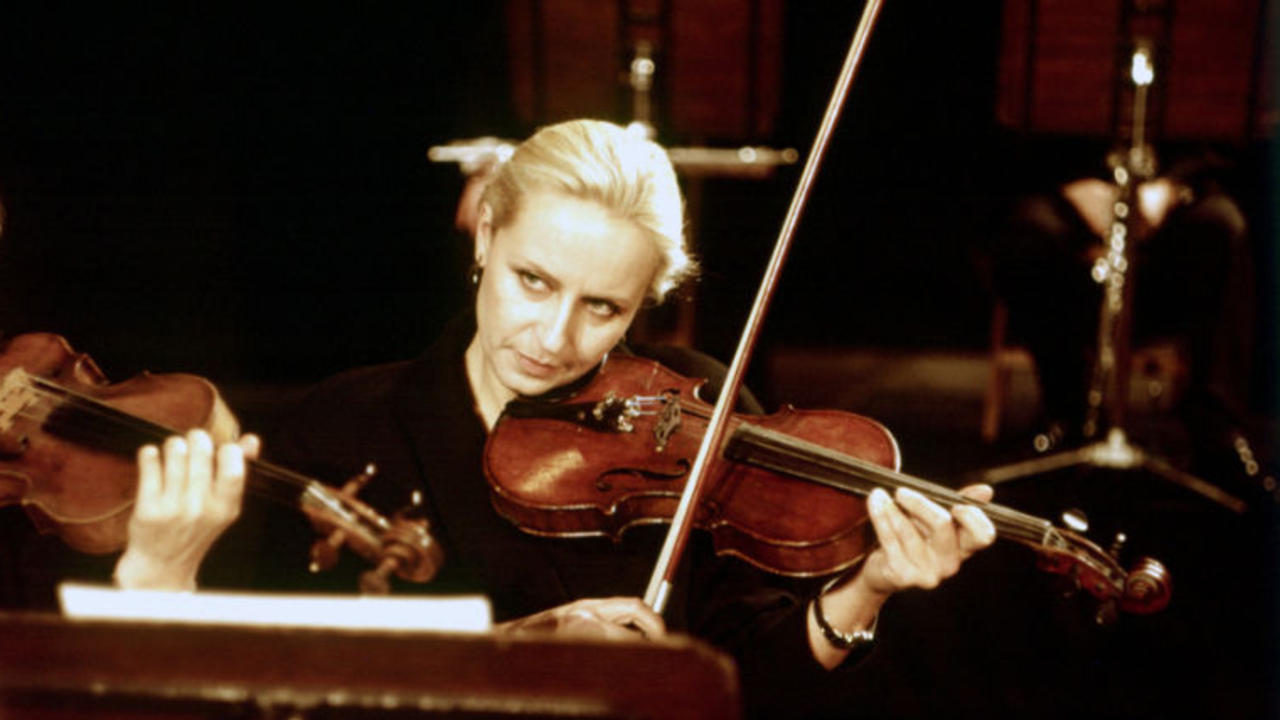
The brilliant final sequence begins with a shot of Dorota at her window. The camera is positioned below her, and as it gazes up, we feel the weight of her decision. The camera slowly descends, never cutting, down the building until it comes to the doctor’s window. He is lit in red, and the camera comes even with him. Here we enter into his mind – he has sacrificed his principles, effectively lying to Dorota so she wouldn’t have the abortion. The camera moves quickly to the right, and with a continuous motion with no evidence of a cut (thus connecting all three principles, showing their decisions are intertwined – this functions in a similar way to the apartment building through all ten episodes), we find ourselves in Andrei’s room. He awakens to see a fly struggling to climb out of a glass, which it does. We then cut to Dorota playing the violin with a faint smile, pleased that her husband has been healed. This leads to one final scene change to the doctor’s office, where he and Andrei meet. Andrei tells him that he has returned from a world that was disintegrating and ugly. It made him want to die. Yet now he has life, and his wife is going to have a baby. His question to the doctor is especially poignant: does he understand what it’s like to have a child? The doctor’s response is heartbreaking: with eyes downcast, a reflective gaze, and the look of tears coming to his eyes, he says simply, I do.

This is a tug of war between life and death. There is the tug going on within Andrei. It goes on between Dorota and the baby. It goes on between Dorota and the doctor. And in all these instances, life wins out. The doctor’s painful past reminds us that is not always the case, that death does have its day. But here, even as (and maybe because?) the doctor is forced to go against his conscience, life is the victor.

Scenes From a Marriage (1973)

Scenes From a Marriage chronicles the marriage of Johan (Erland Josephson) and Marianne (Liv Ullman), a couple happily married for ten years that sees their marriage disintegrate over the next decade. Over the course of the nearly six-hour miniseries, Bergman peels away the layers of this couple until we see them for who they are – profoundly imperfect human beings whose deepest desire is to love and be loved by another. They lie, manipulate each other, and put on masks to cover their true feelings. Yet as they move closer to divorce, that is all pushed aside in a raw and troubling climax.This is my eighth Bergman film, and while I am by no means done with his work, I finally feel like I’m getting a footing with him. Technically, the films are often simple, but expertly done, whether it be the placement of the camera, the abrupt change of scene, or the use of sound. Bergman uses all the elements to his advantage in evoking the kind of mood and feeling for which he is aiming. In terms of writing, he can tell simple stories that bring the viewers into dialogue with many of the great questions of human existence: What do we have to look forward to beyond the grave? What does it mean to be human? What is love, and can it be attained? How does overcome or live in the knowledge of their guilt? What does it mean to believe, and how can it be done? What is it that all people seek? Questions like these and others run all through his work. It is these elements that draw me to his work: a fascination with those kinds of questions and a desire to see artistic excellence on display.

And while Bergman’s answers are not always wholly satisfying, I still appreciate much of the tension he raises with his answers. We are confronted with this at the conclusion of Scenes from a Marriage. Both Johan and Marianne have suffered, come through the suffering, and have some heightened sense of themselves and who they are as individuals. They are then able to accept one another for who they are, as imperfect people who love imperfectly. There’s something about this that rings so true – it gets at the heart of what it means to love and be loved by another. We love in spite of our imperfections, and in spite of the imperfections of those who mean to love us. I am not confident I or anyone else in this world will ever attain the level of loving another truly in this life. We love in our imperfect ways, and those we love put up with our imperfections.

All this leads us back to a comment Marianne makes in the interview that begins the film. When asked to define love, Marianne hesitates, but then offers 1 Corinthians 13 as the pinnacle. Yet even then she recognizes that she cannot attain such a love, deciding that kindness, affection, tolerance, and a sense of humor can be combined to take the place of love. It’s no wonder that she and Johan couldn’t remain married. Neither of them were even pursuing the ideal, but had instead given up on it for something lesser. Yet even still, with maybe a supreme act of grace, they end up declaring their imperfect love for each other. This is a film about the terrifying death of a marriage, and its rebirth as something new and different.