Mutual Appreciation (2005)

Watching Andrew Bujalski’s most recent work, Mutual Appreciation, one almost gets the feeling they are watching home videos of some great friends. There’s a familiarity to the characters, borne out of a dedicated realism evident in Bujalski’s style. The writer/actor/director has little use for effects shots, impassioned diatribes, intricate sets, and big actorly moments. Instead, the film is built on the quiet, often mundane moments in the lives of its characters – people hanging out, going to a concert, having a beer, or baking cookies. Mutual Appreciation is shot in a soft black and white, always in a natural setting; in apartments it looks like these actors might actually be living in themselves.

This is not at all meant to be a turn off though. It’s just the opposite, in fact. For it’s in these simple moments that Bujalski is able to show us something about life and what it means to be human. The moments then take on a new meaning, pointing us toward thoughts about friendship, guilt, love, fear, and loyalty. Yet, it all just feels, well, so normal, which appears to be exactly what Bujalski is aiming for. He has a knack for getting these “normal” performances out of his actors. Scenes are filled with ums, misspoken words, goofy jokes, and awkward pauses. For many, these could be the kind of elements that add up to boredom. But for the attentive viewer, there is much to be revealed.

A scene later in the film helps to see this more clearly. Ellie (Rachel Clift) heads over to Alan’s (Justin Rice) apartment to get a CD, or so she says. Clearly she has schemed a way to drive him home. Inside, Ellie asks Alan what he thinks of Buddhism, just to get some kind of conversation started. The cramped room, so indicative of where a guy like Alan might live, is the perfect setting for such a moment. Ellie presses on, doing most of the talking, introducing the subject of her boyfriend Lawrence (Andrew Bujalski), and then quickly retreating, when she feels Alan not responding appropriately. Eventually, she gets down to it, and confesses her affection for Alan.

During the conversation, Bujalski often keeps both players in the shot – even his close-ups tend to keep the other person in the extreme foreground. But the edits aren’t typical of a scene like this. Normally, when someone speaks, the camera is on them. Bujalski is not so interested in this “rule”, instead leaving the camera mostly on Ellie, with shots of Alan interspersed that tend to be pretty short overall. This is Ellie’s scene. She initiates this conversation; she does most of the talking. But even at times when she is waiting for a response, Bujalski doesn’t shy away from shooting her face. We see her question herself, try to take back what she says, offer an openness and vulnerability to Alan, and she even reveals a kind of aggressiveness or determination (or maybe foolishness?) to get her feelings out in the open. All of this is available to us only because the camera sticks with Ellie so much – just by seeing her, paying close attention to her, we begin to get a sense of where she’s at in all this. But Bujalski is smart enough to trust the viewer, letting us make the connections instead of driving them home with perfunctory editing.

I like Bujalski’s films for a lot of reasons – the dialogue, his sense of humor, his taste in music, and the actors – but the trust in me as the viewer is maybe the biggest attraction. It’s inherent to his style, and as such, I look forward to Mutual Appreciation actually getting distributed in theaters, and/or released on DVD. I was able to see it only because Bujalski makes it available to us through his website, and because of the good graces of my wife, who got it for my birthday. How fortunate am I.

Saraband (2003)

Ingmar Bergman’s latest (and final?) film, Saraband, revisits the main characters from his earlier Scenes From a Marriage (1973). Marianne (Liv Ullmann) and Johan (Erland Josephson) are back, now with the addition of Johan’s son Henrik (Börje Ahlstedt), and his 19 year old daughter Karin (Julia Dufvenius). Marianne has gone to Johan’s wilderness hideaway to stay with him for a while. They haven’t been together in decades, but something spurs her to go anyway.The film is divided into ten dialogues, each involving two of the characters. And in typical Bergman fashion, we delve deep into their psyches, which in turn reveals the pain and anguish latent after many years of mistreating one another. Yet there’s another source of angst for Johan, Henrik, Karin, and eventually even Marianne – the recent death of Henrik’s wife (Karin’s mother) Anna. For those characters who knew her, she remains close to their hearts and thoughts. She constantly enters into the conversation, with everyone saying how much they miss her, what a great loss it was when she died, and how they each feel connected to her. Marianne never knew her, but as each of the characters introduces her to Anna, she comes to have her own sort of connection with her, illuminated for us in the film’s conclusion.

All of this leads to the features of Saraband that I most appreciate. First, the dialogue is a sharp and piercing as ever. Bergman has always been a keen observer of the human condition, and is especially proficient at writing dialogue that is both clear and thematically conscious. A couple of things come to mind here, beginning with a dialogue between Johan and Henrik, in which the father delivers words of such venom that they cut right through the heart of his son. He may be describing certain tendencies in his son accurately, but the years of selfishness have stripped their interaction of anything remotely approaching gentleness. In terms of theme, Bergman is able to weave in reflections about Anna that strike one as completely natural in the moment, yet use those comments as a whole to bring about a beautiful, puzzling, and strangely hopeful conclusion.

This presence of Anna adds an element of mystery and transcendence to the film, as it threatens to be sucked into the mire of selfish and bitter people. She is dead, yet she becomes a living, breathing human being through the memories of these tortured souls. Her life matters. It continues to make an impact on these people years later. For those who knew her, the change is slight. But for Marianne, the recipient of a miracle, the change is dramatic. This miraculous event happens so quietly and subtly that it may go unnoticed. All through the film, Marianne has emulated Anna, unconsciously, of course. Yet she’s patient, she listens, she aids, and she does what she can for each of them. The culmination of this is a return to her daughter, long since ill and far gone. That moment with Martha hints at Marianne’s transformation into saintly Anna. No doubt the similarity of their names is another indicator of this.

Saraband becomes, then, a film about selfish, wounded, and depraved people that has within it a strong and unmistakable glimmer of hope. Each of these characters has fond memories of Anna. They have some desire to see Anna again, presumably in another life beyond this one. Thus, there’s an implicit hope for them that there’s more to this life than, well, this. This isn’t all there is. People who write about Bergman tend to pick up on the bleak aspects of his work, and rightly so – it’s present here, and at times oppressive. Yet that isn’t all there is.

This is a touching film from a man who is leaving behind him body of work that will be revisited time and again. Saraband is a worthy entry into that canon, and as the final image of Anna’s picture faded from the screen, I couldn’t help but think what a hopeful image it was. Anna remains, even in death. If this is to be his final film, it marks a fitting conclusion to the career of one of the most important filmmakers ever to grace the screens with his work.

Favorites of 2005

2005 has been a year of changes for me – most significantly, the birth of my son, who has pretty much rearranged all my priorities. I now am less able to get to the theater, which means I see less that’s current. That results in a pretty minuscule list. Yet (and this is one of the other changes), I was noticing that even before he was born, my wife and I were less interested in the theater anyway, and not because I don’t like the theater. I list watching a film in a crowded theater as one of the more pleasurable activities in life.

Instead, as I reflected on our reasons for avoiding the theater, I hit on a single thing that dampened our enthusiasm: the dearth of interesting options available to us here in Dallas. First, neither of us gets too enthusiastic about big blockbuster, epic kind of films any more. Neither are we generally interested in the weekly horror, action, or comedy offering. Thus, we tend to seek out more complex fare. Let me illustrate our problem: in the city limits, we have three “arthouse” theaters (two Landmark, one Angelika). Currently, one of the Landmark theaters is screening Narnia on two of its screens, with The Producers on the third. The other has Brokeback Mountain on three, Capote on one, and Good Night, and Good Luck on one. I cannot see how any of these films justify Landmark’s little opening, played before every film (“The language of film is universal”). Rather, it appears the language of film is English. The Angelika is not faring much better, currently showing the likes of Munich, Casanova, Pride & Prejudice, and Match Point, all of which can be found at the local megaplex (which is not to say any of these films isn’t necessarily worthy). But where’s the unique programming? What about traveling retrospectives, classics, smaller films, or a steady diet of important contemporary international film? These are too few in such a big and diverse metropolitan area.

All of which leads to my year end list. It’s going to be shorter than in years past, reflecting the fewer number of films I’ve seen. But I note it includes three heavily dramatic pieces (1, 3, and 6), along with four films that have a strong comedic sensibility (2, 4, and 5). Finally, to compensate for the shorter list, I’d like to offer a list of older films I’ve seen for the first time, all of which surpass virtually everything new I’ve seen this year. The rankings in both lists are not meant to reflect quality, or which film is “better” than another, but rather, which films I am most looking forward to revisiting and spending some quality time with.

2005 Favorites:
1. Saraband: Bergman’s final (?) film, and easily the best thing I’ve seen this year, a sequel to his earlier Scenes From a Marriage. I was struck by two things: First, Bergman’s attention to emotional detail. Second, the surprisingly hopeful and brilliant ending. It both ties the rest of the film together thematically, and provides some basis on which to go forward. Beautifully done.
2. Funny Ha Ha and Mutual Appreciation: Funny Ha Ha, like Saraband, is actually a couple of years old, but received a theatrical release just this past year. Writer/Director Andrew Bujalski injects his film about an aimless 23 year old college graduate with humor, dramatic conflict, and a kind of pathos that really is endearing. The latter film is actually Bujalski’s effort from this past year. Shot in b&w with the same intimacy as his previous effort, Mutual Appreciation builds on the earlier work in humor, characterization, and his excellent taste in music.
3. The New World: Malick’s creation is one of my favorites from this year. It has all of the lyrical quality I’ve come to expect from him, but this one offers a subtle critique of the Eden presented early in the film. It’s almost as if the film grows from adolescent to adult before our eyes.
4. Look at Me: Co-Writer/Director/Star Agnès Jaoui has improved upon her debut, The Taste of Others. She has a way of taking a pretty standard story and giving it great dialogue, an emotional core, and the subtlest of pointers toward what might be a better way of being.
5. Howl’s Moving Castle: Miyazaki’s glorious film, which is visually so inventive and interesting that I can’t help but include it here. And yet another heroine for us to connect with.
6. Capote: Subtle and conflicted, with a standout performance by Phillip Seymour Hoffmann, long a favorite of mine. The rest of the acting is top-notch, and I especially appreciate director Bennett Miller’s willingness to give the film a more meditative quality.

Other 2005 Films I Enjoyed: Up and Down; Broken Flowers; 2046; Good Night, And Good Luck

Still to See: L’Enfant, Caché, Trilogy: The Weeping Meadow, The Best of Youth, The Wayward Cloud, The Death of Mr. Lazarescu, Tristram Shandy, Hell, Hawaii Oslo, Tony Takatani, The World, Grizzly Man, The White Diamond, Duma, 3-Iron, Me and You and Everyone We Know, L’Intrus, The Squid and the Whale, Wallace and Gromit, A History of Violence, Syriana, Munich…

Older Films I Loved:
15. Close-Up (1990): Kiarostami’s half drama, half documentary. The interplay here between truth and reality was fascinating, though the director wisely keeps us connected with the central character.
14. More Miyazaki [Nausicaä (1984)/Porco Rosso (1992)]: I finally caught up with these older works of my favorite animator. I loved in ingenuity of Nausicaa, and the central characters in Porco Rosso.
13. The Flowers of St. Francis (1950): Beautiful, strange, funny, and heartfelt. Simple faith on display.
12. All or Nothing (2002): Mike Leigh at his best, intimate family drama. Wonderful stuff.
11. Sanjuro (1962): Maybe the funniest Kurosawa film I’ve seen, not to mention clever, and Mifune at the height of his powers.
10. The Searchers (1956): John Ford and John Wayne, maybe the best Western I’ve ever seen.
9. The films of the Dardennes [La Promesse (1996)/Rosetta (1999)]: Caught up with some of their earlier work, which is wonderfully rewarding, especially Rosetta. I’m still waiting for a chance to see their newest effort, L’Enfant.
8. Time of the Wolf (2004): Disturbing, (mostly) restrained apocalyptic vision from director Michael Haneke.
7. A Renewal of My Appreciation for Alfred Hitchcock [The Wrong Man (1956)/The Birds (1963)/The 39 Steps (1935)]: Caught a few of his films this year, and these were all wonderful. I’m learning to love the power of suggesting inherent in his films.
6. More Ingmar Bergman [Fanny and Alexander (1982)/The Virgin Spring (1960)/Scenes from a Marriage (1973)/Persona (1967)]: I especially connected with the first couple here, though I appreciate all of them on different levels.
5. Stalker (1979): Having seen most of Tarkovsky’s work once, this is the one I connected with most on a first viewing. I was mesmerized all the way through. The rest of his work is in need of another go around.
4. The Films of Tsai Ming-liang [Rebels of the Neon God (1992)/What Time is it There? (2000)/The Skywalk is Gone (2002)/Goodbye Dragon Inn (2003)]: I’m guessing Tsai’s films are going to become even more significant for me in the years to come. The meditative pace is refreshing, and Tsai seems to have his finger on where modern society is or is headed. Looking forward to seeing his other stuff – Vive L’Amour is next.
3. The Apu Trilogy [Pather Panchali (1955)/Aparajito (1957)/The World of Apu (1959)]: Beautiful series of films from the late Satyajit Ray following the life of Apu, from boyhood, through adolescence, to adulthood. Sensitive, moving stuff.
2. Late Spring (1949): Just saw this film from Japanese director Yasujiro Ozu. It’s such a beautiful portrayal of family, getting older, and post-WWII life in Japan. The complexity of the emotional content snuck up on me as I neared the end. Wonderful.
1. Werckmeister Harmonies (2000): This is another of those disturbing apocalyptic visions, but is filmed in stunning black and white. The music sets the tone for what really amounts to film as poetry for director Bela Tarr. It’s enigmatic, troubling, and wondrous. One of the best films I’ve seen in the last several years.

Other Older Films I Enjoyed (in no particular order): The Twilight Samurai (2002); The Adventures of Prince Achmed (1926); Gertrud (1964); The Great Dictator (1940); Cool Hand Luke (1967); Buffalo ’66 (1998); Control Room (2004); The Lost Weekend (1945); Dersu Uzala (1974); Days of Heaven (1978); Open City (1946); At Five in the Afternoon (2003); The Elephant Man (1980); Crimes and Misdemeanors (1989); Sansho the Bailiff (1954); Metropolitan (1990); The Celebration (1998), Born Into Brothels (2004), Intimate Strangers (2004)
Funny Ha Ha (2003)

Language is a funny thing. Take that word “funny”. No doubt when most people read the title, they will think “comedy”. But the film also includes elements which are funny as in strange, or funny as in uncomfortable. The language here is no doubt purposefully chosen, in part to show that this film denies genre conventions. It aims instead for something more organic, and in doing so, hopefully more truthful. Having said all that, writer/director/co-star Andrew Bujalski has crafted one of the more interesting films to cross my way in some time. In its opening moments, 23 year-old college graduate Marnie (Kate Dollenmayer) is looking to get a tattoo. The scene is a perfect beginning to the film. It sets the tone, as Marnie has no idea what she wants, and when she does finally make a decision through a drunken haze, it turns out to be a poor one. The film repeats these rhythms, as Marnie stumbles through life, without a clue of what to do, and making bad decisions right and left. Some of those decisions are comical, some are uncomfortable, and still others are off the wall.

Maybe that description doesn’t sound endearing, but the reason the film works is that Dollenmayer and Bujalski combine to make Marnie a person who earns our empathy. Sure, some of her actions induce anger, but we never lose sight of a delicacy or fragility she carries with her. Her poor decisions, usually with men, leave scars. And it’s not just that we feel sorry for her. Marnie takes the time to help people out, whether it be hanging out with lonely Mitchell, or giving Liz a place to crash for the night.

All of this is done with such a light touch, in such an endearing way, that it’s hard not to admire the film. Bujalski also seems committed to a healthy realism that marks the film off stylistically from most of what’s out at the megaplex. Several times, and especially after the film’s final scene, I was reminded of the Dardennes, with their own penchant for realism and the unique rhythm to their storytelling. Except Bujalski’s film is funny. In Funny Ha Ha, Bujalski offers something that’s becoming increasingly rare at the cinema these days – a film that defies simple classification and provides a unique film watching experience. I’m looking forward to seeing where he goes from here.

Vera Drake (2004)

Mike Leigh’s most recent effort, Vera Drake, is probably best known as “that movie about an abortionist.” It is that, I suppose, though it strikes me as something much more subtle, complex, and interesting. The film has been criticized on both sides of the debate, either for being another in a long line of liberal propaganda pieces, or as a missed opportunity for a pro-choice director to get the message out in a strong and effective manner. Rather, Vera Drake presents for us a study in human nature, depicting what human beings might do or how human beings might be, in and around a contentious situation like abortion. It brings humanity to the issue, a much-needed respite for those of us tired of the incessant back and forth.Briefly, the film’s first half follows its title character through the ins and outs of her daily life. As is more than once noted by her observers in the film, “Vera has a heart of gold.” In addition to her job cleaning houses for the rich, Vera, whose family is poor, makes a point to check in on an infirm neighbor every day, while his wife is at work. She also takes care of her ailing (and unappreciative) mother, serves her family with joy, and invites a lonely young man from the neighborhood to dinner. Yet alongside all these simple tasks, Vera also, in her words, “helps girls out.” The film’s second half relates the conflict that comes into the lives of Vera and her family as a result of her clandestine activities.

Through all of it, Leigh keeps us focused on the characters, on their simple words and actions. This attention to characterization keeps the film from devolving into an “issue” movie, sermonizing about the evils or benefits of abortion [Contrast that with the recent critical darling Crash, which cannot step away from its issue long enough to get to know its characters]. Because of Leigh’s discipline on this front, it makes formulating a response to the politics of this film a difficult one. That is the biggest reason why it works though. This film cannot be boiled down to a “propaganda piece” or a “missed opportunity.” The issue itself resides in ambiguity within the actions, situations, and hearts of these people. I am reminded of a comment by the ethics professor in Decalogue VIII, as she guides her students to think about an ethical situation in terms of characters and motivations: “What makes it interesting is that we both know prototypes. I think, however, that they are not people we know.” In other words, we need to know people more than issues. This, I think, is where Leigh takes us.

Vera Drake then, is primarily about its characters, and as such, invites us to empathize with their plight, whether they might be responsible for the conflict in their lives (Vera and the girls in need of abortions) or not (Vera’s family). In the case of Vera and the girls she helps, the issue of responsibility is complex. What role does society play, both in the way the justice system works as well as in the double standard that exists for the rich and poor? What about those girls like Susan, raped and forced into such a difficult situation?

These are difficult questions. However, in focusing on the people, Leigh allows us space to consider the questions. He keeps them in tension. How would we answer them in the face of real human beings suffering through such an experience? Everyone here suffers – from the girls getting abortions, to Vera, to her family. Leigh allows the questions to simmer under the surface, refusing to offer easy answers for us. This invites the viewer to engage the film, to engage its characters, and then finally, to engage the issue. But note – the issue cannot be addressed until the people have been sufficiently seen and heard. And it seems to me, because of Leigh’s balanced portrayal, the judgment about the issue is ours to make. Just because the film lacks an explicit pro-choice statement doesn’t mean it favors a particular side of the debate. Likewise, just because the film empathizes with its central character and her plight doesn’t leave the film in the pro-choice camp.

Leigh is too smart for all that. He offers a chilling portrayal of several abortions, with women scared, crying, and distraught. One falls ill. Vera even seems to have brief moments of consideration about what she’s doing. On the flip side, Leigh offers empathy for Vera (and her family), something it seems any of us should be willing to offer any person in need. This refusal to pass judgment on his characters, as well as empathy for everyone, is part of what makes Leigh’s film (and his work in general) so stimulating.

Winter Light (1962)

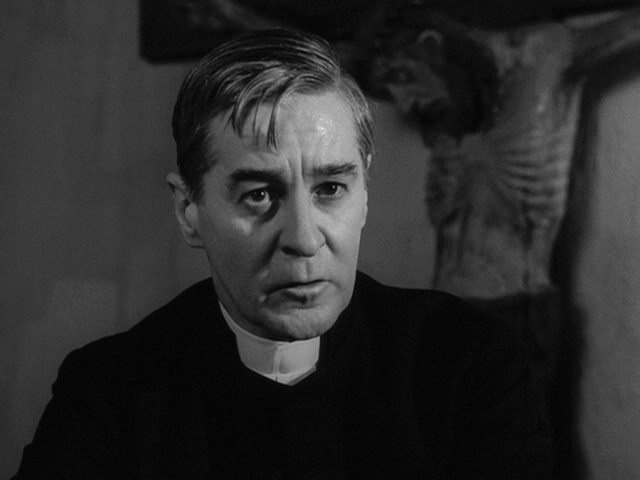
The second of Bergman’s “Faith Trilogy,” Winter Light has always been my favorite. Seeing it again last week (though for the first time with an audience), rekindled and deepened my appreciation and love for the film.As I’ve said about Bergman before, what I most appreciate about him is how he frames the big questions of life. I’m not always excited about where he ends up, but the questions take on such a great significance in his films, and they are asked so precisely, with such a keen attention to detail, that I can’t help but appreciate what he’s doing.

This is especially so in Winter Light, during which Pastor Tomas (Gunnar Björnstrand) doubts his faith, and about halfway through the film, “frees” himself from it, adopting an atheism that he asserts “makes sense” of everything. You see, Tomas is overwhelmed with the randomness of existence, not understanding why his wife has been taken from him (she died several years earlier). So he adopts an atheism which embraces the randomness and meaninglessness of life. Nothing really matters, he doesn’t have to care for anyone, and now he can go about his business without the weight of having to make sense of everything because there’s some orderly God in heaven running this world.

Yet on this viewing, I note three specific things that happen after Tomas declares his freedom – three things that call his decision into question. First, he makes his atheistic declaration during one of the more beautiful shots of the film, in front of a large window with the sun shining through it. As Tomas has just made his decision to leave his faith behind, he steps in front of the light, briefly blocking it from our view. Yet almost as soon as he does this, he is forced to the ground by a coughing fit. The light shines back through.

Second, later in the schoolroom with Märta (Ingrid Thulin), Tomas again asserts that he cares about nothing. Märta, a professing atheist, seems strangely troubled by all this. This is one of those places where Bergman’s questions are so rigorously framed. In light of Tomas’ embrace of the meaningless, Märta sees right through him, and asks a stinging question (though the question pains Tomas, she delivers it with a gentle grace). “The question, paraphrased here: “Did you love your wife?” Tomas, repelled by the suggestion he didn’t love her, fires back quickly and forcefully that he did. Clearly there is to be no discussion on this point. Yet Märta has seen the inconsistency in his embrace of the meaningless: His newfound atheism asserts a meaningless existence, yet there is still evidence of meaning in his heart even then. He cannot escape the light that pursues him.

Finally, we go backwards just a bit to the scene when Tomas waits with the body of Jonas (Max von Sydow). This scene stands out from the rest in a very peculiar way – its volume. This is the film’s loudest moment, so much so that we cannot even hear the characters speak to one another. The noise, of course, comes from the rushing river in the background. Tomas has already declared his newfound atheism, yet at this crucial moment, we (and presumably he) cannot think of anything but the raging river in the background.

In the final scene of the movie, Tomas begins the service with the quotation of Isaiah 6:3: “Holy, holy, holy is the Lord Almighty; the whole earth is full of his glory.” This particular passage speaks directly to that earlier scene near the river. Just after Tomas has made his atheistic declaration, the first time he leaves the church, he ends up at the side of a raging river, which according to this verse in Isaiah, declares the glory of God. He cannot escape the light that pursues him. This is evident in the final scene at the church at Frostnäs, which is filled with light of all kinds – electricity, the sun, lit candles. Bergman seems to emphasize the light in this scene, offering a close-up of the candles, having the sun shine through the window as Märta prays, lighting Märta’s face after she prays, and then by having Algot make such a big deal about the electric lights. While Tomas’ final words may be uttered in ambiguous fashion, there is doubt that the light continues to surround him.

Goodbye, Dragon Inn (2003)

Stop and listen: a ticking clock, a passing car, a siren off in the distance, the dull rumble of the refrigerator, your heart pounding in your ears. Our world is full of sounds that we never hear or think about, mostly because we won’t take the above advice. Watching a Tsai Ming-liang film, especially Goodbye Dragon Inn, is an exercise in this discipline. Virtually every individual shot is from a non-moving camera, has a wide vision, and lasts at least 1-2 minutes, often longer. Yet instead of getting antsy, I find comfort in these shots. This aspect of his films is very much a respite for me, where I am forced to stop and really listen.The first line of dialogue (outside of a film playing in the background) in Goodbye Dragon Inn occurs at about the 40 minute mark. At that point, I had pretty much decided there wouldn’t be any talking. And yet, without human voices filling the space, sounds are everywhere, from water dripping to solitary footsteps to a film playing in a movie theater.

The theater where it all takes place is alive with activity, both human and otherwise. People come there for any number of reasons, and often their motives aren’t quite clear. It doesn’t ever seem to be as simple as: there’s a movie playing that they want to see. Their interactions with others are rarely “normal” and reveal anything from discomfort and bewilderment to sexual attraction and friendship. In these ways, the theater takes on a sort of religious significance: the people file in to a large and “living” building, looking to have a common experience with something other than or removed from their experience, and trying to make connection with others. So this theater really becomes a character in the film. It facilitates any number of varied experiences for those who come.

The film really came alive for me near the end, with a still shot of the theater taken from in front of the screen. The movie playing at the theater has ended, and the ticket woman enters from the side door to clean. With the camera still, looking up at the seats, she slowly walks through the theater gathering trash. She eventually steps out of the shot and still the camera runs for at least another minute, probably more. As I sat, staring at the empty theater, now lit up for cleaning, it seemed that all the mystery and magic of the darkened room with the flickering images had disappeared. Instead, we were left with a plain and rather non-descript auditorium.

And then it hit me. It isn’t the theater by itself that makes magic. It is the people in it. We spend the entire run time of this film watching people watch another film, as they drift in and out of the theater. Sometimes when we watch a film, we get caught up in the images on the screen, as they move us and make us feel connected to something other than ourselves. Yet that’s only a small part of our human experience. Eventually the film ends, and we slowly drift back into the mundane reality of our lives. It is here that we seek the deepest connection, and as per the three Tsai films I have seen, where it is most difficult to find. People in Goodbye Dragon Inn go about seeking that connection in all sorts of ways, and all of them fail. Yet in spite of that, Tsai leaves us with a final sequence that I cannot help but read hopefully, as two characters continue to make the effort to connect. Maybe it will work out, maybe not. But at least they’re trying.

Rosetta (1999)

Having seen two of the three most recent Dardenne efforts (2002’s The Son and 1996’s La Promesse), I figured I was prepared for their style. Handheld camera. Close-ups. Following behind characters, without being able to see their faces. What I was not prepared for was the relentless energy that this style can bring to the table. Maybe I just missed it in their other films, but Rosetta (1999) has a much greater immediacy to it than their other work. This, I think, is accomplished in two ways: First, editing. Second, Rosetta, the main character.

The opening scene is a great combination of these two factors. As Rosetta storms down hallways and stairwells on her way to who knows where in some non-descript, fluorescent building, the camera strains to keep up. When she goes through a doorway, sometimes the camera follows. At other times, it cuts ahead, almost as if to say that it couldn’t keep up, and if it wouldn’t be too much trouble, could they start again. These cuts are immediate, yet the individual shots have continuity to them, in that they continue with her journey through the building. Eventually, as the scene concludes with a confrontation with co-workers, the quick cuts, shaky camera, and extreme close-ups lend a sense of chaos that is appropriate to the character. And while this chaos is not always explicit through the rest of the film, it is always implicit, and through various circumstances, we receive hints about the kind of chaos that must be going on inside Rosetta as she tries to scrape by in life.

She has job troubles, family troubles, and friendship troubles, and has little going for her outside of sheer determination to make something happen for herself. An early scene makes this apparent, as she confronts her mother about some fish she is preparing for dinner. Mom acknowledges that the fish was given to her, which 18-year old Rosetta finds unacceptable. “We aren’t beggars!” she yells at her mother, all the while trying to wrest the fish from her to throw it in the garbage. Rosetta will make it on her own initiative, through her iron will and fierce work ethic. Every time she is offered help, she refuses. She asks for it only once, by my count, and it comes at a particularly low moment for her, when she asks her friend, Riquet, for boots.

This determination and perseverance in her character also reveal themselves in other ways. With the desire for a normal life, yet being surrounded by chaos, Rosetta builds a routine into her life. This includes a hiding place for her boots, her fish traps, and maybe even the waffle stand. She visits these places repeatedly, going through the same motions. These things have a practical purpose, but their placement in the film is at such odds with the hectic pace of the rest of her life that they are almost like touchstones, both for her and for us – finally, something familiar and expected. We know what she is doing with the boots and the traps. We know why she goes to the waffle stand (looking for work).

Yet even with all this structure she tries to build in, and though she finally gets the job, she does not achieve a normal life, at least not like what she had in mind. Even with getting what she wants, she is still confronted with the problems that plague her life, and that cannot be healed with a steady job. All of which leads to the affecting conclusion, where Rosetta’s will reaches its limit. She tries and tries and tries to carry the burden of her life alone, but she cannot. The brilliance of this scene by the Dardenne’s is in being able to illustrate this physically, as Rosetta attempts to get that canister home. As she plods through the RV park, we feel the weight of her burden, yet we cannot do anything to help her. And the only person around, Riquet (on his motorbike, with a use of sound in this scene to create a troubling tension), seems only to want to heap burning coals on her head in judgment. She finally falters, falling to the ground in tears and defeat. She has nothing left. Yet, at her lowest point, there is hope. And in those final few frames, we are treated to a wonderful picture of love and hope. And we have a moment to realize what is happening before the camera cuts away and the credits roll. An abrupt but deeply moving finale – sometimes you can’t make it on your own.

What Time Is It There? (2001)

The film opens with a medium shot inside a small home, which could be mistaken for a photograph were it not for an old man slowly moving up and down the hallway between his dining room, his kitchen, and his son’s bedroom. He has prepared a meal, and as it sits hot on the table, he calls out for his son, presumably to come and eat. He receives no answer, so he moves beyond the kitchen, onto the patio, and after moving a plant, he gazes out beyond the house.Next comes an immediate cut to his son, Hsaio-kang (Lee Kang-sheng) holding an urn, on his way to bury his father’s ashes. The cut between these two scenes is abrupt, creating a jarring sense of disillusionment that serves this moment of vulnerability well. The father’s gaze has gone unmet, and in this single cut, already there is a palpable sense of loss and guilt over things unsaid. The meaning is created through these scenes occurring one right after the other. Nothing much happens in either scene, yet when brought into contact with one another, the significance of each begins to become apparent.

What Time Is It There?, by director Tsai Ming-Liang is full of these strange juxtapositions, as the edits between scenes create both discontinuity and synchronicity. The scenes themselves contain little dialogue (and sometimes none at all). Often, not much of consequence seems to occur in any single scene. The acting is mostly nondescript, with the character of Mother (Lu Yi-Ching) getting the most opportunity to emote. All of this reminds me of the Bresson films I have seen, especially Au hasard Balthazar.

The story itself is rather simple. After Hsaio-kang’s father dies, he meets a woman, Shiang-chyi (Chen Shiang-chyi) while selling watches as a street vendor. She wants to buy his own watch, which he eventually agrees to, and then she treks off to Paris. Yet in his fragile state, his memory of her is strong, and he finds himself thinking about her quite often. He starts trying to track down French films, and eventually begins resetting clocks he sees to Paris time. She too longs for connection, sitting in a crowded French café alone, listening to her upstairs neighbors walk through their apartment, and so on. Hsaio-kang’s mother also suffers from loneliness, wanting nothing more than to welcome her husband home in his reincarnated body. This film is about going on a journey with these people in exploring certain aspects of the human experience. It is a glorious and beautiful trip, that concludes with a scene of such simplicity and beauty that I find deeply affecting, even if I am not sure what it all means.

A couple of other observations: After the first couple of scenes, as I settled in for long static shots, with little movement and dialogue, I was pleasantly surprised by the liberal use of comedy throughout the film. Often, comedic scenes involve characters going in one direction and for some reason, immediately turning around and going back the way they came. Hsaio-kang creeping into his hallway, or Shiang-chyi following a stranger on her way home come to mind as examples of this.

Second, it seems Tsai is especially concerned with the bodies and the physicality of his characters. It often feels as if the shot is pushing us to look closely at the actors. The nondescript acting and static shots no doubt encourage this phenomenon. I think here of Shiang-chyi’s brief friendship with the woman in Paris (Cecilia Yip). In one scene, Shiang-chyi simply looks at this woman as she moves ever closer to her. Yet the camera is firmly on Shiang-chyi’s face, and we are invited to look at her, to invest some thought and imagination as to what she might be thinking and feeling at that moment. This is a kind of filmmaking that challenges the viewer to engage what they see on the screen. I look forward to seeing more of Tsai’s films.

The Adventures of Prince Achmed (1926)

I heard about this a few months back, and thought it might be an interesting movie to experiment with. Its claim to fame is that it is the first feature length animated film. It was made in Germany in 1926, directed by a woman, Lotte Reiniger, and tells a tale loosely based on a story in Arabian Nights. Of course, being from the mid-20’s, the film is silent, with musical accompaniment and title cards, but if there ever was a film created for visuals, this might be it.The animation is beautifully rendered with cutouts. Each scene is meticulously formed by laying these cutouts on a lit and tinted glass. Then the characters are placed within the scene, and much like stop motion animation in films like Wallace and Gromit and Tim Burton’s Corpse Bride, they are shot, then moved, then shot, then moved. The characters all have movable limbs, mouths, fingers, etc. The animals are movable as well. But the effect of these figures on the tinted glass is quite stunning, and must have been quite alien to the movie-going public of Germany. I was shocked at the level of detail that went into each scene. The film is full of beautiful and intricate designs.

The story follows Prince Achmed, who is given a magic, flying horse by a magician trying to woo the Prince’s sister. Because Achmed has no experience with such a creature, it flies and flies before he can figure out how to control it. By this time, he lands on some sort of magical island filled with women. While here, he meets his love, who is being held captive on the island by demonic creatures. He eventually takes her with him, and now pursued by the demons and the magician (who had no luck with the King’s daughter), Achmed must fight them off, keep hold of his love, and somehow make it back to his kingdom. Along the way he meets strange creatures, witches, and even Aladdin (pictured above). It all adds up to an enjoyable film presented in unique and beautiful fashion.