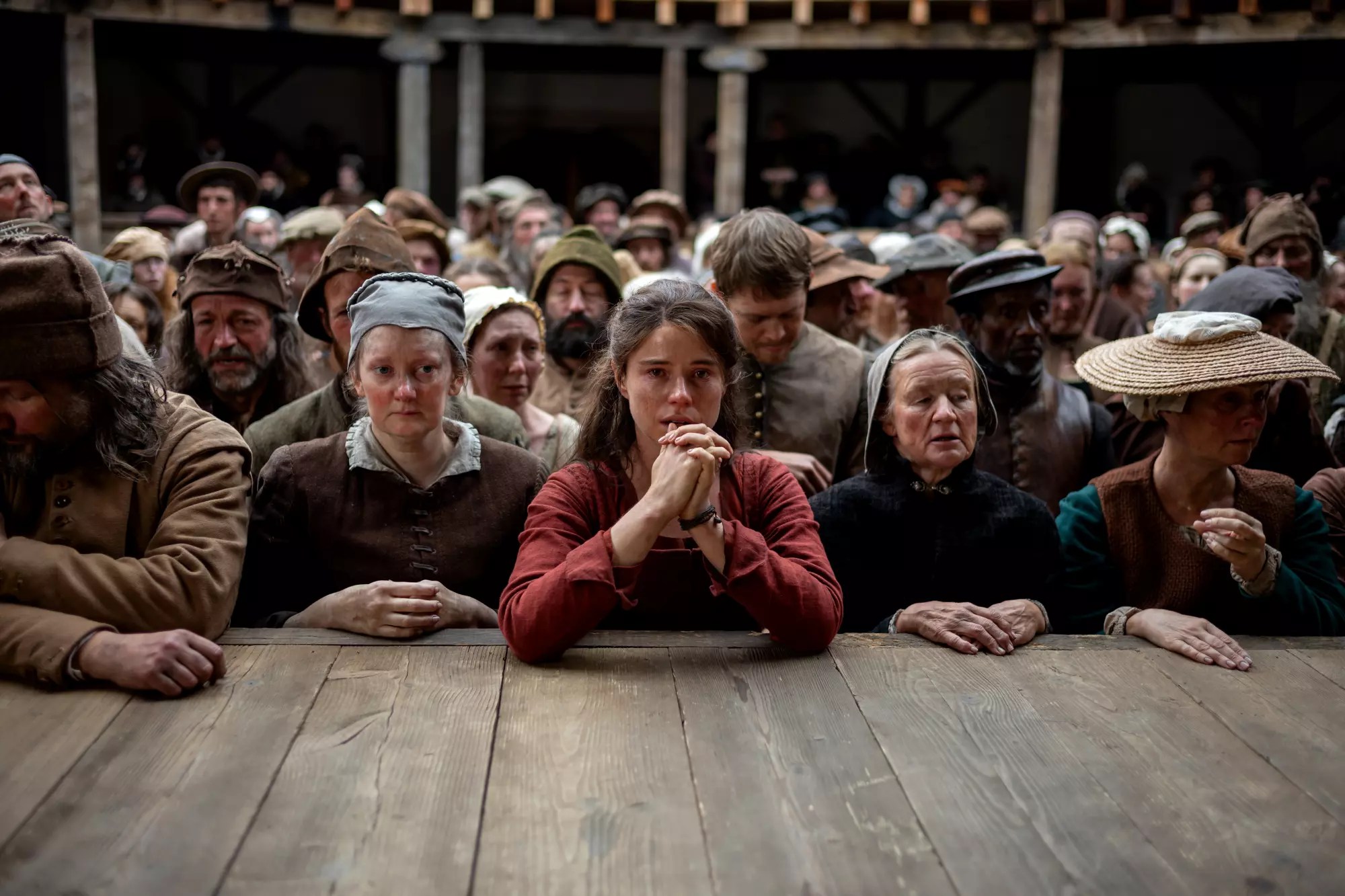
The best works of art point beyond themselves, drawing us into the conversation over the great mysteries of human existence such as life and desire, death and reconciliation. Chloe Zhao’s HAMNET, based on the novel of the same name, is the fictional telling of about a decade in William Shakespeare’s life that includes his courtship of and marriage to Agnes, the birth of their three children, and the tragedy that precedes the production of arguably his most famous play, Hamlet.
The film operates in something of a mythic space from its earliest moments, the quirky and mysterious Agnes curled up in line with a curving tree root. As Agnes walks and works in the forest, she returns regularly to a gnarled and expansive tree, as Zhao highlights a deep void that sits under one side of it. As this void hints at the grave, Zhao’s images remind us that in this life, all our living and growing exists alongside the real threat that all things will turn dark and we will be faced with whatever is beyond that void.
And yet, the first hour or so of Zhao’s film is filled with the joys of new love, marriage, and birthing children. As Shakespeare’s family grows, and love and life grow, so too does the potential to encounter the void. Zhao skillfully keeps this fact of death in the picture, never absent from our thoughts, even in the good times.
Something changes about the way one lives one’s life when our collective mortality is on the table. I think often of something David Foster Wallace wrote in his essay “Fictional Futures and the Conspicuously Young,”
“I claim that the fact that we are strongly encouraged to identify with characters for whom death is not a significant creative possibility has real costs. We the audience, and individual you over there and me right here, lose any sense of eschatology, thus of teleology, and live in a moment that is, paradoxically, both emptied of intrinsic meaning or end and quite literally eternal. If we’re the only animals who know in advance we’re going to die, we’re also probably the only animals who would submit so cheerfully to the sustained denial of this undeniable and very important truth. The danger is that, as entertainment’s denials of the truth get even more effective and pervasive and seductive, we will eventually forget what they’re denials of. This is scary. Because it seems transparent to me that, if we forget how to die, we’re going to forget how to live.”
One of the strengths of Zhao’s film, it seems to me, is its refusal to “submit so cheerfully to the sustained denial” that we are all subject to death and thus are all going to die. In this, it stands in the tradition of the great tragedies of western literature, including Shakespeare’s aforementioned Hamlet. HAMNET’s refusal to deny the reality of death to its characters—I think also of the brief scene in which Shakespeare’s mother, Mary (played brilliantly by Emily Watson) recounts the stories of her own lost children—creates a meaningful space in which they (and, by extension, we) can consider how to live.
The film’s final act, in which Hamlet is staged for the first time, draws its themes of life and death, brokenness and reconciliation, blindness and seeing, together in a striking portrait of continuing to live in the midst of tragic circumstances. HAMNET reveals to us that it is precisely in our vulnerability as creatures (subject to death as we are) that we can begin to see the world outside ourselves and to appreciate those interconnected roots/lives that feed and nourish us. In the end, for Agnes and William, the fact of death remains, even as the mysterious gift of life revealed in (literally) reaching beyond themselves continues to sustain.
 Gladsome Morning