The Conversation (1974)

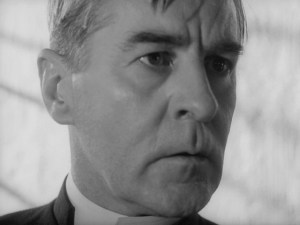
Francis Ford Coppola is best known for the Godfather films, but between the first and second installment, he made a small, intimate film called The Conversation. Starring Gene Hackman in a brilliant, understated performance, the film traces a few days in the life of a surveillance expert, Harry Caul. He has recently taped an innocuous conversation between a man and a married woman—probably a case of adultery. But it doesn’t rise above cheap detective work, and clearly Caul’s capabilities for listening to under-the-breath dialogue put him in a class above an average private investigator. When an initial drop of the tape goes badly, Caul begins to think more about the contents of the recording, leading him to question everything he thought he knew.

The Conversation turns out to be a compelling thriller. Coppola’s sound design makes the greatest impact, as snippets of the original conversation find their way into Caul’s memory, and therefore the film, at various moments through the film. Not only do these snippets serve to inform Caul’s psychological state, but they also begin to take on new meaning, shattering like glass throughout every corner of the film, ultimately redirecting the narrative as Caul’s knowledge of the conversation solidifies.

But what is most interesting about the film is the way Caul’s increasingly fragile psychological state mirrors the cultural context of the last century or so. With the continued advancement of technology, we have grown ever more reliant on it for our knowledge and experience of the world. We don’t have conversations the same way we used to. We now have them mediated for us through various media, thus coming to rely ever more on the individual piece of technology for our experience of reality, relationships, and community.

So, while Caul initially believes in his methods, and uses the most sophisticated tools of the day to listen in to the conversation, he finds that simply an accurate recording of the conversation does not yield him the full truth of the situation. Listening to voices through a box only gives him a limited amount of information. He thinks he knows the truth. But when he listens again, the meaning seems to morph. And again. And again. And again. This leads to Caul feeling increasingly disoriented about what he does and doesn’t know. And that disorientation leaves him unmoored from any meaningful community—even though he “listens” better than anyone around.

In our contemporary cultural context, the disintegration of Caul reminds us of the great irony of a common term: the word “connected.” It means that through the various means of technology available to us, we are able to communicate at any time and any place. We can hear them and they can hear us, therefore we have a greater attachment to them. But instead of actually feeling and being connected at a real and fully human level, people have too often fallen into the trap of allowing the tools of technology to be the primary means of relating to one another. That yields a situation in which people become ever more alone and isolated, cut off from the beauty and spontaneity of true and life-giving human community.

Even 35 years later, The Conversation serves as a strikingly contemporary cautionary tale. It reminds us that though the modern world promises that through technology we will come upon an increased connection with and a clearer vision of one another, we must recognize that ultimately, these sources are fatally flawed—we must look elsewhere for truth, for knowledge, and for true community.
The Dark Knight (2008)

The Dark Knight has raked in obscene amounts of money this summer, becoming the most popular movie released in recent years. Capitalizing on the more modest success of its precursor, Batman Begins, the sequel engages the viewer with a terrifying and senseless villain for Batman to tangle with—the Joker.

With an overly-complex plot involving at least five or six different storylines, the ongoing battle between the Joker and Batman sits as the centerpiece of the film. While Batman attempts to pass the baton of crime-fighting on to Harvey Dent, the Joker wants nothing more than to unmask the caped crusader. And the Joker makes clear early on that he will stop at nothing—not destruction of property, not kidnapping, and not even loss of life—to achieve his goal. The violence and destruction that come as a result take on increasingly senseless proportions, given his desired outcome. Using crude and simple technological elements, he exists solely to create chaos, to push against the rules, and to react against the modern, technologically-advanced world.

Batman on the other hand stands as a symbol of justice. He works hard to avoid killing people, uses the latest technology to aid his crime-fighting, and declares that he lives by a set of rules that govern his behavior. In this sense, Batman is that modern hero of yesteryear; the one who inherently knows what justice is and will stop at nothing to make sure he carries it out to the letter. However, as Joker’s attacks become more and more vicious and unsettling, Batman’s entire position and ethos is called into question. Does he allow this killing to continue in the name of conscience and his own personal rule? Or should he kill the Joker and end the suffering of his victims?

The film has no answer to this question, at least explicitly. We are left with a world of confusion and chaos, one in which the Joker still lives. One could presumably make an argument that due to our implicit knowledge of Batman as the “hero,” we know his way is ultimately the right one. This would all be well and good, except for one significant problem. The Joker has shown that his simple rules do not work. Further, at a formal level, the film leads us to sympathize with the Joker. The plans of the Joker are so cleverly wrought and well-carried out, that we are dazzled by the violence that results.

For instance, in the opening bank robbery sequence, one leaves that scene never really worried about all the criminals that got knocked off one by one. Instead, the thought is—what a great plan. We admire the sharp mind it took to conceive of such a raid. This seems true of most of the violence throughout, where we laugh at the Joker walking away from the hospital in a nurse’s uniform, feel the rush of adrenaline at the close-up fight scenes that offer no sense of perspective and no opportunity for contemplation, or chuckle at his deft ability to use a pencil (or was it a pen?). The excitement brought on by the violence in this film troubles me precisely because the ways in which it excites are more formal than content based.

The film has been popular, I think, because it has pinpointed our times. We live in a confusing world, where people have lost a sense what’s right and what’s wrong. We no longer know who we can trust. Our fathers leave. Our leaders lie. And our nations seem headed for self-destruction. Batman portrays a world that has lost its way. Does anyone know the way back?

How Green Was My Valley (1941)

Before 1941’s How Green Was My Valley, John Ford had only utilized vocal narration one time—in his previous film, Tobacco Road. However, while that narration merely opened the film, in Valley, Ford lays in the narration throughout. In doing so, he adds an extra layer of complexity to a film that would likely be merely trite and overly sentimental without it. In the voice over by an older Huw Morgan, a mere child at the time of the events on screen, Huw admits that he is primarily interested in his happy memories of that time, rather than appreciating the full weight of how the passing of time has eroded the firm beauty of the village and its people.

Yet Huw’s admission in light of the disintegration of the Morgan family and the village as a whole creates a dramatic tension that forces reflection on all sides: the family and village embrace of tradition, the extreme reaction of the village youth who push for labor unions and buck the advice of their elders, and finally, Huw’s own sunny memories of the past. With all these competing perspectives, social tensions boil over and the film then poses a difficult question: How does one respond to the inevitable changes that modern society brings? Do you stick with the deeply rooted tradition that got you there? Do you push for radical change in the name of justice? Do you pragmatically slog through it and decide to remember the good times?

Huw’s father prefers to stick with certain principles he has grown up with: sons accept the opinion of their fathers without argument, a man should be paid fairly for an honest day’s work, and that those with opportunities for a better life should take them. However, most of his eldest sons take a second and opposing view: they are distrustful of parental authority, they set themselves against the powers that be in the name of justice, and they place little stock in tradition. Four of the five older Morgan boys plan to make their own way despite their father’s protestations. They eventually leave the valley and the life drains out of it. Who’s at fault here—is it the father’s blind adherence to tradition or the son’s vigor and lack of respect that speeds up the destruction? Or is it something else completely?

Huw’s position offers the opportunity of a third way. He sits between his father and brothers, yet he is given one distinct advantage—an education. With it, he possesses a legitimate way out of the village, one that doesn’t condemn him to a life (and death) in the mines like his eldest brother and father. Neither does it force him to leave the village harboring the distrust and rebellion of his other brothers. He can better his position in the future while remaining closely aligned with the tradition and honor of his father.

The tragedy of Huw’s ultimate choice allows the viewer to see clearly the dual importance of honoring tradition at the core of one’s being while adjusting to the cultural changes that rumble through our modern world. Huw is in this sense an opposing figure to Ford’s Young Abraham Lincoln. Where Lincoln combines the virtues learned in his past with the promise he sees in his quickly advancing future, Huw as a young boy has not the presence of mind to make such a transition. The world as he sees it is too simple, leaving him only two choices—stay and be like his father, or go and reject his family heritage. Of course, Huw misses the middle ground, and in doing so, he misses the way to navigate the two opposing positions. He compensates by embracing a false and simplistic view of the past and giving up the cause of justice. Though his view of his life in the village is framed by happiness, it remains an utter tragedy.

Black Narcissus (1947)

This classic, brilliantly colorful film from Michael Powell and Emeric Pressberger follows five nuns, led by Sister Clodagh, into the Himalayas to start a hospital and school for the local villagers. The battle against the elements and the local culture proves to be a formidable one, though Clodagh’s most difficult tasks comes from within—through the envious Sister Ruth and Clodagh’s own struggle with her calling and commitment.

The women arrive to find that their donated building lies atop a sheer cliff, far above the village in the valley below. This former palace, where the king’s harem was kept, sits among snow-topped peaks and puffy clouds. Simply getting to the place requires either a difficult walk or a hired animal to ride to the top. Therefore, while the sisters offer the villagers medicine and knowledge, the local ruler must still pay his people to get them to make the daily journey uphill for the free services.

Clodagh, no doubt overwhelmed by the immensity of the task before her, strikes a cool and distant posture toward outsiders, especially to the local Englishman, Mr. Dean. Having traveled to work among the people, Clodagh instead retreats within herself, struggling with the memories of better times, seen in striking contrast to the harsh environment that surrounds her now. Dean, who has no particular love for the church, takes on a rancorous attitude toward her, leaving her to struggle with righteous indignation as well.

Often in view, the image of the crucified Christ hangs just outside their building, silently watching Clodagh and the sisters carry on their work. And during these early weeks and months, the sisters seem so insulated, so consumed with their own troubles, that his presence is more an afterthought than a driving focus.

As the film progresses though, Clodagh begins to take on softer, more personal qualities. In a beautiful shot just beneath that same image of Christ, Clodagh meets the young prince and while initially resistant, she invites him to study with them at the school. She takes on a young female boarder, and she begins to take a softer position toward the bitter Dean, realizing his helpful service to them throughout. She also shows growing concern for her struggling sisters, counseling Philippa through her depression and confronting Ruth about her rebellious spirit.

That latter point is especially significant, as Clodagh is able to retain her self-control and concern for Ruth even as the latter grows increasingly spiteful and jealous. This comes to a head in a disturbingly lit sequence that highlights the darkness and anger that drives Ruth. Reds and blacks stream across the screen, highlighting bloodshot eyes and painting her into lonely corners. Yet Clodagh, as she moves through these dark spaces carrying her small lantern, never dwells in self-pity or blame. Rather, she looks after the needs of Ruth for their own sake.

The slow awakening by Clodagh to a more personal, outwardly focused attitude is punctuated by the final moments, as the women descend their mountain retreat, down into the valley full of people. Dean comments to Clodagh that she’s changed—she seems more human since she arrived. This highlights such a beautiful element of this film. These sisters came to serve Christ by serving the poor of this village—a noble goal. And from their beginning on the cold and stony heights high above the village, they eventually descend into the lush and lively valley filled with people. Clodagh, once so distant from others, has learned to come near, to think of the needs of others, and to lead with grace and generosity. This mirrors the descent and service of the one she serves, He who took on human flesh for the sake of others. Black Narcissus stands as a powerful exploration of what it means to live a life of distinctively Christian faith.

Young Mr. Lincoln (1939)

Young Mr. Lincoln tells the story of the president’s early years—as a fledgling political candidate, a young lawyer with a sense for justice, and a community leader who had a way with people. The film, in many ways, portrays his initial, absolute embrace of the past, and his eventual slow turn toward what the future might hold for him. It does this in a number of ways: his seemingly apathetic speech while running for the senate, the exchange with Ann Rutledge, his encounters with Mary Todd, etc.

However, the chief example of the connection between past and future comes in the motherly theme running through the film. Before Lincoln is even on screen, a poem appears, written in the voice of Lincoln’s now deceased mother, Nancy Hanks. In it, she wonders what her boy Abe does now, and if he’s made anything of himself. Appropriately, in light of the poem’s placement at the beginning of the film, Lincoln’s connection to his mother comes up several times throughout, most notably in his relationship with Mrs. Clay, a frontier woman who gives him his first law book and whose boys give him his first trial as a lawyer. She reminds Abe of his mother, a fact he mentions on more than one occasion.

Mrs. Clay connects Abe to both his past and his future. Because she so reminds him of his mom, she leads him to reflect on where he has come from. She keeps him connected to that reality. However, because of the trial involving her boys, she also points him ahead toward his future.

The pivotal scene in this regard occurs when Lincoln quells the lynch mob. Abe sees the boys accused and taken off to jail. More importantly, he sees their mother weeping for her lost boys. As the men of the town decide to kill those boys, Lincoln knows what he must do. He has seen this woman, this visual representation of his mother. She reminds him of who he is and who he has been brought up to be. How can he not act on her behalf–a young man providing assistance to a mother in need? Were there any doubts in his mind about acting on behalf of the boys, her presence put them to rest.

In this scene, Mrs. Clay points him back to his roots, but she also points him forward to his destiny. He then walks over to the jail, stands in front of a battering ram—putting his own life at risk—and guides the mob in front of him to do the right thing. He uses all manner of rhetorical devices at his disposal, from righteous indignation to humor to the calling out of individuals, eventually leading the men to drop their weapons and go home. He reveals, in this moment, the seeds of a character that will only come into full bloom some thirty years later.

Young Mr. Lincoln portrays the life of a man in transition. It presents a man whose embrace of the past leads to his glorious (albeit tragic) future. It depicts a man whose humble and self-effacing nature endears him to people—“high” and “low” in society. And it reveals a man who willingly gives of himself in the service of justice and truth—here in smaller ways, but eventually, even unto his own death.

Sátántangó (1994)

I’ve long been intrigued by the films of Bela Tarr. And while I had since found copies of Werckmeister Harmonies and Damnation, the Holy Grail remained the 431-minute Sátántangó. Finally, thanks to the recent Facets release, I have had the opportunity to see it. It was worth the wait.

Following the members of a failed agricultural commune over a cold and wet three-day period, Tarr’s vision is typically grimy and dreary. While each of the characters has ample screen time, none can seem to rise above the muck and mud that encompasses them. Every one of them expresses some measure of deceit, greed, violence, or promiscuity. Even those that seem clean or well-put together (like the prophetic and charismatic leader, Irimias) arouse suspicion of some darker and more sinister motives.

Throughout, the physical world of the film mirrors the characters that inhabit it. Tarr’s extremely long takes allow one to get the full sense of that physical world—the rain beating people’s faces, the mud that sticks to their shoes, and the cold that seeps through their clothes, a chill they permanently hold within themselves. The single moment of real warmth comes during the titular tango, which takes place during a night of drunken revelry at the only bar in town. Yet rather than letting up on their self-serving pursuits, they are only enhanced during this lengthy dance. Some drink themselves into oblivion. Others play and dance mindlessly. One man pursues another man’s wife in full view of her husband, pawing at her relentlessly. All the while the music plays and the people experience the closest thing to joy in the entire film.

Should these characters be viewed as products of this filthy, freezing, and unsavory world? Or should we see them as bearing the responsibility for who they have become?

Tarr’s sparsely dialogued film offers little specific guidance on this point. However, the film’s conclusion does provide some hint. The doctor, left behind at the commune due to negligence, ventures out of his hut at the sound of bells (the same bells that awaken Futaki at the outset of the film). After a long walk into the countryside, the doctor comes upon a chapel in disrepair that he believes hasn’t had a bell in some years. When he stumbles up the stairs and in, he sees what appears to be a blind monk ringing and calling out that “The Turks are coming!” over and over and over again.

The historical metaphor is clear: An enemy army draws near, thus the need to sound the warning bells. Death is coming to the Hungarian countryside, to this mass of people who have shown themselves to be anything but worthy. And while I suppose one could see this as another in an endless cycle of mindless tragedy that they don’t deserve and can do nothing about, the location of the call in the chapel lends the message a divine authority (not unlike the lengthy Ezekiel quotation in Tarr’s earlier Damnation). Judgment is coming. The people have left their faith in disrepair. And there is nowhere in this bleak and barren countryside to hide.

Away From Her (2007)

Away From Her, a film about the debilitating effects of Alzheimer’s on a several decades-long marriage was more than ably adapted and directed by a young woman not yet thirty—Sarah Polley. Best known for her acting, Polley offers one of the better debuts for a North American writer/director in some time. The film, which tracks the struggles that Fiona and Grant endure as she succumbs to the disease, has a quiet and unassuming way about it. Rather than big emotional breakdowns, we get silence and contemplation, a choice that serves to open the film and allow the audience to connect with it in more personal ways. One scene in particular was especially striking in this regard.

In an early scene, Fiona moves across the kitchen to place a skillet in the freezer, obviously unaware that she is making a mistake. Grant stands at the sink, watching his wife intently, and nearly expressionless. Fiona then completes her task, makes a brief comment to her husband, and leaves the kitchen. Polley shoots the entire sequence from the far end of the kitchen in a single shot, with both actors in medium close-up. The director’s choice here helps to underline the import of the scene in at least two ways.

First, because the whole of the kitchen is covered in the frame, the changing spatial relationship between the actors is highlighted. Thus, as Fiona moves toward the freezer, she moves away from Grant, and the distance between them becomes more than apparent. However, when she returns to Grant and continues speaking to him as if nothing had happened, a kind of closeness returns—except now, because of this new factor in their relationship, it is always mitigated by that skillet in the freezer. And of course, the ice box still sits in the foreground of the shot, not allowing us to forget about its presence.

Second, because Polley uses a single shot for this scene, it allows the silence of Grant to bring extra weight to the exchange. His silence helps to highlight the previous spatial changes, forcing the viewer to pay attention to something other than words. In addition, it also helps us to focus on the actors, especially the character of Grant. And the mix of fear, confusion, and mystery written on his face help to create a compelling moment that likely would have been lost had someone attempted to script lines for him. Though this is our first experience of Fiona’s forgetfulness, we already understand implicitly the struggle that is beginning for the couple. In this case, the wise choice of silence allows the form of the film to communicate when there is no need for words. That Polley utilizes such techniques has me looking forward with anticipation to her next directorial effort.

Steamboat Round the Bend (1935)

John Ford’s collaborations with Will Rogers are some of the more rewarding of the director’s work, particularly his work in the 1930’s. Light and airy with a touch of the poetic, they always remain profoundly humanist in the central character’s love for his neighbors—often in spite of them. The third and final film Ford and Rogers made together, Steamboat Round the Bend, is a wonderful illustration of this humanism in the sectarian South of the 1890s. It reveals the distinctive virtues that help Dr. John Pearly (Rogers) survive and find success in his attempt to save his nephew, Duke, from the gallows.

The two key characters in the film are Pearly and the self-proclaimed prophet against “the drink,” New Moses. Certain similarities unite these two men, yet their relationship is ultimately punctuated by a striking contrast. Both serve others. They both speak to crowds that gather to hear their message of healing. And they both have a set of followers. However, the key difference between them is in the type of service they provide. While Pearly offers his “neighbors” direct and tangible assistance, New Moses offers only “eternal” rewards. Because of this, New Moses comes off looking like a shyster, needing only the raised hand of a drunkard to dispense his “healing” gifts. No “real” or tangible help is necessary. No long nights spent with a man trying to kick a habit—only a sermon, a ribbon, and a passing of the hat to the sympathetic listeners. And when Pearly and his crew have a comedic encounter with “New Elijah” on the riverside, our suspicion of New Moses is confirmed.

Pearly on the other hand, dispenses tangible “medicine” in the form of rum. However, while that is played for comedy, Pearly proves himself over and again as he helps others throughout the film. He makes Duke turn himself in, even though the boy only acted in self-defense. He saves Duke’s young girlfriend from her abusive family. He earns money for Duke’s defense. He steams up and down the river looking for an eyewitness to Duke’s alleged crime. He tries to help Duke escape from prison when all looks lost. And of course, he competes in the race in a last ditch effort to save his nephew. As is made explicit near the end of the film, Pearly’s concern is saving a life, while Moses has been concerned only with saving souls.

Dr. Pearly wears various hats throughout the film—medicine salesman, museum entrepreneur, law-abiding citizen, and steamboat captain, to name a few. While several of the other characters possess their own shifting identities, Pearly has something else that helps him to transcend both New Moses and the other characters. He possesses good will toward others to such a degree that he will put himself out on their behalf. His service to others is tangible and observable. Pearly’s ability to shift to the changing needs of the moment helps him to survive. But his ability to do so while being guided by his care for others allows him to save a man’s life and earn the admiration of many.

The Informer (1935)

John Ford’s The Informer might best be thought of as a silent film. Or better yet, as a film that relies on its images and sounds, rather than its dialogue, to provide story elements, atmosphere, or character development. The dialogue is fine, but the brilliance of the film lies elsewhere. Ford and his cinematographer Joe August are able to ground the film’s characters (especially its central character, Gypo Nolan) and narrative solidly in the images.

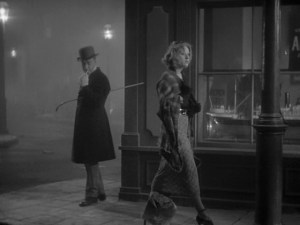
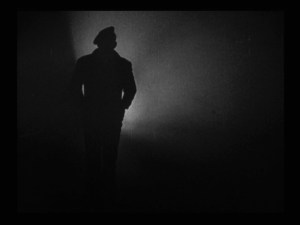
For example, in the opening sequence, Ford sets the mood, the narrative, and the characterization with a series of nearly dialogue-free scenes in the streets of Dublin. The film opens on the shadowy image of Gypo, backlit and walking toward the camera through the foggy Irish night. At this point, his surroundings are impossible to determine. He seems almost not a part of the world, a ghost of a man. A series of these shots continues throughout the opening credit sequence, and already we have a sense that Gypo, the informer, is a man without a home.

A title card just after the credits makes reference to the story of the betrayer Judas. Then the film moves from shadow to reality, as Gypo’s shadow gets smaller and smaller on a nearby wall as he finally enters the frame from the left. His lessening image only contrasts with the man himself, who towers over passing pedestrians. Already the camera hints toward Gypo’s contradictory persona—strong or weak, lies or truths.

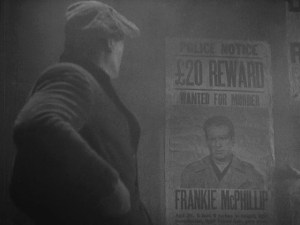
Ford’s camera follows Gypo down a Dublin street, where he encounters a wanted poster featuring a man called Frankie McPhillip. Gypo, shrouded in fog, stares long and hard at the poster. As Ford superimposes a happy memory of Frankie and Gypo over the mug shot, we not only get the distinct sense that Gypo knows the pictured criminal, but that he is struggling, like Judas, with whether or not to betray a friend. As he tears down the poster in anger, we perhaps can see this isn’t the first time Gypo has pondered this course.

The film then moves to three consecutive sequences, each of which is punctuated with that same wanted poster blowing into the frame. In the first, Gypo continues down the street, stopping only to listen to a young man singing an Irish ballad on the corner. As the man sings about the beauty of the Irish night and sea, Gypo stands removed from his countrymen, alone in the gloomy night. The camera’s focus turns to the poster, which, as if following Gypo, blows right on to his leg, sticking there and causing him some effort to remove it. But Gypo is no friend of the British either, quickly scurrying into the fog as a squad of “tans” rounds the corner. This all sets up the tragedy of Gypo Nolan beautifully, without words, save the song—a man without a home, lost in a moral fog, and even when surrounded by people, stands apart from all.

In the next sequence, a woman with covered head looks toward a rich man. Removing the shawl from her golden hair, she offers herself to the man with noting more than a look. As she walks by, Frankie’s poster catches on her feet, signaling her impending role in the Frankie McPhillip business, as well as indicating Gypo’s impending arrival. Just as the rich man approaches her, Gypo arrives. Perceiving the situation, he runs in to protect his female friend, throwing the man into the street. Here we get the only spoken dialogue of this sequence, as Gypo and Katie lament their poverty, speak of going to America for the required twenty pounds, and then break as Katie’s guilt causes her to ridicule Gypo’s reaction to her selling herself.

Finally, we see one final set of feet, those of Frankie McPhillip himself. As he walks down the city street, the poster blows up to him. Frankie picks it up, sees how much reward is being offered, and then quickly runs away to hide from another squad of “tans.” He is in the city, and the stage is set. The conflict is clear, though the night is anything but.

Ford accomplishes this set up in under ten minutes with only a minimum of dialogue. This aids the inherent suspense in the situation because it allows the viewer the freedom to make the connections of the narrative himself. And it makes clear the foggy moral morass that will imbue the film throughout.

Winter Light (1962)

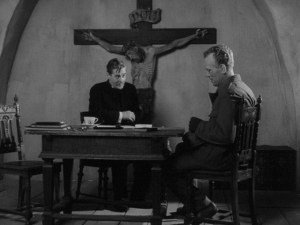
Bergman’s Winter Light contains a wonderful sequence of shots that reveal much about Pastor Tomas and his struggle to (dis)believe. As Pastor Tomas battles with his health and his faith, he meets with Jonas Persson, who finds himself in a deep depression and fear over the possibility of a nuclear attack. Bergman’s framing of the scene, his cutting, the lighting, and the dialogue that occurs between the two all unite to create one of the more stunning scenes of the film.

This first frame is a wide shot. As you can see, Jonas and Tomas sit at the table, both men framed under an arch with Christ. The Pastor attempts to make eye contact but the shame Jonas feels causes him to drop his eyes in a distinctly similar way to Christ on the crucifix in the background. Note also that von Sydow’s sharp features mirror those of the suffering man behind. Yet while von Sydow’s downturned gaze causes him to look away from Tomas, the same gaze from Christ looks directly at him. This leaves an impression not of shame, but of a silent questioning.

Bergman then briefly cuts away to von Sydow, still with his eyes burning a hole in the ground. Then he comes back to Tomas. Here Bergman underlines the angles from the opening wide shot. Von Sydow still shares the turned down head with Christ, while Tomas becomes even larger in comparison to the crucified man behind him. This comes as Tomas draws ever nearer to his proclamation of atheism.

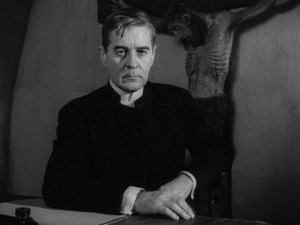
When Bergman cuts back to Tomas, Jonas is outside the frame. Now the focus is solely on the pastor, who looks defiant in the sight of Christ. The attitude hardens, and the dialogue becomes more and more focused on his own struggles with doubt, rather than those of his parishioner. Note also that the sign above Christ’s head proclaiming his kingship has now been removed from the frame.

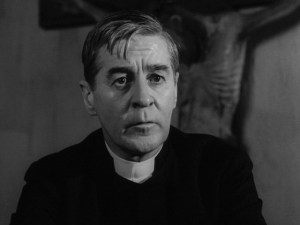
As Bergman frames Tomas’s head more tightly, the pastor grows in the frame while Christ fades into the background, both getting smaller and sliding slightly out of focus.

Bergman cuts back to Tomas, so much tighter that the face of Christ is obscured from view. Tomas is now fully given over to himself and his own suffering. Rather than counsel Jonas off the suicidal ledge, Tomas gives Jonas every reason to die. However, because Tomas believes in his move to atheism, he sees this as a move to freedom, thus the desire to keep Jonas in the office and convince him of this new faith. Here it becomes clear that Tomas is actually advocating for a kind of anti-faith.

In this final image of the scene, after Jonas has left having received none of the counsel and comfort he came for, note how Tomas has moved away from the gaze of the suffering Christ. He now stands where Jonas stood, against a blank wall, criss-crossed with what look like shadows of bars. The light has just brightened the room, signaling some kind of illumination. And Tomas, now separated from his God, utters a line that, ironically, identifies him profoundly with Christ: “My God, why have you forsaken me?”

In this scene, Bergman’s camera and lighting move in unison with the burgeoning atheism of the film’s central character to produce a sequence that crystallizes the tension of faith present throughout the film.