Lake Tahoe (2008)

Lake Tahoe is the kind of film that proves the old axiom true: looks can certainly be deceiving. Its slowness and stillness hide its comic sensibility. Its lightest moments cover over something deeper and more menacing. And that churning menace masks a hard-won hopefulness and sense of expectation that undergirds the entire film.

Opening on a sandy but desolate landscape, director Fernando Eimbcke holds a stationary and extremely wide shot for several seconds, with only the sounds of wind and a far off automobile accompanying the stark imagery. Eventually the opening image fades to black, and when the picture returns, the camera has moved in much closer. Now a road sits in plain view, with a few telephone poles lined up on the far side of the street, while the wind and that passing automobile remain evident to the ear. After several more seconds and another fade, we get the sound of a car crash against the black screen. When the image returns, a red Nissan has crunched its front bumper into a telephone pole.

As the teenaged driver exits his vehicle, it’s clear that the car won’t start. And evidently without a phone (and none in sight), he begins to walk. What follows is a slightly surreal or absurd journey of a young man in search of a repair. As he moves through what appears to be a largely desolate town, Eimbcke uses the fade to black as a buffer between each sequence. The directorial choice stands out a first, but also allows the film to settle into a kind of rhythm, a bit like breathing. This rhythmic breathing throughout the film contrasts strongly with the circumstances of the young protagonist, whose life is even more out of control than it initially seems.

The form of the film, both in the stillness of its camera and its consistent rhythm provide an effective counterpoint to Lake Tahoe’s main narrative arc. This strengthens the dramatic tension only hinted at in the story over the course of the film. That Eimbcke is able to create this kind of tension with such a pulled back narrative is a testament to his skill as a filmmaker. I look forward to seeing more from this exciting young director.

Avatar (2009)

Well, it was pretty.

Avatar has received quite a lot of publicity, even if the majority of it seems more about economics than it is about the experience of the film itself. While the half-a-billion dollar movie has gotten nearly universal acclaim for its use of CGI, the story and dialogue have received more divergent commentary.

And rightly so. The voice over narration nearly sinks the ship in the first half hour or so. And occasionally the characters move a little too conveniently into sermon mode. On one level, Cameron’s story of the broken down Marine who would rather live as another being is naïve in the worst way. It thinks little of humanity, conceiving that our true nature is something purely immaterial, and that our bodies, once broken can be replaced for another, better model. Beyond that, virtually none of the humans that populate are worthy of being called human. Most are a nameless mass that serve one of only three non-scientists introduced in the film—the bloodthirsty military commander. A few have been enlightened by science, but most have no problem following their commander’s orders when it comes time to destroy an entire civilization. Finally, the devaluation of the human body through the narrative arc of one significant character strongly reflects our own world, in which people increasingly relate to one another by means of technology. That the film is unable to comment at all on the pitfalls of such a life doesn’t at all speak in its favor.

Interestingly, the film seems consumed with the bodies of the Na’vi, which are on display throughout. Not only does their blue skin draw attention to them in contrast with the browns and grays of the human world, but the camera often lingers (if we can even say that about a movie like Avatar) on their bodies. As such, the film highlights their lean and athletic builds, fanged teeth, and elongated foreheads. Beyond that, the physical aspects of Pandora shine in comparison to those of the human base (or even earth as we know it). There seems to be in the film a desire for something greater and beyond what we currently experience as humans (a desire that at some level we can all appreciate). However, the film seems to think that the only way to experience that is to, like Jake, trade in our bodies and be incarnated in some other kind of race.

In light of this perspective on the human body, it’s intriguing that the humans are associated so closely with science, while the Na’vi are associated with religion. The humans can only mimic true transformation through their invention, while the Na’vi can experience true transformation through a connection with some kind of spiritual being. Therefore, when the scenes of transformation finally enter the story, the dialogue largely drops away. There are no explanations of processes as there are in the science lab. There are no people fiddling with instruments and adjusting levels. The transformation, however it occurs, is cloaked in divine mystery. And unlike the illusory scientific transformations that take place throughout the film, this one, accomplished under the watch of the “primitive” race, is complete and true.

Not only then does the film side with the Na’vi, but it does so in a way that honors religious commitment. And it’s precisely that more spiritual component that is obviously lacking in the portrayal of humanity. This is what makes the film both interesting and infuriating. Interesting in that Cameron pushes the audience toward an embrace of an overtly spiritual reality, but infuriating because he has to do it by creating a human foil devoid of spiritual content. He could have made a much more interesting film had he made his human characters more complex in just this way.

Sure, it was pretty. But in the end, I wish Avatar had been a whole lot wiser about its portrayal of humanity.

Cry Me a River (2008)

Jia Zhangke’s 20-minute short film, Cry Me a River (which you can find as an extra on the Region 1 release of Jia’s feature 24 City), follows four friends in their late twenties (two men and two women) who have reunited to attend a dinner party in honor of their former professor. Jia’s camera tracks their movements over two days—playing basketball, revisiting old haunts, touring the city by boat and on foot, and of course, attending the dinner that’s brought them back together.

The meeting and meal with the professor takes place about one third of the way through the film, and this sequence, in which Jia uses only three shots, communicates volumes about the director’s concerns in the film as a whole, and also illustrates with striking clarity and efficiency why I appreciate his work so much.

Immediately following a brief tracking shot of the four friends walking to the dinner, Jia brings us directly into the dinner scene in the first of three shots at this location. The edit into this shot provides continuity with the previous shot in its focus on the four main characters of the film. However, it contrasts strongly with what has gone before in a number of ways: the stationary, rather than tracking, camera; the friends seated and still rather than walking; and the bright and colorful indoor setting rather than the drab and gray outdoor location.

This first shot (above) lasts for nearly three minutes, with the camera sitting stationary at eye level. Notice the modern looking dining table, the trendy and/or Western clothes worn by the attendees, the sleek glass—both in the open doors behind the table and the shelving or window in the foreground. The modern world dominates this shot, which is appropriate for what is, outside the professor, a crowd of twenty-somethings. The conversation tracks with the modern look of the shot, with the four friends discussing investments, economics, and the difficulty of survival in a newly westernized China.
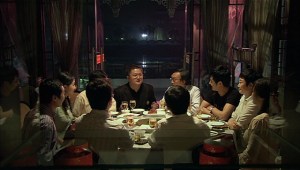
After a man comes to pay their travel expenses—another reveal of their financial hardships—the others in the group (who had been standing out on the deck behind the table) file in to take their seats. With the group now gathered around the table, the professor offers a few words of reflection, noting that his students used to be wonderful poets. Now though, they no longer write. While it goes unsaid by the professor, the implication of his comments is clear: his students left behind the “impractical” and “useless” pursuit of poetry for the “practical” and “useful” pursuits of business and monetary gain. What better place for these young and upwardly mobile students to be in than a fancy western dining room?

When the group stands for a toast to celebrate the professor, we get another strong hint that the way chosen by these young students is not the only one available to them in China. In the doorway pass four people—two musicians heading to their instruments, and two dancers donning traditional performing makeup and robes. As the traditional Chinese music begins to play, it stands as a complement to the scene behind the chatter around the table.
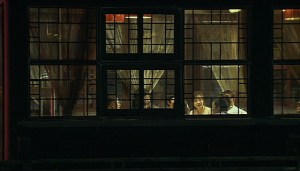
Jia uses a straight cut to shift to the next shot, which lasts just over 30 seconds. Now we see from outside the building, looking in at the dining room through the windows. The traditional music continues to play. Instead of a stationary camera though, we get a tracking shot, at first drifting slowly to the right before centering on the windows and the dinner party. Now the people are much less visible, generally only their heads popping up above the bottom of the window frames. Most obvious in this shot is the outside of the building, which is clearly a traditional Chinese structure. The criss-cross patterns in the windows are the biggest clue at this point. This traditional building was also suggested in the previous shot, as decorative eaves dropped into the shot from the top of the frame. We see then a group largely composed of people who have embraced the new modernity in China, yet despite their best efforts to surround themselves with western fineries, find themselves enclosed in a traditional world.

At this point, the camera begins to track back to the left along the buildings wall. Just as the shift takes place, we see the shadows of the dancers across a thin red strip at the corner of the building. The camera moves, eventually dividing the new and the old world distinctly, as we see in the shot above.
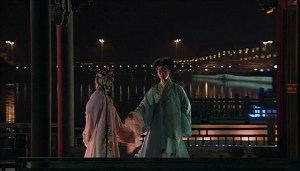
But the camera doesn’t stop at the split, continuing on to frame the dancers under a traditional gazebo, with red columns to the left. The costumes and makeup become clear now, a woman in a pink robe and a man in blue. They move to the music, which continues to play from some other unseen place on the deck. However, as the eye drifts beyond the performers, we see a short iron or wooden fence dividing the platform from a body of water. Continuing on, we see quite clearly a large modern bridge in the background, lit with electric lights and with cars speeding across it in the night. Now the traditional has taken the foreground, while the modern sits cold and distant in the background.
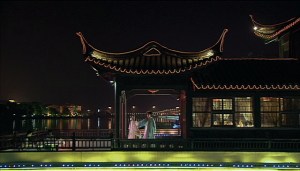
Finally, Jia makes his final cut to a shot that lasts about 10 seconds. It’s a striking long shot, encompassing the entire building and deck area in the shot. The building is more clearly than ever now a traditional Chinese structure with the decorative roof and walls. At the right side stands the main enclosure, with the guests still enjoying their meal in the room. In the center are the dancers, in the open air but covered by the gazebo roof. And finally to the left, for the first time we see the musicians playing completely in the open air. In the background, we get a different kind of progression, from a large modern building at the left, to the bridge in the center, and finally the whole landscape blotted out by the traditional building at the right. And though these three groups are separated by strong vertical lines (columns and walls), they are all ultimately joined by the yellow strip striking across all three areas below.

What we see here then is a beautiful illustration, both through the narrative and dialogue, and especially through Jia’s refined visual sensibility, of the complex relationship between tradition and “progress.” “Progress” seeks to move beyond the constraints of tradition; to either set aside or build upon the old in favor of the new. Yet Jia shows us here that even in humanity’s best attempts to progress, we still find ourselves surrounded by tradition, borne out of it and drawn back to it, however briefly.

Fantastic Mr. Fox (2009)

Wes Anderson makes family films—thankfully not films in the mold of a movie-of-the-week, complete with poor production values and a sappy ending. Instead, Anderson makes films about families, usually families under some kind of duress or struggling with various forms of dysfunction. And even if they’re not the main characters, it’s the fathers that sit at the locus of the narrative—one dad recently dead in The Darjeeling Limited, an absentee Steve Zissou in The Life Aquatic or Royal Tenenbaum in The Royal Tenenbaums, or in his most recent effort, a conflicted Mr. Fox in Fantastic Mr. Fox.

Up to this point in his career, Anderson has filled out his films with generally well-educated, white, and world weary characters. Nothing seems to surprise them—they’ve seen the world, and aren’t all that enamored with the place. There’s an ironic distance to most of their interactions, one that results in plenty of humor, but also one that after five features was beginning to grow stale.

On comes Fantastic Mr. Fox. While it undeniably feels like an Anderson film, continuing with a focus on father figures and carefully framed action, it also seems liberated from the almost singular focus on family dysfunction. That’s in part because, when we meet Mr. Fox and his family, they are a functioning family unit—they all live together, for one, which is a first for an Anderson film. But beyond that, we learn early on that Mr. Fox has sacrificed his career as master-thief for a life in the newspaper business—a job that puts food on the table but doesn’t provide the kind of satisfaction he once received from the thrill of the break-in.

That leads Mr. Fox to have an existential crisis which creates family drama, but that’s a far cry from the all-out dysfunction of Anderson’s previous films. And the film is all the better for it—looser, sillier, and extremely well-paced. What we witness instead is the way a few cracks in the foundation (Mr. Fox’s lack of respect for his promise to Mrs. Fox or Mr. Fox’s continual underestimation of his own son) are exacerbated in crisis; but also how those cracks can be repaired and fortified by relying on one another and sticking together through that crisis.

Anderson’s films always end on a hopeful note, but one that refuses to ignore the difficult realities of living life together as friends and family.  However, Fox feels like Anderson’s most unabashedly hopeful film yet. It avoids the heavily ironic and disengaged tone that was at its height in The Life Aquatic and The Darjeeling Limited—possibly a result of Anderson working with animal characters instead of humans. Instead, Anderson presents Mr. Fox and the rest of the cast in a more direct and lively fashion, rejoicing in their foibles and differences and ending with a series of images that evoke both laughter and delight. In the end, the great irony of the film is that Anderson finds the more liveliness in puppets than he has with humans in his last couple of films.

What we have here then is a first for Wes Anderson: a functional family that stays functional throughout the film. They start out together, persevere through their crises, and come out on the other side the stronger for it. That he pulls this off with it still feeling like an Anderson film (quirky characters, off-kilter humor, and moments of beauty) makes it one of the most enjoyable films I’ve seen in the last year.

Dracula (1931)

When discussing Tod Browning’s Dracula these days, it seems almost a cliché in many circles, often lumped in—as it often is in the popular consciousness—with the later Universal monster movies that tend to ratchet up the cheese factor. However, returning to the original source proves illuminating, from the arresting portrayal of the titular character by Bela Lugosi to the especially creepy introduction and conclusion to the film.

It’s that introduction in Dracula’s castle and the conclusion in his English lair that are so striking in the film, particularly due to Browning’s use of space. In the early scenes that take place at Dracula’s castle, as Renfield makes his visit, everything in the castle is grand, dominating the singular and diminutive real estate agent. The arches stretch up high toward the towering ceiling; the massive staircase curves up and out of sight; spider webs cover walkways taller and wider than a grown man; the fireplace in Dracula’s dining room is from the same family as the massive hearth Welles employed near the end of Citizen Kane ten years later; and even the table where Renfield sits, including the dishes and silverware, seems too large for him.

All of this communicates a sense of dread and powerlessness, not only because of the imposing grandeur of the place, but also because of its isolated location, two qualities it shares in common with Dracula’s English manor. Old and overgrown, the manor is difficult to access, at one point even looking like it is partially underground, or at least built into a hillside; the door that Van Helsing and Harker eventually enter through is difficult to breach; once inside the lair, and impressive staircase hugs the cylindrical wall; and as they pursue Dracula into the cellar, they discover what appears to be a catacomb-like series of rooms, a never-ending series of chambers that stretch out for what seems like forever into the blackness beyond.

These scenes, early and late, contrast significantly with the middle section of the film, most of which takes place on Dracula’s boat or in Dr. Seward’s house/mental hospital. Each of these locations seems small and confined by comparison to the other locations, and as such, much of the mystery in the film drains away in favor of clearer explanations, more plot information, and an ultimate understanding of vampires that comforts rather than terrifies. However, this works well in the scheme of Browning’s film. When we eventually arrive at Dracula’s English lair near the end of the film, Browning continues what he had begun early in the film—cloaking his villain in a mysterious space, one where he sits larger than life, where everything is dark and treacherous and unpredictable. The effect of the space in these final scenes therefore leaves a much more terrifying impression.

So when Van Helsing finishes off the vampire at the film’s end, it’s hardly surprising that it occurs off screen. What better choice could Browning make? What some have criticized as a limp ending actually seems a brilliant choice. Rather than show his villain limited and defeated in this place of mystery and darkness—traditionally a place of strength for the vampire—he prevents the viewer from having the full catharsis of seeing the vampire killed. This in turn leaves everything somewhat unsettled, which is appropriate for such a dark and unpredictable setting. Through his use of space, Browning is able to end the film with more of a question than a full resolution.

The unique use of space in Browning’s film creates an equally unique structure to the film, where the real catharsis and victory comes with the action still in Dr. Seward’s house. For it is there that Van Helsing is portrayed as master of all things vampire; there where the doctor has a tight hold on his patient and daughter, Mina; and there where Dracula seems least able to affect his victim. The brilliance of the film then comes that it uses its final act to attain some narrative resolution, while at the same time remaining unwilling to resolve all the mystery and tension that surround a compelling creation such as Dracula.

Take Out (2004)

Take Out, a 2004 film by co-directors Sean Baker and Tsou Shih-Ching, follows a day in the life of a young Chinese immigrant, Ming Ding, who delivers food on his bicycle for a living. The film eventually appeared in a few U.S. theaters in 2008, and now on Region 1 DVD from Kino in 2009, but it’s a shame this film has had such a difficult time finding an audience.

The film was shot in New York City and takes on elements of neo-realist style, with its use of natural lighting, actual locations, and elliptical editing. The writing effectively reveals the details of the narrative slowly, beginning with only the barest amount of information. This tactic allows the viewer time to experience Ming’s life, to appreciate his hard work, and to come to have a rooting interest in his fate.

The film opens with two thugs rummaging through a dingy apartment in the early morning, looking for Ming. On their search, they climb over sleeping bodies and walk around multiple bunk beds in an otherwise strikingly spare dwelling. Eventually, they find the object of their search, and pull Ming into the unoccupied kitchen. After informing him what he owes and that they’ll double his loan amount if he doesn’t have the full amount that night, they pull out a sledgehammer to leave Ming a message that they really are serious. However, Baker and Tsou cut away as the thugs strike their blow, setting a pattern that will hold through most of the film: interaction and introspection will trump sensational and sentimental events.

Not only does this technique of handling violence bring the imagination to bear in a productive way on the act itself, but in this choice the filmmakers refuse to aestheticize the violence. In doing so, they step away from what has been the tradition of American cinema for the last forty plus years, which has by and large reveled in increasingly disturbing depictions of violent behavior. Instead, Baker and Tsou take a step toward a style of cinema that limits the portrayal of violence without eschewing a willingness to dwell on its effects.

From the apartment filled with illegal immigrants, the film moves outside for the bulk of its runtime. Excepting several conversations with co-workers, most of the film follows Ming as he repeatedly delivers food on his bicycle to try and earn all the money he needs to repay his debt. The directors shoot the film in such a way to highlight Ming’s interconnection with the life and movement of New York City. Horns honk. Cars zip by in the foreground. People cross in front of Ming’s bike, prompting him to make quick stops. Grounding the film like this in its physical location—a reality further highlighted by the repeated shots of cooking in the restaurant and doors opening and closing—encourages the viewer to observe closely. What might be different about this delivery, when compared to the one before? How does this apartment building compare with the last? Who will answer the door, and how will they respond to the delivery man?

Ultimately though, Ming becomes the focus of these deliveries. Will Ming do anything differently? How will he react if there’s a problem? Will he take his friend’s suggestion about interacting with customers? The intense focus on Ming and the invitation to observe creates a bond with the main character. Not only is he quietly desperate in his desire to earn the needed money, thus creating empathy for the character, but he works so hard that it is difficult not to come away appreciating the work ethic that kicks into gear when necessity calls. In that we connect deeply with Ming.

And this is, I think, where the film makes an important contribution in our world. The reality is simple: Illegal immigrants more than likely come across as strange and different to most Western viewers. But the filmmakers put a face on Ming that allows us the opportunity to see him as a human being, rather than simply as a political position. This isn’t to say the filmmakers hint at the political issue of immigration at all. Had they done that (a la The Visitor), this would have been a much lesser film. It’s precisely because the filmmakers limit themselves to the simple details of Ming’s life that their film carries the power and expansiveness that it does.

I can’t offer an exhaustive list of what makes a great film, but I can say with confidence Take Out’s insistence on portraying characters that resemble actual human beings puts it well into the discussion.

I Walked with a Zombie (1943)

During the Enlightenment, philosophers sought to find out the truth about our world through the aid of reason. No longer was revelation the primary source of knowledge about the world. God may have spoken to the world, but if he did, his words would have to pass the muster of our reason. As such, the age of revelation passed on in favor of our own sense and perceptions of the world, leading to the modern conflict between faith and reason.

This conflict of ideas gets played out cleverly in the Val Lewton-produced psychological horror film, I Walked with a Zombie. Released in 1943 by RKO on a B-movie budget, the film nevertheless makes good use of its more limited cast and sets through the application of atmospheric lighting, thoughtful writing, and an inventive use of the camera.

The setup is simple: a young Canadian nurse is recruited to the Caribbean by a rich sugar cane farmer to care for his mysteriously ill wife. When she arrives, she finds a woman we might describe as blank—she will obey simple commands, but never speaks or shows any emotion whatsoever. Of course, as a medical professional, she consults with the doctor on possible treatments, and even gets him to administer an experimental treatment in the hopes of shocking her back to waking life.

However, not even the most advanced medical procedures make any difference in the patient’s health. The sick woman continues in her zombie-like state, while the nurse, feeling great compassion for the lonely husband, wracks her brain for any possible solution. Out of a sense of love and obligation to her employer, the nurse eventually decides it would be worth taking her to the local voodoo meeting, where the natives gather for mysterious nightly rituals. It’s her love and care for another human being that leads her to break out of her strictly rationalist mindset in treating the illness and look for another solution.

The key scene of the film is the walk these two ladies take on a winding path through the sugar cane fields on their way to the voodoo meeting. The women move through the tall cane on a narrow path in what becomes a journey from the natural to the supernatural. Initially, they are merely surrounded by the natural world, the sugar cane reaching high above their heads and severely limiting their view. Yet as they walk along, they encounter decidedly unnatural sights: a cow’s skull on a stick, a dog hanging from a tree, bones arranged in the dirt, and eventually, a disturbingly bug-eyed guardian to the voodoo meeting.

As the women take this journey, a journey where they eventually discover the true nature of the sick woman, they step into what looks like another world at the voodoo meeting. A man dances with a sword. A woman seems under a trance. A mysterious wise person offers advice through a strangely decorated wall. To find the answer to her problem, the nurse had to step into a world of perceptions beyond the senses, one which allowed for supernatural explanations. Reason alone was simply not enough.

I Walked with a Zombie illustrates beautifully through a horror-story narrative the fallacy of approaching life from a purely rationalist point of view. G. K. Chesterton once wrote on this topic that, “It is idle to talk always of the alternative of reason and faith. Reason is itself a matter of faith. It is an act of faith to assert that our thoughts have any relation to reality at all.” Chesterton’s self-deprecating recognition of humanity’s limited viewpoint coalesces nicely with the overall narrative arc of Zombie.

An Enlightenment viewpoint has certainly resulted in exponential technological, medical, and scientific advances. These gains cannot be ignored. But neither can we ignore the reality of our limited viewpoint, and the need to receive trustworthy knowledge from outside ourselves. I Walked with a Zombie helpfully creates a space from which we might be able to consider such knowledge.

A Serious Man (2009)

“I haven’t done anything.” So goes the constant refrain of Larry Gropnik, the protagonist of the most recent film from Joel and Ethan Coen—A Serious Man. To the outsider, Larry looks like the perfect candidate for what constitutes a serious man. He works as a physics professor at a small college, drives a non-descript car, dresses conservatively, works late into the night, and has a son preparing for his bar-mitzvah.

While everything seems to be going along nicely for Larry at first, he eventually becomes a human punching bag throughout the film. He’s not a recipient of physical violence, but an onslaught of tragedies and pressures that he can’t seem to make sense of. First his wife wants a divorce. Then her lover wants to befriend Larry. There’s also a dispute with a neighbor, a car accident, a disgruntled student, and a delinquent brother—not to mention a TV antenna constantly in need of adjustment. Larry, like the Old Testament figure of Job, can’t seem to figure out what’s going on in his life. Though unlike Job, Larry has clearly brought some of his problems on himself.

Larry seeks out three rabbis for assistance (much like Job’s three friends), each of the rabbis offering different guidance. The first, and youngest, seems to think Larry suffers from a problem of perspective. If he could just see his problems in a new light, they would stop being problems. The second seems to think Larry should just get over his problems and live his life. After telling a mystifying story that Larry takes to mean he should be helping others, the rabbi unhelpfully offers: “couldn’t hurt.” The third and final rabbi, the oldest and wisest, won’t even see Larry. But when his son comes to the man at his bar-mitzvah, the old rabbi ultimately tells him to “be a good boy.”

It is this simple advice that Larry has needed, but not received throughout the film. Frustrated by the lack of answers, and feeling like he hasn’t deserved all these trials (“I haven’t done anything!”), Larry eventually breaks down and actually does something. However, what he does is less important than what it seems to indicate, and what the film seems to be aiming at on a larger scale: a full-scale critique of contemporary Jewish (or more broadly, religious) life. The religion in this film is one informed by tradition and ritual, but one that remains completely distanced from the day to day lives of its proponents. The religion on display has long since died on the vine, and the film portrays its withering corpse in all its broken glory.

At the end of the Old Testament book of Job, after the titular character has conversed with his friends for chapter upon chapter about what is going on in Job’s life, Job receives a visit from God Himself in a whirlwind. But rather than offer Job answers, God asks only questions, leaving Job speechless and humbled. Job eventually receives a merciful, rather than a judgmental, response from God because Job was a righteous man. He took his position as a believer seriously.

At every turn Larry eschews his religious tradition in favor of inaction or worse—evil action. Job suffered more intensely than Larry, yet bore it well. He found mercy in the whirlwind. Larry suffered less intensely than Job and bore it poorly, missing out on ample opportunities to ease or end much of his suffering, and even compounding his own trials with poor choices. What will Larry find when the whirlwind visits him?

Lorna’s Silence (2008)

Lorna’s Silence, the 2008 film from the Dardenne brothers, recently played a limited theatrical engagement here in Dallas. It’s always a pleasure to see their work on the big screen, and this film is certainly no exception to the rule. Here, as in the brothers’ four previous full-length fiction films, we find characters situated in a stifling urban milieu, a protagonist placing herself in situations that quickly spin wildly out of her control, and a resolution that resists easy categorization.

Hearkening back to their 1999 film, Rosetta, the brothers again focus their camera on a woman, this one an Albanian immigrant hoping to earn Belgian citizenship through a sham marriage to a drug addict. Lorna has to make several difficult choices along the way, but all of them, at some level, come back to money.

The film opens with the sounds of a bank while the opening credits pass in white over a black background. When the first image finally appears, we see a stack of money changing hands. Knowing the Dardennes, it’s difficult not to think of Robert Bresson’s final film L’argent at this point (their 2007 short film Dans l’Obscurité makes explicit reference to Bresson’s Au hasard Balthazar). The narratives end up quite differently, but the two films share a decidedly pessimistic view of money’s role in modern society.

Finances remain the driving factor in Lorna’s Silence through most of its runtime, as people constantly grapple over money, offer money to others, buy cigarettes, get paid for marriages, and take out loans. Everything in Lorna’s life is a transaction—from prescription drugs to a marriage partner, and even to her own identity as a Belgian citizen. Indeed, Lorna’s drive to leave Albania for Belgium is explicitly never spoken about in the film, but all indications are that she came with a boyfriend that they might make a better life for themselves—better as in more economic choices available to them.

The Dardenne brothers highlight this transactional nature of Lorna’s life. People are constantly exchanging cash, a striking series of scenes when so much of modern commerce takes place without coins and bills. Money becomes for Lorna (and all of the other main characters in the film), a means to achieve her dreams—new freedoms, a new place to live, a new job, and a new identity altogether. However, what becomes clear through the film is how little of this dream she actually attains. She has indeed moved from Albania and has a job, but at the price of both freedom and an identity that’s her own. Lorna becomes an indentured servant, and finds that while her location has changed, her options remain dangerously limited.

Because of her situation, Lorna seems distant, cold, and inhuman as the film begins. She has decided to pursue life as transaction, to essentially sell herself in the hopes of a better existence. However, when she actually has to come through on her end of the bargain, she finds some shred of human feeling and conscience left in her. That flame within her stands in danger of being extinguished early in the film, but as she continues to fight the forces arrayed against her on behalf of another human being, she comes alive. Love is the evidence of life in such a world, and Lorna’s struggle reveals that such love comes only with much sacrifice.

Lorna’s life seems to ask: What does it look like to live a truly human existence in the midst of a life-sapping environment where one’s existence is dictated by transactions? Considering life in purely (or even in primarily) economic terms is no life at all, the film seems to suggest. In highlighting this reality, the Dardennes have placed the proverbial finger on the pulse of modern society. Even contemporary religious communities sometimes define themselves in primarily economic terms, using phrases like “Jesus paid our debt in full” and “count the cost” as descriptors of spiritual realities. What kind of hope can we have when those who speak about hope (religious or otherwise) do so in terms that, were they taken at face value like they are in this film, would sap the life right out of their communities?

In typical Dardenne fashion, the film concludes with more of a question mark rather than a period: How can an actual human being live and love in such an economically driven world that knows nothing of either life or love? Does such a world even allow for humanity? And finally, what does it say about us if we’re living comfortably and carefree in such a dehumanizing world?

Match Point (2005)

Woody Allen’s Match Point was hailed, on its premiere in 2005, as a return to relevance for the New York actor-writer-director. Suffering under a largely underwhelming output through the 90s and the early part of this decade, Allen relocated to London, a move that paid off in the production of this taut, suspenseful drama about a man who finds himself caught between two women—his wife and his mistress.

Allen’s film begins with bold narration laid in over a close up of a tennis net. The yellow ball travels left, right, then back to the left, over and over again as the film’s main character, Chris, speaks about the importance of luck to all of life. When the ball hits the net, the direction it falls will be determined by chance. Or so he’s come to believe. This narration, coming at the beginning of the film, serves to frame the action that follows, providing insight into how Chris views the events that transpire in his life. In fact, he even vocalizes similar views during a dinner scene later in the film, arguing for the ultimate meaninglessness of life because all things happen due to random chance. There is no power to determine one’s direction in life.

A former professional tennis player himself, one wonders if Chris’ belief in chance resulted in his lack of belief in himself. A tennis-playing friend comments to Chris later about how he always seemed to be within a bounce or two of really competing at the highest level. It seems that in the face of years of hard work, Chris could never get the bounces to go his way, so he quit and floated into another way of making a living.

Early in the film, Chris alternates between reading Dostoevsky’s Crime and Punishment and a companion to Dostoevsky that offers readers a shortcut to understanding the novel. As the film goes on, it becomes clear that the narrative unfurls like Crime and Punishment in reverse. The novel portrays Raskolnikov as one who believes himself as unique, superior among human beings, and above the law. These beliefs lead him to commit a crime to prove his theory. However this crime occurs extremely early in the novel, leaving the bulk of the pages to portray Raskolnikov’s struggle with the guilt and fear that come with such heinous deeds, and the redemption that follows.

On the other hand, Match Point portrays Chris as someone who sees himself as an outsider, but who tries to fit into civilized society. The crime that Chris commits, almost a mirror image of the crime in Dostoevsky’s novel, comes at the end of the film, rather than at the beginning. Instead of emphasizing the guilt and fear that result from the crime, Allen lays the emphasis on the guilt and fear that cause the crime. Allen’s film presents us a series of events that lead up to the crime—a list of reasons for it, if you will.

This change of focus presents us a world in which rather than mourning our sins and finding redemption, we ponder the reasons for our sins and lose our connection with humanity. The heart the film, therefore, moves away from introspection, and toward victimization, not a surprising shift in light of contemporary fascination with blaming others. And when the time for fear and guilt over his sins finally arrives in the film, it’s given no more than a few of minutes of screen time.

However, either due to the brilliance of the filmmaker or in spite of him, Match Point cannot be categorized as a simple narrative that illustrates the randomness of the universe. Sure, the main character firmly believes that, even in light of the film’s stunning conclusion. But the film shows us other things as well: we see a man consistently making choices to pursue one woman, then another, even when it forces him to be dishonest or, more selfishly, puts his own living situation at great risk; we see a man who creates a plan to eliminate the conflict between the two women, a plan that will require him to commit a heinous and unthinkable crime; and most significantly, we see a man who, in the final frames of the film, stands apart from the only family he knows.

Allen shoots his final scene in an extended tracking shot, as the family all return from the hospital with a new baby. But the continuity of the shot belies the discontinuity between Chris and the rest of the family. Allen’s camera does not allow this sad reality of Chris’ new life (or is it new death?) to escape. As the family gathers for a champagne toast around the new life sitting before them, an ashen Chris walks toward the window overlooking the Thames, his face bathed in an unforgiving sunlight. The light reveals all—a man who on the outside has no troubles, yet on the inside remains troubled by his deeds; a man who lives in material comfort without, but has no spiritual or emotional comfort within.

If everything really were simply left up to chance, if life really were completely random and without any ultimate meaning, would the look on his face be so predictable? Sure, Allen’s film begins with a narration on the luck of life and includes multiple spoken scenes on the randomness of the universe. But it’s that troubled and guilty face we’re left with, a face that shows us maybe things aren’t as random as they sometimes seem.