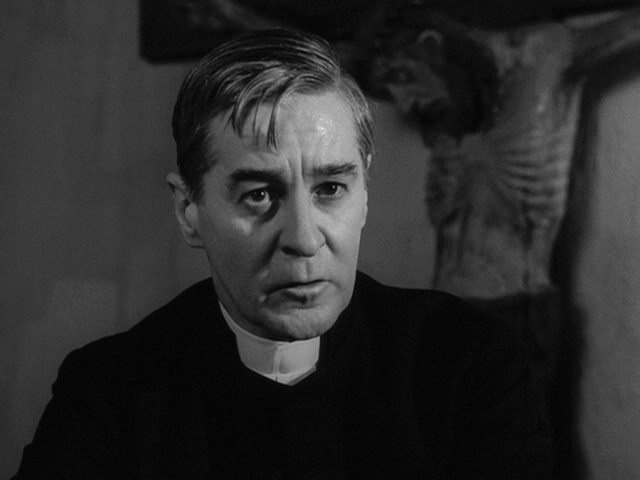
Magnolia (1999)

Magnolia is one of the more divisive films to come out in the past decade. Everyone who sees it seems to have an opinion about it, offered in strong terms. It’s often a love it or hate it proposal. This polarized reaction is quite interesting, and seems to be spurred on by the feature of the film that most excites me: its aggressiveness. Director P.T. Anderson leaves no room for middling positions on Magnolia. The varied opening sequence, complete with an homage to silent films, certainly raises an eyebrow for the uninitiated. The confidence and fluidity of his camera cause the viewer to either come along for the ride or bail out quickly. The in your face attitude of characters and dialogue, often so full of vulgarity that it cannot be ignored, leave viewers challenged and at times, reeling. Even the placement of music, with his fearless decision to turn his film into a musical 2/3 of the way through, smells of someone throwing all his cards on the table in an effort to push the viewer into a corner, leaving them nowhere to go and unsure of what might come next. And of course, no one could imagine what would come next, with Anderson leaving his most aggressive move for last.

All of this gets the blood boiling, as these elements contribute in their own ways to imbuing the film with meaning. However, it is chiefly that meaning, varied and expansive, that makes this film memorable and infinitely watchable several years after its release.

Once the characters are introduced, we hear the key line in the film, spoken twice fairly early in the film: ‘And the book says, “We may be through with the past, but the past ain’t through with us.”’ In the film’s early moments, we are introduced to a series of people deeply scarred by their pasts. Lies, drugs, sexual indiscretion, desertion, and theft populate the lives of these characters. This repeated line should resonate in our minds as we watch these people and the mess they’ve made of their lives.

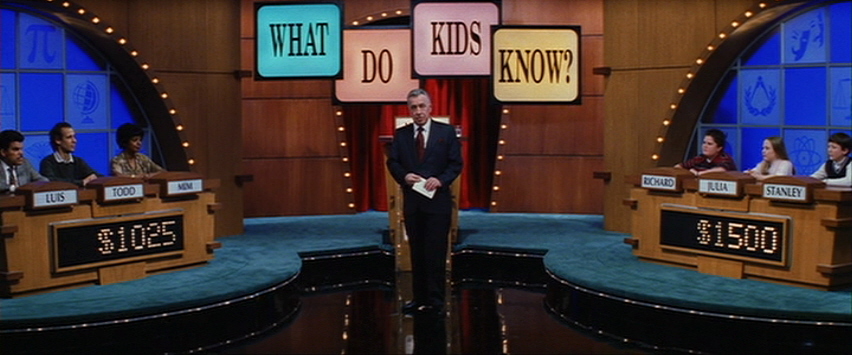
The real centerpiece of the film’s story, it seems to me, is the game show What Do Kids Know? hosted by Jimmy Gator. The title’s double meaning in the context of the film is telling. While the show deals with mindless trivia that either feeds kids’ overenthusiastic sense of pride or places them up on a pedestal only to be knocked down for the sake of entertainment, the mosaic of the film is all about parents and children. As we see both kids and the adults they become scarred by a lifetime of poor decisions their parents made, we wonder if the title of that game show might have been in Earl or Jimmy’s mind some other time in their past. Also, a line that seems to come from almost out of nowhere takes on a much greater significance in this context. After Donnie confesses his love for Brad the bartender, he runs to the bathroom, and while vomiting over the toilet, he can be heard mumbling a verse from the Bible (Exodus 20:5). He says the children are punished for the sin of the fathers. The fact that it comes from a religious text lends transcendence to the proceedings, though Anderson subverts it nicely by having it spoken over a filthy barroom toilet. Big things are indeed happening in the midst of the stench of this world.

This punishment spoken of by Donnie raises its head in the form of suffering and poor choices, and is true of every child in the film: the young African-American boy named Dixon, Stanley, Donnie, Frank Mackey, and Claudia. Each of them carries deep scars and pain from the failure of their parents (usually their fathers). In Dixon’s case, his father is a killer, thus putting his son in harms way. On top of that Officer Jim Kurring fails to listen to his rap, thus denying Dixon an important moment in his life (and bringing further harm on himself). Stanley’s dad is more concerned about money and using his kid to bolster his acting career than he is about caring for the real needs of affection and approval in his son. Donnie’s parents stole his money. Neither does it seem they prepared him well for adulthood. Frank’s father Earl bailed on the family when his wife Lily got sick. Jimmy molested his daughter and even when staring death in the face, refuses to admit it. The cause of all these failures is beautifully summed up in a line from Earl Partridge (father of Frank), when he states: “I’ll tell you the greatest regret of my life: I let my love go.” This heartbreaking commentary on a failed life gets at the heart of the conflict in each relationship. It also provides a link toward the way of reconciling with the past and moving forward in renewed relationships – these people need to find that lost love.

Just after the characters sing Aimee Mann’s Wise Up, a moment at which it seems they will each give up, the rain stops and they seem to be making some changes. Jim and Claudia, Jimmy and Rose, Frank and Earl – all of them are honest with each other, revealing bits of who they are and how they feel about one another. But with that honesty, there is still anger, mistrust, and fear. Then, the frogs come.

They are an announcement, a judgment, and a means of grace rolled into one. They announce for us a second time that something transcendent is going on. There is more going on in this world than meets the eye. These people are not alone (both the biblical references to Exodus 8:2 and the framing segments on coincidences are key in this conclusion). The frogs also come as a judgment on the truly wicked lives these people have led. Earl takes his last breath during the downpour. Jimmy appears as if he will suffer his last months alone. Donnie, recently becoming a thief, is thrown for a hard fall from the ladder.

But what makes this final climactic incident so important is the way it allows for grace in the lives of these lonely people. Jim is able to give a helping hand to Donnie, who desperately needs someone to care for him. Claudia gets to experience the comforting embrace of her mother, this time with all the honesty of their past open before them. Frank and Stanley witness this strange and miraculous occurrence, softening their hard edges and providing them with the courage to strive for a better way once morning comes.

After the narrator repeats the key line: ‘And the book says, “We may be through with the past, but the past ain’t through with us,”’ we get a final monologue from Jim. It’s on the subject of forgiveness. The implication here is that through forgiveness, one can find that lost love Earl spoke of. Jim talks honestly about forgiveness, that it isn’t easy, and at least in his job, not always called for. But he asks the question: “What can we forgive?” In other words, are things ever so far gone that we can’t forgive?

The film leaves us then with people on the road to personal renewal: Frank, his face tear-stained, stumbling through the hospital to visit Linda, Jim helping Donnie to return the money, Stanley telling his dad how their relationship needs to be characterized by kindness, Rose caring for Claudia, and Jim coming to be with Claudia, who, in the famous closing shot, provides us with a glorious (albeit slightly broken) smile after all this madness.

The question remains: What do kids know? Well, maybe they know more than trivia, more than we parents give them credit for. Maybe they know how to forgive, to begin the process of healing their broken relationships, and to move on with their lives. Maybe they can even break the cycle of wickedness, sparing their own kids some of their torturous experience. Maybe…
Sunrise (1927)

Sunrise is considered by many to be one of the greatest silent films of all time. Take out the word “silent” from that last sentence, and you get a more accurate picture of my own feeling on the matter. The story is simple, almost fable-like, as we see a farmer tempted to leave his wife for a “more exciting” woman from the city. An American film, directed by the German F.W. Murnau, Sunrise takes us on this journey with the help of Murnau’s expertise as one of the leading filmmakers of his day. There are three formal elements that stand out for me in Sunrise.

Murnau carefully frames each shot in the film to communicate a maximum of information visually. The economy of each scene is remarkable. The early scenes in Sunrise illustrate this best, both in editing and camera movement. After the travel montage that opens the film, Murnau settles on a boatload of people traveling to a vacation community. It is a sunny day, and the people act as if they know it. Crowds gather to meet the incoming boat, people chatter with excitement, a man climbs the fence to greet friends, and Murnau caps the joyous moment with a sweeping crane shot that captures the charming village at its height – filled with people and hope.

After a brief title card, Murnau introduces us to The Woman from the City (Margaret Livingston), who, in contrast to the other vacationers, dwells in a dark room, by candlelight, and most importantly, alone. Other cues signal our suspicion of her – the way she lights her cigarette at the candle, her half-open robe, her stockings (which Murnau shoots at leg level, making sure we notice them), and the way she makes the old woman polish her shoes.

It is in this scene, when The Woman enters the dining room, that Murnau includes the strangest shot of the entire film. He tilts the camera slightly to the right, with a lamp in the extreme foreground. The old couple eats their soup together at what appears to be a crooked table in the middle of the shot. Finally, the background hides a doorway though which The Woman eventually enters the dining room. The lamp and the crooked table get our attention here, as if to say “Do you see what’s going on here? All is not well.” And after we have had a moment to take in those more obvious elements, the shot answers its own question by producing The Woman through the doorway. She is on her way out, alone of course, in striking contrast to the old couple at the table.

Once outside, Murnau follows her down the village lane with a long tracking shot, beginning at the doorway, with another couple in the extreme foreground. She walks past a second doorway, this time filled with three women, as well as a window filled with smiling people inside a warm home. And in a laugh inducing moment, she even passes a man with his horse. Everyone has someone, it seems. Yet The Woman doesn’t seem to be bothered, either with the scorn of the people she passes or in the fact that she’s alone, and we soon find out why. She knows lonely soul – The Man (George O’Brien). Murnau shoots him almost entirely alone, and for the brief moment his Wife (Janet Gaynor) enters the room, they are faced away from one another. The loneliness in these early scenes is overwhelming, particularly in contrast to the chipper opening.

Murnau also communicates a great deal through his sets. In those early scenes, the stark distinctions between light and darkness, the placement of fences, walls, and doorways all seem to be significant. Note the doorway mentioned above. Also, when The Woman approaches The Man’s house, she encounters a fence and a curtained window, the final battlements to scale before she wins her prize. She has already borne the scorn of the onlooking neighbors as she stalked through the village. She simply whistles, allowing the wind to carry her message to her waiting lover. The Woman simply then need wait a few short moments to receive the object of her affection. At this moment, Murnau uses the curtained window to great effect, showing The Man’s shadow pointing The Woman to their regular meeting place. There’s a foreboding in the image that signals the dark conversation to come.

Likewise, the lamp in the home of The Man and Wife seems almost as if it is fighting off the darkness, much like the candle in The Woman’s room. The darkness in these places points to the moral treachery that is about to take place, as well as the loneliness of these people and the oppression they must all feel as no one seems to have what they want. Contrast that with the great dining/dancing hall later in the film, filled with lights, giant glass walls, and crowds of people everywhere. At that point, the Man and Wife are a part of this world, a world we caught a glimpse of at the beginning of the film with the sunny vacationers. The couple has moved from loneliness, treachery, and despair to joy, peace, and happiness.

Finally, Murnau’s evocative use of sound presents the ringing church bells in varied ways from one scene to the next. When the couple leaves on the boat, the bells ring a sort of warning, maybe of an impending judgment. This happens right on the heels of the dog’s incessant barking and swim toward the boat which adds to the foreboding sense. During the boat ride, just as The Man is going to commit an act of violence, those bells ring again, this time evoking a kind of conviction – he has done wrong and he knows it. He can’t get away from the sound of those bells fast enough. Finally, the bells ring at the city wedding, just as the Man and Wife are repairing their relationship. In this case, the bells become a symbol of joy and hope. They call the couple into the church, where they watch the wedding from afar and no doubt recall their own vows. They are transformed, a new couple, rebuilding a broken trust and recommitted to loving one another. Murnau, then finally shows us the bells that so often ring in our ears, calling out just as this important act of forgiveness and reconciliation takes place.

Sunrise is a beautiful film for a number of reasons, not the least of which are these (and other) formal elements that provide a richness for the presentation too often lacking in other films of its kind or genre. Sunrise has these in abundance, a testament to the genius of such an important filmmaker.

Junebug (2005)

Each year it seems there are a few films that fly under the radar. I might hear some good things about them, but I just don’t get around to seeing them. Junebug was a film like that for me. I had heard a few good things, but until it was recommended by a close friend, I didn’t think much about it. It just kind of looked like the standard, indie, quirky comedy. Now, don’t get me wrong. I like some of those “SIQC’s”. However, in this case, director Phil Morrison, along with his writer and cast, has created a poignant picture of life in the South. Yes, there are some unique characters that one might consider quirky. Yes, the film was independently financed. And yes, there are some rather funny moments (though I’m not sure I’d like to think of it strictly as a comedy). But Junebug should not be qualified as standard, because it captures something too few films even aspire to any longer: reality.

Junebug reminded me at times of films by Bujalski, Tsai, and the Dardenne brothers. Not really in any kind of formal sense, as those filmmakers are rigorously devoted to their own unique senses of style. Morrison presents the elements here in a more straightforward fashion. Rather, each of those filmmakers has a knack for capturing real moments. And while Morrison is more closely tied to his narrative than any of those filmmakers, he still is able to make us feel as if we’re stumbling upon something or someone real.

Several things tune us into this reality: A key aspect of the family in Junebug is their lack of substantive communication with one another. It seems that everyone has something to say, but too often, nothing gets said. This frustrates us from the outset, as we are sort of in the position of Madeleine, the outsider from Chicago who meets her husband’s North Carolina family for the first time. No one speaks to her, except for Ashley, of course (she talks to everyone). And outside of Ashley, when Madeleine is spoken to, it’s often with at least a little edge, usually from Peg or Johnny. And while neither the silence nor the edge ever really let up, the film provides us an opportunity to see their true qualities lurking beneath the silence and occasional hostility. When tragedy strikes or someone is hurt, they have one undeniable virtue: they are there for each other. Even George, who’s been away from home for so long, feels the tug of family at those most crucial moments. Thus, Morrison here holds the tension between this family that doesn’t speak a whole lot about its problems, yet is deeply devoted to one another when the worst comes.

A second element that evokes reality: We learn to know these people by observing their surroundings. In communicating this, Morrison isn’t afraid to let his camera speak for him. Thus, we are allowed observe the quiet town, green front yards, empty rooms throughout the house, all without dialogue. These are people intimately connected to a particular place, and everything about them evokes that place. George, who left years earlier, anxious to get away, may be more connected to this town than any of the others. He exudes a quiet confidence, doesn’t speak a whole lot, and therefore allows his presence to speak for him more often than not. This is what the film often feels like as well: its mere presence does much of the speaking to us. Morrison often shows without telling.

Third, I was impressed with the characterization of these people, particularly the two young couples. There are a number of tensions and moments of connection between these four individuals, but Morrison wisely keeps most of that under wraps. Occasionally, something comes out, a burst of anger, sexual passion, or even tears. Junebug’s best moments are in between these occasional outbursts. Our introduction to Ashley is a great example of this, as words fly from her mouth faster than it seems anyone should be able to get them out. Yet, even in this opening flurry, we can already see the cracks in her relationship with Johnny, and her naïve way of trying to deal with it. It’s these moments, when things are communicated through tone of voice, a downcast eye, or someone quietly leaving a room that Junebug really excels.

All of this adds up to a gentle piece of work in Morrison’s debut feature. In one scene involving an artist with whom Madeleine is trying to sign a contract, he sits down with her and begins to explain his method, and how he communicates through his painting. In that brief conversation, he notes that he is attempting “to make the invisible visible.” I think that’s what Morrison and crew do here in Junebug. With a gentle touch, he shows us truths about these people and this place. This gentleness on the part of the filmmakers evokes an empathy and affection for their subjects, many of whom don’t do anything particularly likable. In this approach to the people who populate this film, we are offered an alternative in dealing with those who might act differently or believe differently than we. Morrison deserves the utmost credit for this gracious approach to his characters.

Red Beard (1965)

Akira Kurosawa’s Red Beard, a story of deep compassion and transformation, made in 1965, marks the end of the most active phase of his career. Kurosawa is at the height of his powers here, combining the two greatest strengths of his career: his exquisite use of the camera, and the powerful presence of his favored star, Toshiro Mifune in the title role. In what would be their final film together, Mifune dominates every moment he is on the screen, and many that he is not. These two elements serve to enhance its story of a young, educated doctor coming to work at a hospital, unwillingly at first, with an old and experienced veteran who is set in his ways

Kurosawa’s strengths are immediately evident in the film’s opening sequence, about eight minutes long, which depicts a tour through a hospital. Dr. Yasumoto has just arrived at the village hospital to pay a call on Dr. Niide (who we find out everyone calls Red Beard, for obvious reasons). The camera follows the young doctor into the hospital, and then through it, as he receives a tour from an outgoing and rather cynical young doctor, Tsugawa. More often than not in this sequence, Kurosawa holds the doctors in a two shot, giving us only a view of the immediate surroundings – enough to see sick patients and workers, but not much else. In this decision, Kurosawa creates a cramped and overcrowded feeling in the hospital. Since Tsugawa is handling the tour, Yasumoto’s picture of this place immediately becomes tainted. And Kurosawa communicates the transference of this attitude beautifully by the amount of time these two spend in the same shot together. It’s as if Tsugawa is passing on his legacy of cynicism and angst to Yasumoto in this rather brief opening sequence. The genius of Kurosawa is that we would probably know that even if we removed the dialogue. He is using his formal decisions to contribute to the narrative.

The most interesting shot during the tour comes after they have passed the poor patients, the pharmacy, and the clinic itself. Kurosawa places the camera at the far end of a darkened hallway leading to the men’s ward. Initially, the camera looks as if it’s at a low angle, so that if the doctors were to venture into the hallway, they would literally be descending into darkness. This of course fits beautifully with their current mindset as they hesitate and gaze down it. Yet when they finally step into the hallway, the camera now behind them, we see an area full of activity and light. It’s at this point the two doctors encounter a room of sick men, and we viewers get the first sense this place may not be as bad as it seems. The sick man Sahachi is devoted to Red Beard, realizing that while his rules may require some extra discomfort, they are always in the best interests of the patients. In an otherwise one-sided presentation of the hospital by Tsugawa, this moment stands out, signaling that all may not be as it seems.

Finally, they arrive. Kurosawa has Red Beard’s back to us as the young doctors enter his room. They kneel before him in a perfectly symmetrical shot, the parties in the room forming a triangle, an arrangement Kurosawa returns to time and again both in this film and in others. Here, with Red Beard at the center of the triangle, the attention is all on him. As he turns though, Kurosawa cuts to a close-up of Mifune, glaring powerfully at the new young doctor. He is in charge of his domain, and he is not to be trifled with. In the next cut, Kurosawa pulls wider and to the right. Dr. Yasumoto is now in the center of the shot, under the gaze and questioning of Red Beard, the pressure and focus is all on him. He eventually breaks away under Red Beard’s piercing gaze, which places him at a disadvantage in the relationship, even if he doesn’t recognize it yet. What’s so great about this whole sequence is the way Kurosawa uses the camera and the framing of the shots to communicate narrative details, significant moments, and the personalities of his characters. That he is able to communicate so much in just the images is one of the things that make his films such rich experiences. The dialogue is only one layer of meaning in the film. The framing is another; the editing another. And so on.

Which leads me the biggest reason why I appreciate this particular film of Kurosawa’s – the images themselves are the most beautifully framed he has ever put to film. I think of that introduction to Red Beard. Or during Yasumoto’s angry period, as he reclines in the garden, near the nurse, Osugi, and they are separated by a twisting tree branch cutting through the middle of the frame. So much is communicated there, in the contrast of her worry and his carefree spirit to her selflessness and his selfishness. They may be together, but they are further apart than one might think. I also think of what could be viewed as a throwaway moment, when Masae comes to visit him at the hospital, and he refuses to see her – she stands alone, outside the hospital, on a lonely stone path. She has made a sacrifice to come, made herself vulnerable to Yasumoto, and he refuses to even acknowledge her presence. Even in this brief moment, we are given a glimpse, sans dialogue, of the character of Masae.

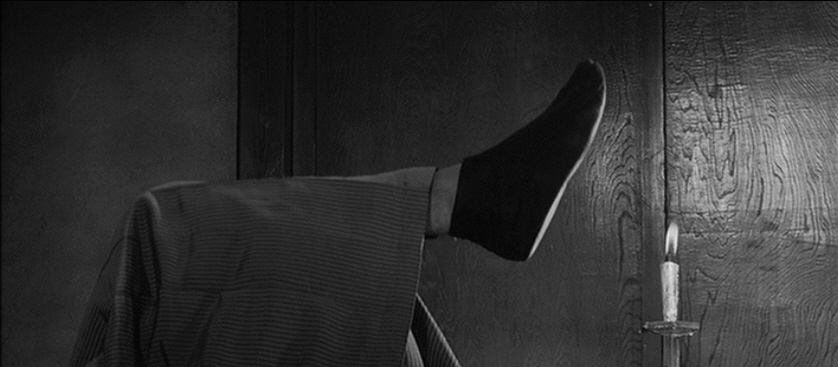
The most striking images in the film as a whole occur when Yasumoto is confronted by an insane patient, called only The Mantis, for she likes to kill the men she’s involved with. We first see a lit candle just below his foot, as he reclines in his typical, lazy fashion. She enters his room meekly, immediately kneeling, hardly taking up any space. He, full of himself as usual, taken in by her humility, and thinking he’ll be able to cure her, seizes the opportunity and faces her, the single candle lit between them. The fire is there lighting the space, providing the opportunity for conversation, yet as he moves closer to her, and the candle, we sense the fire taking on a more dangerous, even menacing character. When he finds himself virtually on top of it, we know for sure he has entered into a terrible situation, merely waiting for what must surely be a tragic conclusion.

It is these kinds of images I love in Red Beard. Of course, the film itself isn’t half bad either. The clash of personalities between young and old, inexperienced and experienced, arrogant and compassionate, takes on a complexity not unlike Kurosawa’s previous film, High and Low. In Red Beard, you have two people who both have a kind of “highness” and “lowness” about them and it is for us to sort out just who is who and what is what. No doubt if we look closely, Kurosawa’s beautifully framed images will offer many riches to that end.

Mutual Appreciation (2005)

Watching Andrew Bujalski’s most recent work, Mutual Appreciation, one almost gets the feeling they are watching home videos of some great friends. There’s a familiarity to the characters, borne out of a dedicated realism evident in Bujalski’s style. The writer/actor/director has little use for effects shots, impassioned diatribes, intricate sets, and big actorly moments. Instead, the film is built on the quiet, often mundane moments in the lives of its characters – people hanging out, going to a concert, having a beer, or baking cookies. Mutual Appreciation is shot in a soft black and white, always in a natural setting; in apartments it looks like these actors might actually be living in themselves.

This is not at all meant to be a turn off though. It’s just the opposite, in fact. For it’s in these simple moments that Bujalski is able to show us something about life and what it means to be human. The moments then take on a new meaning, pointing us toward thoughts about friendship, guilt, love, fear, and loyalty. Yet, it all just feels, well, so normal, which appears to be exactly what Bujalski is aiming for. He has a knack for getting these “normal” performances out of his actors. Scenes are filled with ums, misspoken words, goofy jokes, and awkward pauses. For many, these could be the kind of elements that add up to boredom. But for the attentive viewer, there is much to be revealed.

A scene later in the film helps to see this more clearly. Ellie (Rachel Clift) heads over to Alan’s (Justin Rice) apartment to get a CD, or so she says. Clearly she has schemed a way to drive him home. Inside, Ellie asks Alan what he thinks of Buddhism, just to get some kind of conversation started. The cramped room, so indicative of where a guy like Alan might live, is the perfect setting for such a moment. Ellie presses on, doing most of the talking, introducing the subject of her boyfriend Lawrence (Andrew Bujalski), and then quickly retreating, when she feels Alan not responding appropriately. Eventually, she gets down to it, and confesses her affection for Alan.

During the conversation, Bujalski often keeps both players in the shot – even his close-ups tend to keep the other person in the extreme foreground. But the edits aren’t typical of a scene like this. Normally, when someone speaks, the camera is on them. Bujalski is not so interested in this “rule”, instead leaving the camera mostly on Ellie, with shots of Alan interspersed that tend to be pretty short overall. This is Ellie’s scene. She initiates this conversation; she does most of the talking. But even at times when she is waiting for a response, Bujalski doesn’t shy away from shooting her face. We see her question herself, try to take back what she says, offer an openness and vulnerability to Alan, and she even reveals a kind of aggressiveness or determination (or maybe foolishness?) to get her feelings out in the open. All of this is available to us only because the camera sticks with Ellie so much – just by seeing her, paying close attention to her, we begin to get a sense of where she’s at in all this. But Bujalski is smart enough to trust the viewer, letting us make the connections instead of driving them home with perfunctory editing.

I like Bujalski’s films for a lot of reasons – the dialogue, his sense of humor, his taste in music, and the actors – but the trust in me as the viewer is maybe the biggest attraction. It’s inherent to his style, and as such, I look forward to Mutual Appreciation actually getting distributed in theaters, and/or released on DVD. I was able to see it only because Bujalski makes it available to us through his website, and because of the good graces of my wife, who got it for my birthday. How fortunate am I.

Saraband (2003)

Ingmar Bergman’s latest (and final?) film, Saraband, revisits the main characters from his earlier Scenes From a Marriage (1973). Marianne (Liv Ullmann) and Johan (Erland Josephson) are back, now with the addition of Johan’s son Henrik (Börje Ahlstedt), and his 19 year old daughter Karin (Julia Dufvenius). Marianne has gone to Johan’s wilderness hideaway to stay with him for a while. They haven’t been together in decades, but something spurs her to go anyway.The film is divided into ten dialogues, each involving two of the characters. And in typical Bergman fashion, we delve deep into their psyches, which in turn reveals the pain and anguish latent after many years of mistreating one another. Yet there’s another source of angst for Johan, Henrik, Karin, and eventually even Marianne – the recent death of Henrik’s wife (Karin’s mother) Anna. For those characters who knew her, she remains close to their hearts and thoughts. She constantly enters into the conversation, with everyone saying how much they miss her, what a great loss it was when she died, and how they each feel connected to her. Marianne never knew her, but as each of the characters introduces her to Anna, she comes to have her own sort of connection with her, illuminated for us in the film’s conclusion.

All of this leads to the features of Saraband that I most appreciate. First, the dialogue is a sharp and piercing as ever. Bergman has always been a keen observer of the human condition, and is especially proficient at writing dialogue that is both clear and thematically conscious. A couple of things come to mind here, beginning with a dialogue between Johan and Henrik, in which the father delivers words of such venom that they cut right through the heart of his son. He may be describing certain tendencies in his son accurately, but the years of selfishness have stripped their interaction of anything remotely approaching gentleness. In terms of theme, Bergman is able to weave in reflections about Anna that strike one as completely natural in the moment, yet use those comments as a whole to bring about a beautiful, puzzling, and strangely hopeful conclusion.

This presence of Anna adds an element of mystery and transcendence to the film, as it threatens to be sucked into the mire of selfish and bitter people. She is dead, yet she becomes a living, breathing human being through the memories of these tortured souls. Her life matters. It continues to make an impact on these people years later. For those who knew her, the change is slight. But for Marianne, the recipient of a miracle, the change is dramatic. This miraculous event happens so quietly and subtly that it may go unnoticed. All through the film, Marianne has emulated Anna, unconsciously, of course. Yet she’s patient, she listens, she aids, and she does what she can for each of them. The culmination of this is a return to her daughter, long since ill and far gone. That moment with Martha hints at Marianne’s transformation into saintly Anna. No doubt the similarity of their names is another indicator of this.

Saraband becomes, then, a film about selfish, wounded, and depraved people that has within it a strong and unmistakable glimmer of hope. Each of these characters has fond memories of Anna. They have some desire to see Anna again, presumably in another life beyond this one. Thus, there’s an implicit hope for them that there’s more to this life than, well, this. This isn’t all there is. People who write about Bergman tend to pick up on the bleak aspects of his work, and rightly so – it’s present here, and at times oppressive. Yet that isn’t all there is.

This is a touching film from a man who is leaving behind him body of work that will be revisited time and again. Saraband is a worthy entry into that canon, and as the final image of Anna’s picture faded from the screen, I couldn’t help but think what a hopeful image it was. Anna remains, even in death. If this is to be his final film, it marks a fitting conclusion to the career of one of the most important filmmakers ever to grace the screens with his work.

Funny Ha Ha (2003)

Language is a funny thing. Take that word “funny”. No doubt when most people read the title, they will think “comedy”. But the film also includes elements which are funny as in strange, or funny as in uncomfortable. The language here is no doubt purposefully chosen, in part to show that this film denies genre conventions. It aims instead for something more organic, and in doing so, hopefully more truthful. Having said all that, writer/director/co-star Andrew Bujalski has crafted one of the more interesting films to cross my way in some time. In its opening moments, 23 year-old college graduate Marnie (Kate Dollenmayer) is looking to get a tattoo. The scene is a perfect beginning to the film. It sets the tone, as Marnie has no idea what she wants, and when she does finally make a decision through a drunken haze, it turns out to be a poor one. The film repeats these rhythms, as Marnie stumbles through life, without a clue of what to do, and making bad decisions right and left. Some of those decisions are comical, some are uncomfortable, and still others are off the wall.

Maybe that description doesn’t sound endearing, but the reason the film works is that Dollenmayer and Bujalski combine to make Marnie a person who earns our empathy. Sure, some of her actions induce anger, but we never lose sight of a delicacy or fragility she carries with her. Her poor decisions, usually with men, leave scars. And it’s not just that we feel sorry for her. Marnie takes the time to help people out, whether it be hanging out with lonely Mitchell, or giving Liz a place to crash for the night.

All of this is done with such a light touch, in such an endearing way, that it’s hard not to admire the film. Bujalski also seems committed to a healthy realism that marks the film off stylistically from most of what’s out at the megaplex. Several times, and especially after the film’s final scene, I was reminded of the Dardennes, with their own penchant for realism and the unique rhythm to their storytelling. Except Bujalski’s film is funny. In Funny Ha Ha, Bujalski offers something that’s becoming increasingly rare at the cinema these days – a film that defies simple classification and provides a unique film watching experience. I’m looking forward to seeing where he goes from here.

Vera Drake (2004)

Mike Leigh’s most recent effort, Vera Drake, is probably best known as “that movie about an abortionist.” It is that, I suppose, though it strikes me as something much more subtle, complex, and interesting. The film has been criticized on both sides of the debate, either for being another in a long line of liberal propaganda pieces, or as a missed opportunity for a pro-choice director to get the message out in a strong and effective manner. Rather, Vera Drake presents for us a study in human nature, depicting what human beings might do or how human beings might be, in and around a contentious situation like abortion. It brings humanity to the issue, a much-needed respite for those of us tired of the incessant back and forth.Briefly, the film’s first half follows its title character through the ins and outs of her daily life. As is more than once noted by her observers in the film, “Vera has a heart of gold.” In addition to her job cleaning houses for the rich, Vera, whose family is poor, makes a point to check in on an infirm neighbor every day, while his wife is at work. She also takes care of her ailing (and unappreciative) mother, serves her family with joy, and invites a lonely young man from the neighborhood to dinner. Yet alongside all these simple tasks, Vera also, in her words, “helps girls out.” The film’s second half relates the conflict that comes into the lives of Vera and her family as a result of her clandestine activities.

Through all of it, Leigh keeps us focused on the characters, on their simple words and actions. This attention to characterization keeps the film from devolving into an “issue” movie, sermonizing about the evils or benefits of abortion [Contrast that with the recent critical darling Crash, which cannot step away from its issue long enough to get to know its characters]. Because of Leigh’s discipline on this front, it makes formulating a response to the politics of this film a difficult one. That is the biggest reason why it works though. This film cannot be boiled down to a “propaganda piece” or a “missed opportunity.” The issue itself resides in ambiguity within the actions, situations, and hearts of these people. I am reminded of a comment by the ethics professor in Decalogue VIII, as she guides her students to think about an ethical situation in terms of characters and motivations: “What makes it interesting is that we both know prototypes. I think, however, that they are not people we know.” In other words, we need to know people more than issues. This, I think, is where Leigh takes us.

Vera Drake then, is primarily about its characters, and as such, invites us to empathize with their plight, whether they might be responsible for the conflict in their lives (Vera and the girls in need of abortions) or not (Vera’s family). In the case of Vera and the girls she helps, the issue of responsibility is complex. What role does society play, both in the way the justice system works as well as in the double standard that exists for the rich and poor? What about those girls like Susan, raped and forced into such a difficult situation?

These are difficult questions. However, in focusing on the people, Leigh allows us space to consider the questions. He keeps them in tension. How would we answer them in the face of real human beings suffering through such an experience? Everyone here suffers – from the girls getting abortions, to Vera, to her family. Leigh allows the questions to simmer under the surface, refusing to offer easy answers for us. This invites the viewer to engage the film, to engage its characters, and then finally, to engage the issue. But note – the issue cannot be addressed until the people have been sufficiently seen and heard. And it seems to me, because of Leigh’s balanced portrayal, the judgment about the issue is ours to make. Just because the film lacks an explicit pro-choice statement doesn’t mean it favors a particular side of the debate. Likewise, just because the film empathizes with its central character and her plight doesn’t leave the film in the pro-choice camp.

Leigh is too smart for all that. He offers a chilling portrayal of several abortions, with women scared, crying, and distraught. One falls ill. Vera even seems to have brief moments of consideration about what she’s doing. On the flip side, Leigh offers empathy for Vera (and her family), something it seems any of us should be willing to offer any person in need. This refusal to pass judgment on his characters, as well as empathy for everyone, is part of what makes Leigh’s film (and his work in general) so stimulating.

Winter Light (1962)

The second of Bergman’s “Faith Trilogy,” Winter Light has always been my favorite. Seeing it again last week (though for the first time with an audience), rekindled and deepened my appreciation and love for the film.As I’ve said about Bergman before, what I most appreciate about him is how he frames the big questions of life. I’m not always excited about where he ends up, but the questions take on such a great significance in his films, and they are asked so precisely, with such a keen attention to detail, that I can’t help but appreciate what he’s doing.

This is especially so in Winter Light, during which Pastor Tomas (Gunnar Björnstrand) doubts his faith, and about halfway through the film, “frees” himself from it, adopting an atheism that he asserts “makes sense” of everything. You see, Tomas is overwhelmed with the randomness of existence, not understanding why his wife has been taken from him (she died several years earlier). So he adopts an atheism which embraces the randomness and meaninglessness of life. Nothing really matters, he doesn’t have to care for anyone, and now he can go about his business without the weight of having to make sense of everything because there’s some orderly God in heaven running this world.

Yet on this viewing, I note three specific things that happen after Tomas declares his freedom – three things that call his decision into question. First, he makes his atheistic declaration during one of the more beautiful shots of the film, in front of a large window with the sun shining through it. As Tomas has just made his decision to leave his faith behind, he steps in front of the light, briefly blocking it from our view. Yet almost as soon as he does this, he is forced to the ground by a coughing fit. The light shines back through.

Second, later in the schoolroom with Märta (Ingrid Thulin), Tomas again asserts that he cares about nothing. Märta, a professing atheist, seems strangely troubled by all this. This is one of those places where Bergman’s questions are so rigorously framed. In light of Tomas’ embrace of the meaningless, Märta sees right through him, and asks a stinging question (though the question pains Tomas, she delivers it with a gentle grace). “The question, paraphrased here: “Did you love your wife?” Tomas, repelled by the suggestion he didn’t love her, fires back quickly and forcefully that he did. Clearly there is to be no discussion on this point. Yet Märta has seen the inconsistency in his embrace of the meaningless: His newfound atheism asserts a meaningless existence, yet there is still evidence of meaning in his heart even then. He cannot escape the light that pursues him.

Finally, we go backwards just a bit to the scene when Tomas waits with the body of Jonas (Max von Sydow). This scene stands out from the rest in a very peculiar way – its volume. This is the film’s loudest moment, so much so that we cannot even hear the characters speak to one another. The noise, of course, comes from the rushing river in the background. Tomas has already declared his newfound atheism, yet at this crucial moment, we (and presumably he) cannot think of anything but the raging river in the background.

In the final scene of the movie, Tomas begins the service with the quotation of Isaiah 6:3: “Holy, holy, holy is the Lord Almighty; the whole earth is full of his glory.” This particular passage speaks directly to that earlier scene near the river. Just after Tomas has made his atheistic declaration, the first time he leaves the church, he ends up at the side of a raging river, which according to this verse in Isaiah, declares the glory of God. He cannot escape the light that pursues him. This is evident in the final scene at the church at Frostnäs, which is filled with light of all kinds – electricity, the sun, lit candles. Bergman seems to emphasize the light in this scene, offering a close-up of the candles, having the sun shine through the window as Märta prays, lighting Märta’s face after she prays, and then by having Algot make such a big deal about the electric lights. While Tomas’ final words may be uttered in ambiguous fashion, there is doubt that the light continues to surround him.

Goodbye, Dragon Inn (2003)

Stop and listen: a ticking clock, a passing car, a siren off in the distance, the dull rumble of the refrigerator, your heart pounding in your ears. Our world is full of sounds that we never hear or think about, mostly because we won’t take the above advice. Watching a Tsai Ming-liang film, especially Goodbye Dragon Inn, is an exercise in this discipline. Virtually every individual shot is from a non-moving camera, has a wide vision, and lasts at least 1-2 minutes, often longer. Yet instead of getting antsy, I find comfort in these shots. This aspect of his films is very much a respite for me, where I am forced to stop and really listen.The first line of dialogue (outside of a film playing in the background) in Goodbye Dragon Inn occurs at about the 40 minute mark. At that point, I had pretty much decided there wouldn’t be any talking. And yet, without human voices filling the space, sounds are everywhere, from water dripping to solitary footsteps to a film playing in a movie theater.

The theater where it all takes place is alive with activity, both human and otherwise. People come there for any number of reasons, and often their motives aren’t quite clear. It doesn’t ever seem to be as simple as: there’s a movie playing that they want to see. Their interactions with others are rarely “normal” and reveal anything from discomfort and bewilderment to sexual attraction and friendship. In these ways, the theater takes on a sort of religious significance: the people file in to a large and “living” building, looking to have a common experience with something other than or removed from their experience, and trying to make connection with others. So this theater really becomes a character in the film. It facilitates any number of varied experiences for those who come.

The film really came alive for me near the end, with a still shot of the theater taken from in front of the screen. The movie playing at the theater has ended, and the ticket woman enters from the side door to clean. With the camera still, looking up at the seats, she slowly walks through the theater gathering trash. She eventually steps out of the shot and still the camera runs for at least another minute, probably more. As I sat, staring at the empty theater, now lit up for cleaning, it seemed that all the mystery and magic of the darkened room with the flickering images had disappeared. Instead, we were left with a plain and rather non-descript auditorium.

And then it hit me. It isn’t the theater by itself that makes magic. It is the people in it. We spend the entire run time of this film watching people watch another film, as they drift in and out of the theater. Sometimes when we watch a film, we get caught up in the images on the screen, as they move us and make us feel connected to something other than ourselves. Yet that’s only a small part of our human experience. Eventually the film ends, and we slowly drift back into the mundane reality of our lives. It is here that we seek the deepest connection, and as per the three Tsai films I have seen, where it is most difficult to find. People in Goodbye Dragon Inn go about seeking that connection in all sorts of ways, and all of them fail. Yet in spite of that, Tsai leaves us with a final sequence that I cannot help but read hopefully, as two characters continue to make the effort to connect. Maybe it will work out, maybe not. But at least they’re trying.