Shoot the Piano Player (1960)

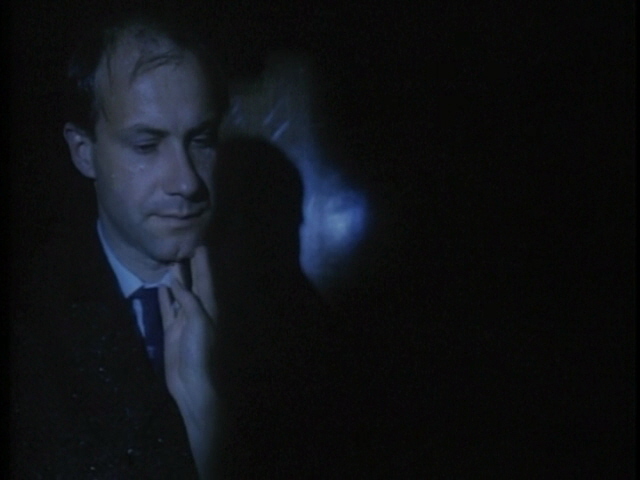
Francois Truffaut’s 1960 comic-noir offering both defies and fulfills genre expectations. The contrasts are everywhere. Often funny, its tragic undertone is never far from the surface. Amorous escapades and freewheeling music buttress the tension felt as the thin plot rolls along. Irony inhabits a reference to peace sought by the US in John Wayne’s Torpedoes in Alaska. A married bar owner masks his continual pursuit of a young employee in painting himself as unlucky with women. Not only do these contrasts provide interesting and complex characters for Truffaut to investigate, but they also become the points at which we encounter meaning. It is in these contrasts that questions are raised about whom these characters really are, why they do what they do, and how they conceive of life.

The opening sequence offers several such moments. Immediately after the credit sequence, which features a static shot of the insides of a piano as Charlie presumably plays a little pop ditty repeated throughout the film, we see a man (whom we later learn is Charlie’s brother) running through the streets, being chased by a car. The sequence is edited briskly in stark contrast with the credit sequence, as Chico runs up and down streets, in and out of shadows. It ends abruptly when, out of breath and energy, he runs into a lamppost and falls to the ground. The opening static shot evokes a kind of playfulness (through the tune) in the midst of an overall stillness (through the piano). The motion is controlled, yet suggests a certain kind of beauty. The chase sequence, on the other hand, is deadly serious in its intensity, full of motion, and completely out of control. There’s anxiety to Chico’s life as he makes his break. Thus we find here a contrast between controlled reserve and wild desperation, one that arises within Charlie himself often through the film.

The chase scene is immediately followed and contrasted in a number of ways by a discussion between Chico and the stranger who helped him up. While the earlier scene was harried through its extensive use of cutting, this one employs a long tracking shot of the two men as they walk down the street. Now Chico has caught his breath, though the focus here is primarily on the stranger who speaks rather eloquently about his lengthy marriage (he’s on his way home with flowers for his wife). The stranger exudes stability, having fought through some initial doubts about his relationship. While we know little about Chico at this point, he responds favorably to this man’s conversation, at the very least respecting his commitment and showing warmth to this man who helped him up. There’s a sense in which this scene serves as a kind of third way between the first two, offering stability, rather than precise control or desperation. It also sits as an ideal to look back upon as Charlie’s story progresses (most notably as a companion to the flashback sequence with Charlie’s wife).

Once they part, Chico makes his way to his brother Charlie’s place of work. While Chico appears warm, albeit desperate and helpless, Charlie immediately strikes the viewer as cool and aloof towards his brother. Thus, while we, at least briefly, side with Chico, we also realize that as the titular character, Charlie at the very least requires our full attention. The impression of these two is quickly complicated by Chico’s carrying on in the bar while Charlie carries himself with a certain quiet confidence that results in him helping his brother to escape. Further, our intro to Chico is through his scared and tense facial expressions throughout the chase sequence, while our intro to Charlie is simply through his music, without getting to see him. This serves to heighten the contrast between them in this first meeting, where Chico initially appears to be the more likable of the two. It also causes us to be more removed from Charlie at the outset, allowing Truffaut to slowly build this character throughout the film.

Then there’s the contrast within Charlie’s character, which is central to the film. Who is this man? What drives him? What is he all about? Our very first moment with him has Chico calling him Edouard, and he demanding to be called Charlie (a point that is later explained by a flashback to his past). This inner contrast continues throughout the film, not only through his dual identities, but also through his action or lack thereof. In the first bar scene with his brother, he doesn’t want to get involved in Chico’s troubles, but then his assistance ends up being the sole reason his brother gets away. His timidity is apparent to everyone, yet he’s found to be rather aggressive in the bedroom.

All of these contrasts serve to set us off balance regarding the action and the characters, Edouard in particular. What will they do? What will happen next? Truffaut uses the device to keep us guessing throughout, never tipping his hand. And even in the film’s conclusion, another static shot, this time of Charlie rather than the piano (though the song is the same), we are left with more questions than answers. Has he retreated into his timidity, or does he sit at his piano waiting for another opportunity to engage and truly live life? This is the final contrasting question, one that makes us unsure about the future of this character. But more profoundly, one that calls us to the same question. We too, like Charlie, have experienced successes and tragedies, good and evil, hope and despair. In the end, we go back to the mundane of life and are faced with the daily decision to retreat or engage.
Red (1994)

The third film in Krzysztof Kieslowski’s Three Colors trilogy, Red portrays a movement from cynicism to hopeful innocence, from death to life, and ultimately, from isolation to connection. Yet this movement appears in a universe where it is difficult to determine the difference between fated events on the one hand, and the utter randomness of Lady Luck on the other. This ambiguity brings a freshness and vitality to the proceedings where lesser films are crushed as the gears of plot groan into motion.

Red introduces us to Valentine (Irene Jacob), currently living in Geneva apart from her busy and brusque boyfriend Michel. She’s a model who’s just agreed to a photo shoot for a bubble gum company, part of an ad campaign creatively titled “A Breath of Life.” One cannot help but appreciate the characteristic underplayed Kieslowskian humor here. One night while driving home, Valentine runs over a dog, Rita, and upon returning her to the address on the collar, meets with a rather unpleasant old man (a retired judge, played by Jean-Louis Trintignant) who tells her she can do what she wants with his severely injured pet. Valentine, befuddled and hurt by his insensitivity, fires back a penetrating question about whether his daughter would merit the same concern, and storms off to get the dog medical attention. The film follows both the developing relationship between Valentine and the judge, as well as a parallel story of sorts with a young law student and his girlfriend. There are three strange, and what might be considered throwaway moments that help to bring the film and its concerns into focus.

The first takes place early on, the day after Valentine’s initial meeting with the judge. She has since brought the dog home from the vet, and as is her habit every morning, she heads down to the corner store and plays a single coin in the slot machine. She’s prepared to lose, which as we see in an earlier scene, seems to indicate all is right with the world. Yet on this day, three cherries come up, many coins fall out, and Valentine is left nonplussed. After a moment’s reflection, she notes to the store keeper in a rather dour way that she’s pretty sure she knows why this happened (a reference to the incident the night before). Why so gloomy though? A scene like this flies in the face of common human experience. Most of us, when presented with large amounts of money, tend to be pleased rather than distressed.

By including this strange reaction, Kieslowski sets us up for the ambiguity between fate and freedom. Valentine’s reaction points out that all is not well in her world. Something is amiss, though even she can’t be completely sure of the exact cause yet. The slot machine victory seems like a fluke, but do we really know that? For Valentine, the corresponding event of hitting a dog also seems fairly random, yet what if it isn’t? What appear to be chance events in the lives of these characters are actually leading to greater things far beyond what they can imagine. Valentine seems to recognize this, even as she cringes at what the consequences might be.

The second strange moment comes not long after. Rita is healed, so Valentine decides to take her for a walk, letting her loose in the park. Rita immediately dashes off, while Valentine gives chase into a church where the Mass is being given. It’s a comic scene to be sure, as Valentine asks the priest at the altar if he’s seen her lost dog. Yet, is it wise to think of it as just that, or is something more going on? It seems such a strange moment, but I have too great a respect for Kieslowski to believe he just chose that location at random. Placing the scene in context, the dog ultimately leads Valentine back to the judge’s home, where they have the first of their three lengthy conversations. Thus, in the midst of this journey to solidify the central relationship of the film, Kieslowski has his heroine stop in a religious service. That he makes it a comic scene takes a little of the pretentiousness out of the moment, all the while leaving its significance. God’s presence is hinted at even in this simple transitional moment. All the while the main characters simply act and react as they normally would. For Valentine, that means following Rita until she makes sure the dog is safe. What we have here then is a recognition of transcendence in the midst of the common reactions of regular people. Yet while we have a hint here at who might be guiding or at least overseeing these events, one cannot help but wonder if the path leads anywhere in particular.

Finally, in a moment near the end of the film, Valentine invites the judge (now, safe to say, her friend) to a fashion show in which she’s modeling. He lingers afterward, hoping to speak with her, and as she walks out, still on stage, she sees him in the seats and moves in his direction. As they approach one another, she on stage, he in the seats, Kieslowski places his camera on her from an extremely high angle, causing her to tower above the judge in quite an extreme way. The moment is visually notable, allowing us to identify first with the judges lowliness and humility in her presence. Before he looked upon her with suspicion, anger, and pride, having no time to even answer the door or look at her when she left. Now though, he comes to her, waits for her long after the show ends, and places her on a pedestal. She has come to represent life, innocence, and community for him, things that have become realities in his life through her presence in it.

These three moments might be considered throwaways in a movie like this. They are certainly too brief to be considered on par with the first lengthy conversation between the judge and Valentine, a scene that crackles with tension and emotional power. Yet, the moments noted here are illustrative of Kieslowski’s work, in which no moment is random, no camera move left unconsidered. Yet somehow, even with such precision evident in his work, Kieslowski is also able to open us up to an unseen world that is far greater and more mysterious than a few words here can begin to comprehend.

Au Revoir les Enfants (1987)

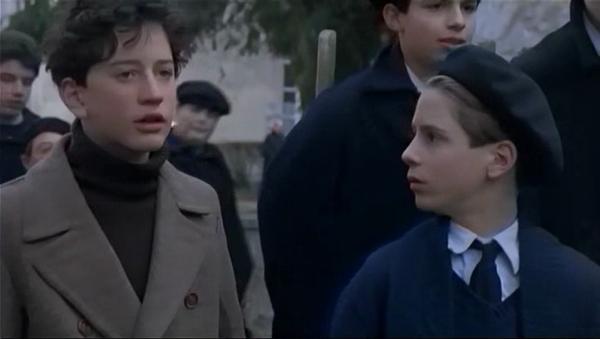
Louis Malle’s Au Revoir les Enfants follows the fate of two boys, one Jewish (Bonnet) and one not (Julien), at a secluded Catholic private school for the children of the rich. Malle begins his film on a train platform in Paris as Julien, a boy of twelve, says a painful goodbye to his mother. The simple scene belies its complexity, as it exhibits an intricacy that is evidence of a master in command of his craft.It is in the middle of WWII, and the boy feels the pain of separation acutely. If he isn’t actually crying, we know he wants to. Still feeling the longing of a child, yet needing to act grown up beyond his years, the tension within bubbles to the surface as Julien lashes out at his mother. We know he doesn’t hate her, in spite of his words. Yet as children are wont to do, he offers an extreme emotional reaction in lieu of expressing his true feelings.

Early in this scene, Julien’s mother says hello to some children passing her to board the train. The subtle irony of this statement, both in light of the film’s title and the fact that these boys are leaving to go somewhere further illustrate the isolation of Julien from his mother. He wants nothing more than to stay at home with her, yet she is happily greeting other children while he gets ready to leave.

Julien’s isolation is seen also in the disconnect between he and his older brother/fellow students on the platform. His brother playfully makes fun of him in the midst of this difficult separation and illustrates his own independence from his mother by smoking in front of her. Julien also expresses disdain for his fellow students, no doubt feeling the sting of his upcoming separation.

The complexity of Julien’s character is further compounded for us as his mother, in a poor attempt at comfort, wishes that she could dress as a boy and be with her son all the time he is away at school. Julien is at a significant moment in his life – being forced away from his mother, yet still a child desiring her embrace. When his mother kisses him goodbye on the forehead, he boards the train with the red lip print still visible. He is so lost in his anguish that he cares not for appearances.

Thus, in a simple goodbye scene that takes place on a non-descript train platform and lasts not longer than two and a half minutes, Malle has essentially established the depth of his main character, the one through whom we will experience the events and people in the film. He’s isolated, frustrated, angry, and sad. The union Malle exhibits between economy and complexity marks the entire film – simple scenes filled with details that enrich characterization, evoke the time and place, and subtly walk us into the loss of childhood that Julien experiences.

The World (2004)

Jia Zhangke’s The World takes place in a theme park a few miles outside of Beijing that includes scale models of many famous world landmarks, thus offering the natives an opportunity to “travel” without the pricey airfare or time commitment. The film invites us into the lives of two of its employees, Tao and Taisheng, both of whom have come from their villages in rural China to make something of their lives, and are now dating one another. One of the central questions the film raises regards the wisdom of such a choice, as the protagonists are constantly isolated and frustrated in their urban world, usually communicating more through text messages than in person. Are they better off than they had been?

The film’s opening scene is brilliant in implicitly bringing forward the film’s central concerns. It is a continuous shot of Tao walking down a plain, painted brick hallway backstage before her performance in a flashy dance number for the park’s customers. She is dressed in elegant robes, bejeweled, with her hair beautifully braided under a veil. One’s immediate impression would be to suspect she is some kind of royalty were it not for her surroundings – the aforementioned hall, filled with pipes running over a hard cement floor. The contrast between setting and costume raises implicit questions about the reality of Tao’s situation that are connected to the idea of the park itself: What are the results of this fake finery and scenery, both for Tao, and more broadly, for the Chinese people who participate in this as employees and paying customers?

Jia tips his hand even in this early scene, because as Tao walks the hall, she calls out for a band-aid, over and over and over again (so many times in fact that I suspect I figure I’ve got this Mandarin phrase down pat). We cannot see her wound (nor do we ever, it remains off camera), but she calls out anyway, each time receiving blank stares or a curt “no” from other performers in their dressing rooms. No one seems to be able to help Tao with her problem. While she eventually pesters someone into getting her a band-aid, the stage is set: this woman has a problem, and its solution is terribly difficult to come by.

The director’s stroke of genius is that through a detailed focus on the lives of Tao and Taisheng, he implicitly broadens the examination of this question throughout his film through various encounters the two protagonists have. It comes to include not only other poor villagers who come to work in the city, but also those rich businessmen who are also being changed by the opening of China to the rest of the world. Jia’s wide, long shots contribute to this poignant and dark vision of a new world.

Blue (1993)

During Julie’s journey from life to death and back to life again, everything in the world seems to be calling out to her, reaching for her in her self-imposed grave, to pull her back toward life, love, and goodness. Of course, the most obvious example of this is the music that breaks into her world all the time, the music that she desperately wants to forget but cannot. But it goes beyond that: chance meetings with strangers and people from the past, a puff of wind blowing her door shut, and a glimpse of herself on the television. Julie is trying to forget, to become like her ailing mother, removed from any reality, any pain, any tears. Everyday is a new day for her mother. For Julie though, in spite of her best efforts, she is painfully aware of the same thing, day in, day out.But it is in this very awareness, in the midst of her pain and suffering that she ultimately finds a kind of grace, resulting in life. Kieslowski’s world is a complicated place, filled with suffering, yet at the same time calling Julie toward new life. Thus, there is this struggle between pushing away and pulling back in. She loves me, she loves me not, indeed. This is both the way of Kieslowski’s world, yet it is also illustrative of Julie’s interaction with her past and those around her – pushing away from her former life, but never for a second being able to resist the urge to reach out for it, to stop the music in her head, to destroy those final mementos of that former life.

What’s interesting about Julie’s choices in the aftermath of the accident is the way in which she ends up cut off from everything and everyone. Even in her extreme moments (most notably the night spent with Olivier), she remains aloof. Her existence after that is very much like a hermit. She speaks as little as possible, goes out rarely, isolates herself from everyone, and descends almost into a kind of nothingness – an attempt to escape memory and thought. It is in her decision (or maybe that’s too active; let’s say experience) of living in this void that she hears and is ultimately able to receive grace.

I cannot help but wonder then, amidst all the noise of normal life, if Julie would even be able to hear the music blasting into her world as she does in the film. Would her surprising encounters with the boy, Olivier, and Lucille have had the kind of impact they did if she had been surrounded by the noise of life? What if she had not been paralyzed by fear of the rat and its babies for days – a fear that eventually pushed her out beyond herself, taking uncertain steps outside her world? What do these questions reveal about her mother, constantly in front of the television, supposedly connected to the world, yet with no idea she’s speaking to her own daughter?

Could it be that Kieslowski is suggesting, with his typical light touch, that Julie’s retreat from the world of the living was somehow necessary to allow the power of grace to pull her back toward life? Had she not done that, instead filling her life with everyday noise and responsibility, what would have become of her? Might she have become her mother, alive, but not really living? It seems that in the end, Kieslowski recognizes the tragedy of suffering, but also its converse: that same suffering works in its own way to bring life. Maybe one will find regret or sadness there. But having walked through such a valley, one also finds a rich and deep appreciation for this life, a belief that things can get better, and a comfort that the world works in such marvelous, life-giving ways.

Army of Shadows (1969)

[I was fortunate enough to catch this on the big screen here in Dallas. I for one am glad to see a recent spate of older films being scheduled at the Angelika. Good for them. I hope they continue it through the fall.]

From its opening printed line, which welcomes bad memories because they are reminders of one’s youth, Jean-Pierre Melville’s 1969 masterpiece, Army of Shadows brings its audience into the horrors and exhilaration of war. These horrors though are not primarily related to physical violence, but rather the violence done to one’s soul.

On its surface, the film tells the story of a segment of the French resistance in WWII, using a stripped down, minimalist style. Philippe Gerbier (Lino Ventura), a former engineer, plays a pivotal role in the resistance as an organizer and liaison to the leader of the anti-Nazi faction. Generally stone faced, but not without his own fears, Gerbier understands that certain things simply must be done, no matter how unpleasant or dangerous. Whether it’s jumping from an airplane, distracting a German soldier, or even killing a man, he continues to influence the resistance for good because of his willingness to act. Not all follow through like Philippe. Not all have his courage. And it isn’t easy to separate the wheat from the chaff.

Melville’s style, which is pulled back, offers most scenes in medium or wide shots, the camera generally keeping multiple characters in the frame at all times. The actors underplay their scenes, only occasionally emoting. By removing these visual and emotional cues, Melville places his audience in the position of these resistance fighters. No one is really sure what anyone else will or won’t do. Neither can the characters be sure of anyone’s trust. This uncertainty is one of the dehumanizing effects of war. The characters become isolated from one another. They may work well together on this mission or that, but the nature of their relationships are skewed because of their circumstances. This is poignantly illustrated in a scene between Philippe and Mathilde, when, after having narrowly avoided disaster, have a quiet moment of connection. After a few brief seconds, they return to their harder, military selves, leaving the moment in a haze behind them.

Another disturbing effect of the war can be seen in the code these resistance fighters are compelled to keep. When a friend gives names to the Nazis, the penalty is death. When captured, the only option is to attempt suicide or escape. When a German stands between you and freedom, they must die. This harsh, tense existence wears on the freedom fighters. Each new friend that is captured, dies, or becomes a traitor is a deeper blow to the cause, and just as significantly, to themselves. Each person they are forced to kill steals a bit more of their humanity from them. Constantly living on the edge of life and death, being forced to place an ultimate trust in people you hardly know, and never being quite sure how much good you are doing leaves these fighters in a constant state of flux, becoming shadows of their former selves.

Finally, while these people are all part of the resistance, Melville significantly never actually shows them at work against the Nazis. Sure, someone delivers an illegal transmitter or provides a safe house for another fighter, but what are they really doing outside of perpetuating their lives? They make rescue attempts for imprisoned fighters, travel to England for aid, and eliminate their own when they betray the group. Thus, this shadow army, at least in terms of action, is invisible to all. And the longer they are part of it, the more they become shadows themselves.

Forgiving Dr. Mengele (2006)

I have found myself in recent years increasingly wary of films that deal with extreme real-life tragedies or genocide, not because I am not interested in such topics or because I fear being overwhelmed by the subject matter. Rather, I am not interested in filmmakers who have little to say about such important subjects, simply using the tragedy to wallow in the heinousness of it all. Neither do I want to become numb to tragedy in the world. Thus, when I first heard about Mengele, a documentary covering the crusade of a holocaust survivor, I noted it and moved on.

Now that I’ve gotten a chance to see it though, I’d suggest this is one of the most important films about the Holocaust (and more broadly about tragedy) I am familiar with. The film gives us little new information about the genocide itself. Rather, it focuses on one woman’s response to her experience at Auschwitz. And if you’ve seen the title, then you can guess Eva Kor’s response to her captors.

At the age of 9, Eva and her twin sister Miriam were sent to Auschwitz, and survived initially simply because they were twins (who were favored for experiments by the Nazis). Mengele’s experiments involved injecting one child with a drug, and then charting the differences in the two children afterward. Eva and Miriam suffered through this for 10 months, with Eva near death at one point. Yet, as she says, she willed her way through the illness, and eventually, walked out of the camp with her sister. She eventually married another Holocaust survivor, moved to Indiana, and got started in real estate. In the early portion of the film, the interspersing of concentration camp footage with Eva’s daily routine evokes the way in which those images must have haunted her over much of her early life in the States.

Yet as her sister struggled and eventually died an early death from a kidney problem associated with their time in the camp, Eva is confronted with a desire to take action and help her. In the process, she meets a Nazi doctor, who was also at Auschwitz concurrent with Eva. She finds he too has nightmares, and struggles with his experiences there just as profoundly as she. This leads her to spontaneously offer forgiveness to him, a decision that eventually results in her forgiving all Nazis, including the head doctor at Auschwitz, Josef Mengele.

Even as Eva does this, she stirs great controversy in the Jewish community, many of whom don’t feel Eva has the right to forgive any Nazi, much less Mengele. Several responses to Eva’s act are interwoven through the film: She has no right to speak for other Jews, her comments could imply she is speaking for the dead, she dishonors her parents who also died in the camp, her decision implies she is willing to forget the evil committed in the Holocaust. Yet Kor fiercely stands by her decision, arguing that forgiveness will “heal your soul and set you free.”

Most interesting about this film is the complexity involved in its portrayal of forgiveness. What is forgiveness? What does invoking it entail? No one seems to know definitively. Everyone seems to have their own perspective. Does it mean one forgets the past? Does it mean one excuses the past? Is it necessary for the perpetrator to be sorry before one can forgive them? If so, how can one ever forgive Mengele, long since dead? Are those who suffered under him or other dead and/or non-repentant Nazis doomed to live as victims the rest of their days? How does forgiveness apply in current conflicts one has with others? Do the rules change? Is it harder or easier to forgive the living?

This film satisfies largely because Kor’s answers to a number of questions above resonate deeply within me. No, forgiveness does not entail forgetting or excusing the evil act. Neither is it dependent on the offender to be sorry. Forgiveness is an act which the victim bestows on another. It is an act they perform. No one can take it from them. All people have the option to forgive, to move beyond victim status and into a fuller life that looks forward in hope, rather than back in pessimism. And yet, in spite of all this, Kor is far from perfect, though she refreshingly recognizes her own limitations, and seems, at least to this eye, to be moving forward, bettering herself, and working out how one forgives, not just for the past, but also for the present. The doggedness and optimism in Kor is a refreshing antidote to the horrors of the genocide she and her people were subjected to.

Decalogue IX (1988)

Decalogue IX begins with Roman receiving some stunning news from his doctor – he is impotent, and will never be with a woman again. Kieslowski takes this simple moment and in light of its consequences, fashions characters that struggle with anger, frustration, loneliness, fear, jealousy, and brokenness. Throughout the Decalogue he places his characters in the midst of ethical dilemmas that challenge their thinking on any number of levels.

Most obvious in this film is the interplay between different kinds of truth and the falsehood that is borne out of that interaction. The first line of the film is the doctor asking what Roman wants to know, to which he answers: “The truth.” He believes that the doctor has reliable information that will determine the rest of his life. Roman, also a doctor, understands this kind of truth, based on observation of physical elements. It makes sense to him. It is objective, and can be trusted.

When he arrives home though, he is confronted by a kind of truth that isn’t scientific, but is rather based on personal commitments to love and be loved. His wife, Hanka, reacts out of love – maybe Roman won’t always have this condition, and it really doesn’t matter anyway, because love is more than, in her words, “what’s between your legs.” So, Roman’s physical and objective truth crashes against that of his wife, an inner, emotional truth. The distinction might be characterized by a rational versus a relational truth. Yet, neither of them is really prepared to deal with the world as seen by their spouse, thus breeding lies, deceit, and mistrust. A change is reached when, on that first night, Roman suggests Hanka find another man to be with. Her reaction that he shouldn’t say such things shows not that she abhors the idea, but simply that certain things should go unsaid. This decision toward infidelity only causes the pain to increase, and their lives to spiral further out of control.

The deceit in their relationship changes their vision of one another. At least three times, Kieslowski uses distortion and darkness to show the limitations of his character’s vision. First, at separate points in the film, the director shoots both Roman and his wife Hanka in their apartment through a glass on a shelf. As they walk past the glass, their image breaks apart. We can still see who they are, but something about their form isn’t quite right. Second, when Roman finally returns home from his trip to the doctor, he and Hanka ride up the elevator together in darkness. The light through the windows alternates, first over her face, then his. They are together, yet separate. We merely see glimpses of them, though never at the same time. Finally, the most famous limiting shot in the film comes when Roman has hidden himself in a cabinet, waiting for the meeting of his wife and her lover. Kieslowski shoots the entire scene through the crack in this cabinet, as the camera sways back and forth, trying to get the best angle on the characters moving around the room. Only at this moment, with his (and our) vision so limited, does Roman begin to really see his wife. And only then does Hanka see what kind of pain Roman has been in.

The lies that limit their vision of each other surface because the couple is trying to deal with an inability to communicate when their lives spin out of their control. Kieslowski uses an interesting visual cue to heighten this reality. Early in the film, as Roman drives home, the glove compartment in his car falls open. Later, when it occurs again, this time with Mariusz’ school papers in it, one might be led to think this was merely a device to move the plot along. Yet it happens a third time, after Roman has spied on his wife and Mariusz during one of their rendezvous’. He has been helplessly sitting on the stairs listening, then had to hide as they each left the apartment. He has no control over them or himself. He can’t stop their meetings; neither can he stop himself from spying. He’s angry, frustrated, knowing he suggested this course of action, but also knowing how wrong it has been. At the height of this, as he climbs back into his car, that compartment falls open, and we see that all along, Roman has had no control over his life. By all appearances he would – successful doctor, beautiful wife, patients who trust and like him. Yet with his diagnosis, his ensuing choices, and now the confirmation that his wife has been with another man all lead to his life spiraling out of control.

And so, in the midst of jealousy, loneliness, and anger, he decides to take control of his life – through suicide. With everything about his life in chaos (at least from his perspective), he takes control the only way he can. Ironically, he doesn’t succeed; he has no control over the end of his own life. Hanka has come back from her trip to try and find him, desperate to repair what’s been broken. And lying in a hospital bed, covered in a body cast, completely at the mercy of doctors, he speaks to his wife on the phone. She says: “You are there. God, you are there.” To which he replies: “I am.” Fade to black with the sacred sounds of Van den Budenmayer playing in the background. Those unfamiliar with the biblical text will miss part of the significance of those final lines. Yes they will be together, yes they want to fix things, but there is more. In a world spinning out of control, Roman utters the name of God from Exodus 3: I am. God is indeed there, and while the situations of life make no sense, there is someone greater in control. Thus Kieslowski, the ever-spiritual director, leaves his characters with the comfort of knowing they are not alone.

Trial of Joan of Arc (1962)

Robert Bresson’s 1962 version of this famous historical event, based entirely on the minutes from the trial, provides a claustrophobic, reverent, and surprisingly brisk walk through significant moments in Joan’s final days. Clocking in at a mere 61 minutes, Bresson’s frequent cuts make the film feel even faster than it is. Constantly the camera cuts away from Joan to those scrutinizing her, and then back again. Some look upon her with sympathetic eyes, though most feel little beyond disdain for her, most often, it seems, for political, rather than exclusively religious reasons. This way of shooting and editing the piece serves to heighten Joan’s alienation from those around her.

The trial tends to focus on religious elements, which makes sense, since Joan was tried by an ecclesiastical court, headed by the Bishop of Beauvais, Pierre Cauchon. However, there was far more in play here beyond a simple theological dispute. Joan, having been involved in what amounts to a civil war in 15th century France, had been captured by the Burgundians and sold to their English allies. It was under these inauspicious circumstances that the trial was conducted. Bresson cleverly highlights the political nature of the trial with brief scenes before and after the day’s proceedings or in and around Joan’s cell. The bulk of the action takes place in the courtroom – a theologically driven question and answer between judges and accused that sees Joan fielding questions from at least three different men who often attempt to trip her up with their adroit queries.

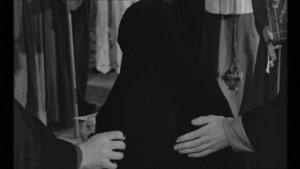
Most interesting about the film is Bresson’s focus on the physicality of his characters. In typical Bresson fashion, he focuses his camera on the bodies of his actors, especially their hands and feet. The opening shot of the film pictures the walking feet of three people (including Joan’s mother), on their way to Joan’s rehabilitation trial some 25 years after her death. Once there, Joan’s mother is held up by the hands of monks on either side of her. As she’s turned away from the camera, reading a prepared piece about Joan, those helping hands are the most notable elements in the shot.

Contrast that opening sequence with the film’s conclusion, as Joan makes the long walk to her place of execution. Bresson refuses to point the camera at her face, preferring instead to show her bare feet, in a continuous shot, walking along the broken stone. In this sequence, the feet of many onlookers stand in the background, one of whom even sticks his foot out to trip her (in case one wondered if they had any pity for her). Then, as Joan is being consumed by flames, Bresson shoots part of the scene from behind, where we see her hands, chained to the post, reach out in pain. Joan’s naked feet and chained hands are quite a contrast from the clothed feet and soft hands of the intro.

Yet, even in that most difficult moment when Joan is so alone, those naked feet are a marked contrast from her chained feet throughout the trial. Consider the first time she is brought back to her room. The guard chains her foot to the immovable beam as Joan weeps at the edge of the bed. She is captive, with no sign it will end. Yet as the film concludes, and Joan makes that long walk over the stony path, her feet, while naked and accompanied only by a dangling cross, are free as they move toward impending death. There is a courage in those bare feet, a courage that evokes the one to whom she serves and entrusts herself.

Masters of Russian Animation, Vol. 1 (2000)

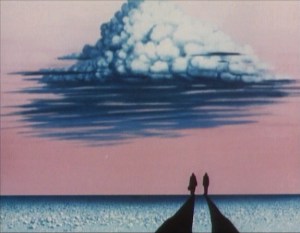
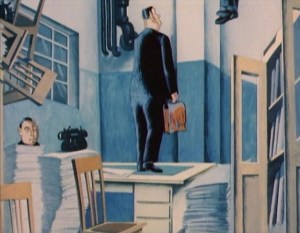
The first volume in this series from Image Entertainment is always interesting and engaging. While containing ten short, animated films, it generally is not aimed at children (though I suspect they might enjoy the fable-like My Green Crocodile or even the silliness of Passion of Spies or Singing Teacher). The films themselves range from funny and satirical on the one hand, to tragic and surreal on the other. The above image comes from There Lived Kozyavin, probably my favorite of the collection. I’ve included comments on three films for your perusal.

Man in the Frame (1966) (dir. Fyodor Khitruk)

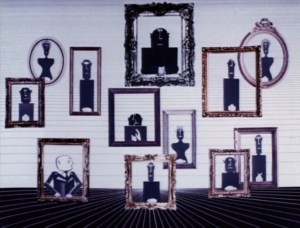
Director Fyodor Khitruk’s second short on this disc is about a single man who spends his days boxed in by a frame, hanging as a picture on the wall of life. The first frame he has is simple and non-descript, but as he gets older and makes his way up the ladder of government bureaucracy, the frame becomes more ornate, yet never really any bigger. Finally, in a critical moment to possibly find meaning at the end of his life, having reached the top of the working world, he ignores a desperate cry for help coming from outside his comfortable dwelling. This immediately leads to a final ascent heavenward, where the man sees objects passing him from earlier in his life – statues collected, papers signed, a woman he once loved, and finally, the playfulness and freedom of a child jumping rope (all images from earlier in the film). The film concludes with this high government official being boxed in by ever smaller frames – a surprisingly tragic ending that is intriguing for its critical perspective of the government, or at least those who work in it.

The animation here varies between traditional hand drawn and actual photographic images. His co-workers sometimes appear to be cut-outs or shadow puppets, a la Lotte Reiniger’s Prince Achmed. The photographs come primarily near the beginning of the film in a sequence that stands out due to its rapid editing of what appear to be disconnected images of life in general. I was reminded of the beginning of Bergman’s Persona in this sequence, though here the images are much more life affirming than those from Bergman. Later, the still image of the girl jumping rope comes back, and the camera dwells on this image of freedom, with a simple up and down motion over the picture to give the sense of movement, something the man in the frame never really experienced.

There Lived Kozyavin (1966) (dir. Andrey Khrzhanovskiy)

This is another favorite, about a man named Kozyavin who does a desk job, shuffling papers (The first moments of this film reminded me of the stacks of papers surrounding the protagonist in Kurosawa’s Ikiru). At the end of the workday, Kozyavin’s boss pulls him aside and asks him to find another employee named Sidorov, pointing in the general direction that he might be found. Kozyavin, the ever-dutiful employee, follows that direction literally. He will not deviate from the path marked out by his boss, which means he quickly exits the building and begins a trek across town. This journey is the bulk of the film, as Kozyavin ends up traveling around the world in search of this employee. His single concern is to find Sidorov, even if that means ignoring a robbery in progress or crushing a stunning archaeological find because it was in his way. As we follow our protagonist, we wonder if he will ever reach his goal, or conversely, if it is within him to give up the journey.

The look of this film is distinct from the other entries in this series. There is a surreal quality to it, at times reminiscent of a Dali painting, what with stairs on the ceiling and vast desert expanses. The characters have a shading that gives a dirty look to them. All kinds of obstacles come across Kozyavin’s path. For a while, we are overwhelmed with images of industry, which at times goes awry, is dangerous, and makes it impossible to communicate with others. Kozyavin goes through an ornate museum, a desert wasteland, and literally around the globe. It’s always an interesting film to look at, and its implicit critique of the government and simple minded employees is surprising due to its timing and country of origin. Clearly much was happening in the Soviet Union at the time beyond what was presented outside the country. This film is a great testament to that.

Glass Harmonica (1968) (dir. Andrey Khrzhanovskiy)

This could qualify for the most unique film of the collection, about a stranger who arrives in a city with a glass harmonica. The instrument appears to have magical powers, and as the man plays it in this city fraught with greed, there is a sense of awakening among the inhabitants. At one point, a flower is formed from the music as it flows through the crowd. However, the evil, black-clad leader of the city breaks up the concert and taps into the people’s greed once again. All that’s left is the single rose; though will anyone set aside their greed to pick it up?

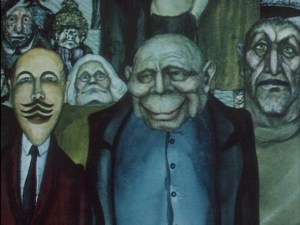
The animation here, in color, takes pieces of classic works of art and mixes them into the action in place of characters. The characters don’t move fluidly as a result, and their faces have a single expression, but the detail of the animation is really something. Once their greed kicks in, they almost appear as cockroaches as they scatter from the harmonica in a wide shot. They are off on another job, this time to dismantle the city clock (everyone takes what he can get). Later, as their greed completely overwhelms them, many people turn into strange creatures. Most of the people were distorted (extremely short, fat, giant heads) to begin with, but this takes things to a new level. This is the richest animation of all the films in this collection. Quite a treat.