Lake Tahoe (2008)

Lake Tahoe is the kind of film that proves the old axiom true: looks can certainly be deceiving. Its slowness and stillness hide its comic sensibility. Its lightest moments cover over something deeper and more menacing. And that churning menace masks a hard-won hopefulness and sense of expectation that undergirds the entire film.

Opening on a sandy but desolate landscape, director Fernando Eimbcke holds a stationary and extremely wide shot for several seconds, with only the sounds of wind and a far off automobile accompanying the stark imagery. Eventually the opening image fades to black, and when the picture returns, the camera has moved in much closer. Now a road sits in plain view, with a few telephone poles lined up on the far side of the street, while the wind and that passing automobile remain evident to the ear. After several more seconds and another fade, we get the sound of a car crash against the black screen. When the image returns, a red Nissan has crunched its front bumper into a telephone pole.

As the teenaged driver exits his vehicle, it’s clear that the car won’t start. And evidently without a phone (and none in sight), he begins to walk. What follows is a slightly surreal or absurd journey of a young man in search of a repair. As he moves through what appears to be a largely desolate town, Eimbcke uses the fade to black as a buffer between each sequence. The directorial choice stands out a first, but also allows the film to settle into a kind of rhythm, a bit like breathing. This rhythmic breathing throughout the film contrasts strongly with the circumstances of the young protagonist, whose life is even more out of control than it initially seems.

The form of the film, both in the stillness of its camera and its consistent rhythm provide an effective counterpoint to Lake Tahoe’s main narrative arc. This strengthens the dramatic tension only hinted at in the story over the course of the film. That Eimbcke is able to create this kind of tension with such a pulled back narrative is a testament to his skill as a filmmaker. I look forward to seeing more from this exciting young director.

Avatar (2009)

Well, it was pretty.

Avatar has received quite a lot of publicity, even if the majority of it seems more about economics than it is about the experience of the film itself. While the half-a-billion dollar movie has gotten nearly universal acclaim for its use of CGI, the story and dialogue have received more divergent commentary.

And rightly so. The voice over narration nearly sinks the ship in the first half hour or so. And occasionally the characters move a little too conveniently into sermon mode. On one level, Cameron’s story of the broken down Marine who would rather live as another being is naïve in the worst way. It thinks little of humanity, conceiving that our true nature is something purely immaterial, and that our bodies, once broken can be replaced for another, better model. Beyond that, virtually none of the humans that populate are worthy of being called human. Most are a nameless mass that serve one of only three non-scientists introduced in the film—the bloodthirsty military commander. A few have been enlightened by science, but most have no problem following their commander’s orders when it comes time to destroy an entire civilization. Finally, the devaluation of the human body through the narrative arc of one significant character strongly reflects our own world, in which people increasingly relate to one another by means of technology. That the film is unable to comment at all on the pitfalls of such a life doesn’t at all speak in its favor.

Interestingly, the film seems consumed with the bodies of the Na’vi, which are on display throughout. Not only does their blue skin draw attention to them in contrast with the browns and grays of the human world, but the camera often lingers (if we can even say that about a movie like Avatar) on their bodies. As such, the film highlights their lean and athletic builds, fanged teeth, and elongated foreheads. Beyond that, the physical aspects of Pandora shine in comparison to those of the human base (or even earth as we know it). There seems to be in the film a desire for something greater and beyond what we currently experience as humans (a desire that at some level we can all appreciate). However, the film seems to think that the only way to experience that is to, like Jake, trade in our bodies and be incarnated in some other kind of race.

In light of this perspective on the human body, it’s intriguing that the humans are associated so closely with science, while the Na’vi are associated with religion. The humans can only mimic true transformation through their invention, while the Na’vi can experience true transformation through a connection with some kind of spiritual being. Therefore, when the scenes of transformation finally enter the story, the dialogue largely drops away. There are no explanations of processes as there are in the science lab. There are no people fiddling with instruments and adjusting levels. The transformation, however it occurs, is cloaked in divine mystery. And unlike the illusory scientific transformations that take place throughout the film, this one, accomplished under the watch of the “primitive” race, is complete and true.

Not only then does the film side with the Na’vi, but it does so in a way that honors religious commitment. And it’s precisely that more spiritual component that is obviously lacking in the portrayal of humanity. This is what makes the film both interesting and infuriating. Interesting in that Cameron pushes the audience toward an embrace of an overtly spiritual reality, but infuriating because he has to do it by creating a human foil devoid of spiritual content. He could have made a much more interesting film had he made his human characters more complex in just this way.

Sure, it was pretty. But in the end, I wish Avatar had been a whole lot wiser about its portrayal of humanity.

Cry Me a River (2008)

Jia Zhangke’s 20-minute short film, Cry Me a River (which you can find as an extra on the Region 1 release of Jia’s feature 24 City), follows four friends in their late twenties (two men and two women) who have reunited to attend a dinner party in honor of their former professor. Jia’s camera tracks their movements over two days—playing basketball, revisiting old haunts, touring the city by boat and on foot, and of course, attending the dinner that’s brought them back together.

The meeting and meal with the professor takes place about one third of the way through the film, and this sequence, in which Jia uses only three shots, communicates volumes about the director’s concerns in the film as a whole, and also illustrates with striking clarity and efficiency why I appreciate his work so much.

Immediately following a brief tracking shot of the four friends walking to the dinner, Jia brings us directly into the dinner scene in the first of three shots at this location. The edit into this shot provides continuity with the previous shot in its focus on the four main characters of the film. However, it contrasts strongly with what has gone before in a number of ways: the stationary, rather than tracking, camera; the friends seated and still rather than walking; and the bright and colorful indoor setting rather than the drab and gray outdoor location.

This first shot (above) lasts for nearly three minutes, with the camera sitting stationary at eye level. Notice the modern looking dining table, the trendy and/or Western clothes worn by the attendees, the sleek glass—both in the open doors behind the table and the shelving or window in the foreground. The modern world dominates this shot, which is appropriate for what is, outside the professor, a crowd of twenty-somethings. The conversation tracks with the modern look of the shot, with the four friends discussing investments, economics, and the difficulty of survival in a newly westernized China.

After a man comes to pay their travel expenses—another reveal of their financial hardships—the others in the group (who had been standing out on the deck behind the table) file in to take their seats. With the group now gathered around the table, the professor offers a few words of reflection, noting that his students used to be wonderful poets. Now though, they no longer write. While it goes unsaid by the professor, the implication of his comments is clear: his students left behind the “impractical” and “useless” pursuit of poetry for the “practical” and “useful” pursuits of business and monetary gain. What better place for these young and upwardly mobile students to be in than a fancy western dining room?

When the group stands for a toast to celebrate the professor, we get another strong hint that the way chosen by these young students is not the only one available to them in China. In the doorway pass four people—two musicians heading to their instruments, and two dancers donning traditional performing makeup and robes. As the traditional Chinese music begins to play, it stands as a complement to the scene behind the chatter around the table.

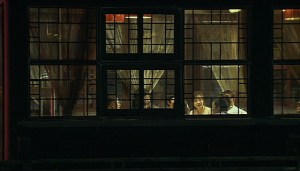
Jia uses a straight cut to shift to the next shot, which lasts just over 30 seconds. Now we see from outside the building, looking in at the dining room through the windows. The traditional music continues to play. Instead of a stationary camera though, we get a tracking shot, at first drifting slowly to the right before centering on the windows and the dinner party. Now the people are much less visible, generally only their heads popping up above the bottom of the window frames. Most obvious in this shot is the outside of the building, which is clearly a traditional Chinese structure. The criss-cross patterns in the windows are the biggest clue at this point. This traditional building was also suggested in the previous shot, as decorative eaves dropped into the shot from the top of the frame. We see then a group largely composed of people who have embraced the new modernity in China, yet despite their best efforts to surround themselves with western fineries, find themselves enclosed in a traditional world.

At this point, the camera begins to track back to the left along the buildings wall. Just as the shift takes place, we see the shadows of the dancers across a thin red strip at the corner of the building. The camera moves, eventually dividing the new and the old world distinctly, as we see in the shot above.

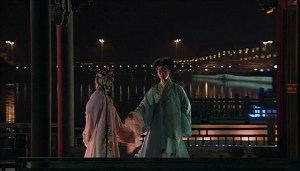
But the camera doesn’t stop at the split, continuing on to frame the dancers under a traditional gazebo, with red columns to the left. The costumes and makeup become clear now, a woman in a pink robe and a man in blue. They move to the music, which continues to play from some other unseen place on the deck. However, as the eye drifts beyond the performers, we see a short iron or wooden fence dividing the platform from a body of water. Continuing on, we see quite clearly a large modern bridge in the background, lit with electric lights and with cars speeding across it in the night. Now the traditional has taken the foreground, while the modern sits cold and distant in the background.

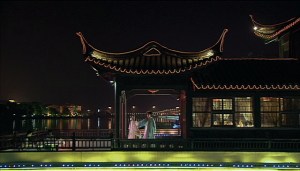
Finally, Jia makes his final cut to a shot that lasts about 10 seconds. It’s a striking long shot, encompassing the entire building and deck area in the shot. The building is more clearly than ever now a traditional Chinese structure with the decorative roof and walls. At the right side stands the main enclosure, with the guests still enjoying their meal in the room. In the center are the dancers, in the open air but covered by the gazebo roof. And finally to the left, for the first time we see the musicians playing completely in the open air. In the background, we get a different kind of progression, from a large modern building at the left, to the bridge in the center, and finally the whole landscape blotted out by the traditional building at the right. And though these three groups are separated by strong vertical lines (columns and walls), they are all ultimately joined by the yellow strip striking across all three areas below.

What we see here then is a beautiful illustration, both through the narrative and dialogue, and especially through Jia’s refined visual sensibility, of the complex relationship between tradition and “progress.” “Progress” seeks to move beyond the constraints of tradition; to either set aside or build upon the old in favor of the new. Yet Jia shows us here that even in humanity’s best attempts to progress, we still find ourselves surrounded by tradition, borne out of it and drawn back to it, however briefly.

Fantastic Mr. Fox (2009)

Wes Anderson makes family films—thankfully not films in the mold of a movie-of-the-week, complete with poor production values and a sappy ending. Instead, Anderson makes films about families, usually families under some kind of duress or struggling with various forms of dysfunction. And even if they’re not the main characters, it’s the fathers that sit at the locus of the narrative—one dad recently dead in The Darjeeling Limited, an absentee Steve Zissou in The Life Aquatic or Royal Tenenbaum in The Royal Tenenbaums, or in his most recent effort, a conflicted Mr. Fox in Fantastic Mr. Fox.

Up to this point in his career, Anderson has filled out his films with generally well-educated, white, and world weary characters. Nothing seems to surprise them—they’ve seen the world, and aren’t all that enamored with the place. There’s an ironic distance to most of their interactions, one that results in plenty of humor, but also one that after five features was beginning to grow stale.

On comes Fantastic Mr. Fox. While it undeniably feels like an Anderson film, continuing with a focus on father figures and carefully framed action, it also seems liberated from the almost singular focus on family dysfunction. That’s in part because, when we meet Mr. Fox and his family, they are a functioning family unit—they all live together, for one, which is a first for an Anderson film. But beyond that, we learn early on that Mr. Fox has sacrificed his career as master-thief for a life in the newspaper business—a job that puts food on the table but doesn’t provide the kind of satisfaction he once received from the thrill of the break-in.

That leads Mr. Fox to have an existential crisis which creates family drama, but that’s a far cry from the all-out dysfunction of Anderson’s previous films. And the film is all the better for it—looser, sillier, and extremely well-paced. What we witness instead is the way a few cracks in the foundation (Mr. Fox’s lack of respect for his promise to Mrs. Fox or Mr. Fox’s continual underestimation of his own son) are exacerbated in crisis; but also how those cracks can be repaired and fortified by relying on one another and sticking together through that crisis.

Anderson’s films always end on a hopeful note, but one that refuses to ignore the difficult realities of living life together as friends and family.  However, Fox feels like Anderson’s most unabashedly hopeful film yet. It avoids the heavily ironic and disengaged tone that was at its height in The Life Aquatic and The Darjeeling Limited—possibly a result of Anderson working with animal characters instead of humans. Instead, Anderson presents Mr. Fox and the rest of the cast in a more direct and lively fashion, rejoicing in their foibles and differences and ending with a series of images that evoke both laughter and delight. In the end, the great irony of the film is that Anderson finds the more liveliness in puppets than he has with humans in his last couple of films.

What we have here then is a first for Wes Anderson: a functional family that stays functional throughout the film. They start out together, persevere through their crises, and come out on the other side the stronger for it. That he pulls this off with it still feeling like an Anderson film (quirky characters, off-kilter humor, and moments of beauty) makes it one of the most enjoyable films I’ve seen in the last year.

Favorites of the Decade

The prospect of creating a list of favorite films for the decade both excites and terrifies me. I am certainly a compulsive list-maker, but with the number of films I’ve seen, and loved, from 2000 through 2009, the task seems a bit like choosing a favorite among my kids or deciding whether Crime and Punishment or The Brothers Karamazov is my favorite Dostoevsky novel. Either it just can’t be done—as is the case with my kids—or one day I might feel a stronger connection to one, only to see my loyalties shift the next day. Today, it’s Crime and Punishment.

That said, the first five entries on the list were shoe-ins. I couldn’t imagine them ever falling off. I’ve seen each of them multiple times (they hold up—an important qualification for making a list like this), and their artistry is without question. The other five might be replaced by films like Spirited Away, Punch-Drunk Love, Persepolis, Take Out, When the Levees Broke, or The Royal Tenenbaums, but in the end I have to admit a certain level of comfort with the list.

I am most pleased by its diversity—3 films from Europe, 3 from the U.S., 2 from Asia, and 2 from Iran. (And honest, I didn’t plan it that way.) I am most disappointed with the lack of animation—Linklater’s Waking Life was important in pushing my personal boundaries as to what films could do on levels beyond plot mechanics and narrative development.

I suspect this list to change as time goes on, not so much because I think these films will fade in my estimation, but because I expect a great number of other films made this decade could rival many of the titles on this list. Here’s where it stands today:

10. Mutual Appreciation (2005)

The final film on the list comes from American indie director Andrew Bujalski, whose first film, Funny Ha Ha, treads some similar ground as Mutual Appreciation. However, where the former film focuses primarily on the romantic trials of a single young woman, Mutual Appreciation expands that palette to include three separate people, each looking for friendship and love while trying to make it on their own. Mutual Appreciation comes across as an unassuming film—it looks like nothing is happening. But on careful reflection, the lives of its three leads are slowly changing, learning to live with and rely on one another. That Bujalski is able to slide this under our noses in such an understated manner while rooting his characters in an all too real world makes this one of my favorite films of the decade.

9. Ten (2002)

Abbas Kiarostami’s Ten is something of a formal experiment, but one that succeeds precisely because it doesn’t lose the hearts of its characters inside the confines of its technical achievements. The film holds its loose narrative threads together throughout the film, bringing them closer and closer together as the successive conversations progress between a female driver and various others—a son, a sister, a pious woman, a whore, and a young single woman. Kiarostami’s film humanizes the “unseen” of Middle Eastern culture, providing a way into the hearts of women and children through the everyday concerns of life: weakening marriages, the aftermath of divorce, parent-child relationships, sex, and prayer.

8. What Time is it There? (2001)

Tsai Ming-liang’s greatest film finds a strict balance between slightly surreal events and the realistic feeling of apathy, loneliness, and confusion among Taiwanese youth. Tsai’s lengthy, often static shots, his frankness about the sexual dysfunction among youth, and the absolute yearning for the mysterious and beautiful other in this film combine to create a strangely affecting cinematic experience.

7. Offside (2006)

Jafar Panahi’s energetic and impassioned film takes place during a World Cup qualifying match between Iran and Bahrain, as a young woman attempts to disguise herself as a man to gain entry to the stadium. Panahi films the scenario during the actual match, bringing a level of documentary realism to a film that has important observations to make about the role of women in Iranian culture. He creates several compelling young characters that evidence the diversity of opinion even among Iranian teenagers. Panahi’s stirring conclusion celebrates his country’s better instincts, even as it indicts the official, lawful position of the government officials.

6. Summer Hours (2008)

Oliver Assayas directs this brilliant, understated film about the effects of a global society on a contemporary French family. As the matriarch passes away, her grown children are faced with the prospect of completely uprooting themselves from their family home, as cares and concerns drive them to the four corners of the globe. The camera persists in quiet observation as each of the children struggle to balance the demands of the immediate family with the concerns of the extended family. Assayas makes that family home the most vibrant and interesting location in the film, a move which effectively creates space for the kind of tension the family feels as they make difficult decisions. And rather than leave the film on a note of simple tension, Assayas offers a five-minute coda that brings the film to a stunning conclusion, one that points to a future with its own pitfalls and hopes.

5. Werckmeister Harmonies (2000)

Speaking of sublime, the opening scene of Bela Tarr’s Werckmeister Harmonies pictures a beautiful dance of drunken men as they mimic the motions of planets and stars in the solar system. This mysterious image of an imminent cosmos brings a grand scope to the apocalyptic narrative that follows. That said, we can only use narrative in the loosest sense, as Tarr’s purposes are more focused on the fear, the judgment, and the puzzlement of the Hungarian people in the face of inexplicable and tragic circumstances. The film, like Tarr’s other work in the past two decades, encourages contemplation and reflection on the spiritual and ethical realities that always seem just outside the reach of a clear and persuasive articulation.

4. Before Sunset (2004)

A number of the films on this list I discovered after the fact, due to word of a few well-chosen mouths. However, in 2004-2005, director Richard Linklater had long been a known quantity to me. That meant that Before Sunset was my most enjoyable theatrical experience of the decade, minus of course the woman next to me who insisted on asking her husband for explanations of the action all through the film. It also helped that Linklater had already introduced the characters to us in his more than capable previous foray into the world of these characters, Before Sunrise. While similar in structure, Before Sunset is the better film of the two, both in its stricter use of real time, and in its matured and in certain ways, chastened characters. Several moments throughout the film resonate with the pains and desires and failures of relationships, and of course, with the music of Delpy and Nina Simone, this film boasts the most sublime ending of any on this list.

3. The New World (2005)

Terrence Malick’s resurgent film career these last ten years is one of the most encouraging things to happen in the American cinematic landscape since the decade he stopped making movies: the explosive and inventive 1970s. Malick’s The New World carries a much stronger narrative line through its runtime than its more unwieldy predecessor, The Thin Red Line, which only enhances, rather than takes away from Malick’s trademark use of voice-over narration and his propensity for elliptical editing. The film deftly weaves together numerous seemingly disparate strands as it barrels ahead from Smith to Rolfe, from the new world to the old and back again. In the process, we gain both a sense of the intense joy associated with discovery intertwined with the tragic loss that occurs through the change that inevitably follows.

2. Still Life (2006)

In the interior of China, Jia Zhang-Ke films this dual storyline of two deserted spouses (a man and a woman) each looking for their significant other after many years apart. They each tramp through a slowly disintegrating city, one that is being demolished brick by brick to make way for a massive new dam on the nearby river. The setting evokes thoughts of loss, regret, and forgetfulness, even as Jia’s camera sees its deep and resonant beauty. The emotional stakes continue to rise as Jia’s protagonists discover their respective spouses, offering a window of insight into the tradition of an old China giving way to the promise of a new one. The film sticks in my memory as the most beautiful achievement of the decade, with awe-inspiring images, shocking in their magnificence.

1. The Son (2002)

The Dardenne brothers were my greatest discovery of this decade, so it’s only appropriate that their masterful film, Le Fils sits in the top spot on this list. The themes of the film resonate because of their complexity and immediacy in the world where people actually live out their lives. Who hasn’t tried to dig into the difficult ground of forgiveness or wade through the murky waters of a questionable relationship? The film thankfully eliminates false distinctions between ethical problems, spiritual poverty, and relational needs so popular in a strictly rationalist society. Instead, the brothers Dardenne root their film in the intimate and often mundane details of its character’s lives, revealing an intense emotional immediacy and a mysterious sense of the transcendent.

Other films I loved this decade, in no particular order whatsoever:

Spirited Away
Half Nelson
Punch-Drunk Love
Saraband
Persepolis
Gosford Park
Royal Tenenbaums
You Can Count on Me
In the Mood for Love
Funny Ha Ha
The Child
13 Conversations about One Thing
All or Nothing
Crimson Gold
Take Out
Three Times
When the Levees Broke
Lars and the Real Girl
Yi Yi
Best of Youth
25th Hour
Monsoon Wedding
Waking Life

Favorites of 2009

I’ve seen many great films this year, and for the first time in a couple of years, I can happily say I’ve even seen enough to create a list of my favorites for 2009. I’ve also continued the tradition of noting my favorite discoveries from past years, noting my favorite films that were released in 2008 or before. This year closes my first full ten-year period of watching films more seriously. Only in the late 1990s did I begin to seek out a wider variety of movies, a process that continues even to this day. Now more than ten years on, I still struggle with how to balance life as a parent of young kids with the desire to “keep up” to any measurable degree with some of the exciting newer films. I think I’ve gotten close to striking that balance, even as a third child is on its way in a few months.

That said, I am most sorry to have missed the short run of Linklater’s Me and Orson Welles a few weeks ago. I also continue to be frustrated at the overwhelming lack of variety in Dallas’ theatrical lineup (Jia’s 24 City and Bujalski’s Beeswax were both scheduled but never shown). Only Lorna’s Silence (with a one week partial run) and the star-powered Public Enemies showed theatrically in the Dallas/Forth Worth area. Any other films under real consideration for the list had to be acquired on DVD, and the simple fact is that many won’t get a DVD release until into 2010, if at all.

Great films are being made all over the world, and have been made throughout history. I still hang onto the hope that distributors will loosen their purse strings and do a little marketing for good films that might fly under most people’s radar, and that theatrical venues will find ways to broaden their selection of films beyond the typical fare available everywhere. Ok . . . rant over. Let’s get on to the list of my favorite films of 2009 [Thanks to Darren over at Long Pauses for reminding me of James Gray’s 2009 film Two Lovers, which I sadly forgot when I initially published this list. I’ve now remedied the problem.]:


5b. Public Enemies

Michael Mann’s exploration of John Dillinger’s crime spree in the 1930s continues to linger in my mind for its beautiful images and Mann’s willingness to offer something of a psychological portrait of the criminal life within the confines of a genre picture. In his film work, Mann has long shown interest in the criminal mind, including Manhunter in the late 1980s, 1995’s Heat—still his most famous work, and his film Collateral earlier this decade. Mann never seems all that interested in celebrating his criminal protagonists, but rather showing them for who they are—complex human beings with various drives and desires, some good and some not. That continues in Public Enemies. Mann beautifully choreographs his action sequences, but they come off as more cerebral than visceral. This choice creates an opportunity to continue the reflection on the criminal outside the confines of the exciting moments the audience tends to expect in a “bank robber” movie. I like that Mann is headed in this direction, as evidenced in his last couple of films, and look forward to his next project.

5a. Two Lovers

This wonderful film from writer-director James Gray really solidifies him in my mind as a filmmaker to keep an eye on. I saw his second feature, The Yards, back in 2000, and I thought it a strong and understated film. In Two Lovers, Gray shows a great willingness to avoid long and talky sequences in favor of short bursts of dialogue and allowing his actors to communicate with their bodies as well as their words. The writing develops each of the three leads, the ladies a bit less than the man, but enough for them to be full-blooded characters. Gray sets up the narrative well, refuses to give us easy answers and doesn’t avoid meaningful ambiguity-all pluses.

4. Still Walking

Without a doubt this comparison has been made numerous times, but Koreeda’s film feels like an updated and modernized Ozu film, a point which should be taken as high praise for Koreeda. It’s rare that a contemporary film compares favorably with the films of one of the great masters of cinema. Still Walking pays close attention to the simple, everyday details of the Yokoyama family, an elderly husband and wife whose two grown children (with families in tow) come for a weekend visit. Long-standing tensions are revealed in hints and snippets of information throughout the film, but thankfully remain underplayed. Instead of big emotional blow-ups between characters, Koreeda’s camera is more interested in capturing close-ups of food preparation, children playing in the yard, or noting the way nature breaks into their world. Koreeda’s camera always seems well-placed to capture the physical interaction between these family members, implicitly revealing their connection to one another, in spite of the disappointments life has brought. In the end, the film stands both as a warning and a reflection of a hard reality: we must care for people while we still have them with us, because life (and death) rolls along without our permission.

3. Lorna’s Silence

A year after (rather than ‘the year of’) the release of a new Dardenne film is always a treat—since I have to wait more than a year for it to cross the Atlantic. Lorna’s Silence, like the Dardennes’ earlier films, explores ethical issues in modern society through closely observed portraits of its character’s lives. In this case, we witness the moral awakening of an Albanian woman seeking Belgian citizenship by her marriage to a known drug addict. When it comes time for Lorna’s handlers to dispose of her husband, she begins to see that the true cost of her actions goes beyond a simple exchange of money. And it’s that dehumanizing tendency to place economics on a pedestal that seems most in the Dardennes’ view: Lorna begins to lose her humanity as she fights for life against the “sound logic” of where the money leads. Can anyone retain their humanity in such an environment?

2. Munyurangabo

A powerfully understated tale of revenge in modern, post-genocidal Rwanda, this film stands out from the pack of “Rwanda films” in examining the lasting impact of the genocide that took place there in 1994. The titular character, shortened in the film as Ngabo, sets out on a journey with his friend from Kigali to the countryside where he means to revenge his father’s death. Old tribal divisions, questions about the meaning of justice and lasting peace, and the short tempers of young men create tensions that only grow as Ngabo inches closer to carrying out his plan. Rather than rely on typical narrative tricks to enhance the drama, first-time director Lee Isaac Chung instead aims for a more poetic rendering, allowing his camera to linger on faces, hands, and feet as people proceed with the largely mundane tasks of their lives. This ultimately enhances the power of the film, eschewing immediate reaction and emotion for something more lasting and thought-provoking.

1. Summer Hours

Assayas’ Summer Hours also made it onto my best of the decade list, and it stands as my favorite film of the year, though the top three are tightly bunched in my mind. Set in contemporary Paris and an outlying village, the film both reflects and offers an opportunity to contemplate our increasingly global society and its effects on families. As a kind of flip side of Jhumpa Lahiri’s novel The Namesake, Summer Hours looks at the home base of a family, and the effects of globalization on their family as various members drift further and further from one another, both in their geographical locations, but also in their relationships with one another. This is a film that evokes the tragedy of traditions passing away with the death of valued family members, the pain of physical locations losing their significance as places that inspire deep connection with others, and the mystery of life that continues on in new ways when the old has passed away.

Now to turn our attention backward in time, here are my favorite discoveries of 2009:
5. La jetée (1962)

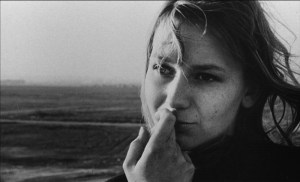
The final film on this list is probably best known to modern filmgoers as the inspiration for Terry Gilliam’s 1998 film 12 Monkeys. However, La jeteé, a thirty minute short film which tells its tale entirely in still pictures, is a much better and more interesting film. The film takes place in some kind of post-apocalyptic future, where we meet a man who vividly remembers a shooting he witnessed as a boy. He desperately wants to return to that moment, and when he is chosen for a time travel experiment, he sees his opportunity. The power of the film comes in the mystery of the photographs, which with the spare dialogue tell just enough, but not too much. It’s really a beautifully chilling film.

4. The Incredible Shrinking Man (1957)

On the face of it, the film seems a recipe for disaster: an existential drama stuffed inside the confines of a cheap science fiction picture. However, because of the close union between the central idea of the movie (that a man is being lost within the ever increasingly terrifying modern world) and the science fiction angle (a man mysteriously shrinking making him unsafe even in the protective world of his own home), the film works brilliantly. The focus of the first half of the film is on the set up and the initial loss of size. However, it’s in the latter half, when the shrinking man finds himself trapped in the basement with a tarantula, when the film really takes off. And because of the investment in the character, the film even manages to wring a few truly creepy moments out of its plot. A great movie for goofy fun and for thought provoking post-film conversation as well.
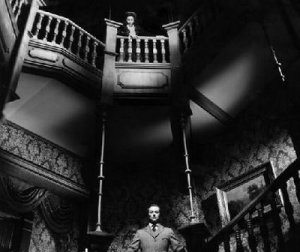
3. The Magnificent Ambersons (1942)

One of the holy grails on the cinematic landscape, Turner Classic Movies in the U.S. ran Welles’ star-crossed film one day early this year. It would certainly be number one on the list were it in its original form, but the studio enforced ending is so terribly and obviously tacked on that I couldn’t justify placing it at the top. However, the film as a whole is nothing short of magnificent, with the typical Wellesian energetic camera and editing in evidence throughout. The film is a grand spectacle, on the scale of Citizen Kane, and probably even beyond it due to the number of primary characters within the Amberson’s world. If you can track down a copy of this excellent film, don’t miss out.

2. Ballast (2008)

Director Lance Hammer’s debut film, Ballast follows the lives of three poor African-Americans scraping by somewhere near the Mississippi Delta. Hammer’s use of the handheld camera seems a questionable choice early in the film as it follows a boy running through a field. However, he settles in admirably. With limited dialogue and a camera that lingers on its subjects, Hammer is clearly of the school that show is better than tell. The director creates a number of memorable moments by, as John Ford once said of his own films, letting the pictures do the talking. But it’s the combination of Hammer’s style with the particular milieu that makes for such an effective picture. The film encourages the viewer to engage the world of these unfortunate people, portraying their lives as something worth looking at, people worth thinking about. Hammer concludes with a fine moment—a single sweep of the camera through a moving car that beautifully ties together the narrative in a most satisfying conclusion.

1. Manhattan (1979)

I am up and down on Woody Allen, but his poetic, Gershwin-drenched paean to New York City was a revelation, and not just for its musical interludes. Allen tends to have a self-effacing way about him, but I can’t say I’ve ever seen it portrayed on screen as artfully as he did here, particularly in the film’s Cabiria-esque conclusion. Of course, where Fellini’s Cabiria has troubles that are almost entirely inflicted upon her due to a certain naiveté about the modern world and men in general, Allen’s lead character here suffers from largely self-inflicted wounds. Manhattan reveals a world grown small, where characters struggle to see beyond themselves, even in the hustle and bustle of a city like New York. That it’s presented with such attention to beauty—accompanied by the aforementioned Gershwin and gorgeous black and white photography—offers a striking contrast to Allen’s limited perspective that underlines the fundamentally comic tone of the film.

Other films I appreciated in 2009: In Bruges; Dance, Girl, Dance; Paranoid Park; Doubt; I am a Sex Addict; The Exterminating Angel; The Player; The Station Agent; sex, lies, and videotape; Greed; Silent Light; I Walked with a Zombie; My Man Godfrey; Nanook of the North; The Immigrant

Dracula (1931)

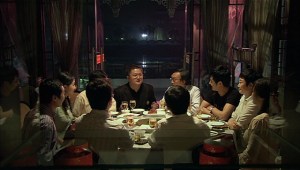
When discussing Tod Browning’s Dracula these days, it seems almost a cliché in many circles, often lumped in—as it often is in the popular consciousness—with the later Universal monster movies that tend to ratchet up the cheese factor. However, returning to the original source proves illuminating, from the arresting portrayal of the titular character by Bela Lugosi to the especially creepy introduction and conclusion to the film.

It’s that introduction in Dracula’s castle and the conclusion in his English lair that are so striking in the film, particularly due to Browning’s use of space. In the early scenes that take place at Dracula’s castle, as Renfield makes his visit, everything in the castle is grand, dominating the singular and diminutive real estate agent. The arches stretch up high toward the towering ceiling; the massive staircase curves up and out of sight; spider webs cover walkways taller and wider than a grown man; the fireplace in Dracula’s dining room is from the same family as the massive hearth Welles employed near the end of Citizen Kane ten years later; and even the table where Renfield sits, including the dishes and silverware, seems too large for him.

All of this communicates a sense of dread and powerlessness, not only because of the imposing grandeur of the place, but also because of its isolated location, two qualities it shares in common with Dracula’s English manor. Old and overgrown, the manor is difficult to access, at one point even looking like it is partially underground, or at least built into a hillside; the door that Van Helsing and Harker eventually enter through is difficult to breach; once inside the lair, and impressive staircase hugs the cylindrical wall; and as they pursue Dracula into the cellar, they discover what appears to be a catacomb-like series of rooms, a never-ending series of chambers that stretch out for what seems like forever into the blackness beyond.

These scenes, early and late, contrast significantly with the middle section of the film, most of which takes place on Dracula’s boat or in Dr. Seward’s house/mental hospital. Each of these locations seems small and confined by comparison to the other locations, and as such, much of the mystery in the film drains away in favor of clearer explanations, more plot information, and an ultimate understanding of vampires that comforts rather than terrifies. However, this works well in the scheme of Browning’s film. When we eventually arrive at Dracula’s English lair near the end of the film, Browning continues what he had begun early in the film—cloaking his villain in a mysterious space, one where he sits larger than life, where everything is dark and treacherous and unpredictable. The effect of the space in these final scenes therefore leaves a much more terrifying impression.

So when Van Helsing finishes off the vampire at the film’s end, it’s hardly surprising that it occurs off screen. What better choice could Browning make? What some have criticized as a limp ending actually seems a brilliant choice. Rather than show his villain limited and defeated in this place of mystery and darkness—traditionally a place of strength for the vampire—he prevents the viewer from having the full catharsis of seeing the vampire killed. This in turn leaves everything somewhat unsettled, which is appropriate for such a dark and unpredictable setting. Through his use of space, Browning is able to end the film with more of a question than a full resolution.

The unique use of space in Browning’s film creates an equally unique structure to the film, where the real catharsis and victory comes with the action still in Dr. Seward’s house. For it is there that Van Helsing is portrayed as master of all things vampire; there where the doctor has a tight hold on his patient and daughter, Mina; and there where Dracula seems least able to affect his victim. The brilliance of the film then comes that it uses its final act to attain some narrative resolution, while at the same time remaining unwilling to resolve all the mystery and tension that surround a compelling creation such as Dracula.

Take Out (2004)

Take Out, a 2004 film by co-directors Sean Baker and Tsou Shih-Ching, follows a day in the life of a young Chinese immigrant, Ming Ding, who delivers food on his bicycle for a living. The film eventually appeared in a few U.S. theaters in 2008, and now on Region 1 DVD from Kino in 2009, but it’s a shame this film has had such a difficult time finding an audience.

The film was shot in New York City and takes on elements of neo-realist style, with its use of natural lighting, actual locations, and elliptical editing. The writing effectively reveals the details of the narrative slowly, beginning with only the barest amount of information. This tactic allows the viewer time to experience Ming’s life, to appreciate his hard work, and to come to have a rooting interest in his fate.

The film opens with two thugs rummaging through a dingy apartment in the early morning, looking for Ming. On their search, they climb over sleeping bodies and walk around multiple bunk beds in an otherwise strikingly spare dwelling. Eventually, they find the object of their search, and pull Ming into the unoccupied kitchen. After informing him what he owes and that they’ll double his loan amount if he doesn’t have the full amount that night, they pull out a sledgehammer to leave Ming a message that they really are serious. However, Baker and Tsou cut away as the thugs strike their blow, setting a pattern that will hold through most of the film: interaction and introspection will trump sensational and sentimental events.

Not only does this technique of handling violence bring the imagination to bear in a productive way on the act itself, but in this choice the filmmakers refuse to aestheticize the violence. In doing so, they step away from what has been the tradition of American cinema for the last forty plus years, which has by and large reveled in increasingly disturbing depictions of violent behavior. Instead, Baker and Tsou take a step toward a style of cinema that limits the portrayal of violence without eschewing a willingness to dwell on its effects.

From the apartment filled with illegal immigrants, the film moves outside for the bulk of its runtime. Excepting several conversations with co-workers, most of the film follows Ming as he repeatedly delivers food on his bicycle to try and earn all the money he needs to repay his debt. The directors shoot the film in such a way to highlight Ming’s interconnection with the life and movement of New York City. Horns honk. Cars zip by in the foreground. People cross in front of Ming’s bike, prompting him to make quick stops. Grounding the film like this in its physical location—a reality further highlighted by the repeated shots of cooking in the restaurant and doors opening and closing—encourages the viewer to observe closely. What might be different about this delivery, when compared to the one before? How does this apartment building compare with the last? Who will answer the door, and how will they respond to the delivery man?

Ultimately though, Ming becomes the focus of these deliveries. Will Ming do anything differently? How will he react if there’s a problem? Will he take his friend’s suggestion about interacting with customers? The intense focus on Ming and the invitation to observe creates a bond with the main character. Not only is he quietly desperate in his desire to earn the needed money, thus creating empathy for the character, but he works so hard that it is difficult not to come away appreciating the work ethic that kicks into gear when necessity calls. In that we connect deeply with Ming.

And this is, I think, where the film makes an important contribution in our world. The reality is simple: Illegal immigrants more than likely come across as strange and different to most Western viewers. But the filmmakers put a face on Ming that allows us the opportunity to see him as a human being, rather than simply as a political position. This isn’t to say the filmmakers hint at the political issue of immigration at all. Had they done that (a la The Visitor), this would have been a much lesser film. It’s precisely because the filmmakers limit themselves to the simple details of Ming’s life that their film carries the power and expansiveness that it does.

I can’t offer an exhaustive list of what makes a great film, but I can say with confidence Take Out’s insistence on portraying characters that resemble actual human beings puts it well into the discussion.

I Walked with a Zombie (1943)

During the Enlightenment, philosophers sought to find out the truth about our world through the aid of reason. No longer was revelation the primary source of knowledge about the world. God may have spoken to the world, but if he did, his words would have to pass the muster of our reason. As such, the age of revelation passed on in favor of our own sense and perceptions of the world, leading to the modern conflict between faith and reason.

This conflict of ideas gets played out cleverly in the Val Lewton-produced psychological horror film, I Walked with a Zombie. Released in 1943 by RKO on a B-movie budget, the film nevertheless makes good use of its more limited cast and sets through the application of atmospheric lighting, thoughtful writing, and an inventive use of the camera.

The setup is simple: a young Canadian nurse is recruited to the Caribbean by a rich sugar cane farmer to care for his mysteriously ill wife. When she arrives, she finds a woman we might describe as blank—she will obey simple commands, but never speaks or shows any emotion whatsoever. Of course, as a medical professional, she consults with the doctor on possible treatments, and even gets him to administer an experimental treatment in the hopes of shocking her back to waking life.

However, not even the most advanced medical procedures make any difference in the patient’s health. The sick woman continues in her zombie-like state, while the nurse, feeling great compassion for the lonely husband, wracks her brain for any possible solution. Out of a sense of love and obligation to her employer, the nurse eventually decides it would be worth taking her to the local voodoo meeting, where the natives gather for mysterious nightly rituals. It’s her love and care for another human being that leads her to break out of her strictly rationalist mindset in treating the illness and look for another solution.

The key scene of the film is the walk these two ladies take on a winding path through the sugar cane fields on their way to the voodoo meeting. The women move through the tall cane on a narrow path in what becomes a journey from the natural to the supernatural. Initially, they are merely surrounded by the natural world, the sugar cane reaching high above their heads and severely limiting their view. Yet as they walk along, they encounter decidedly unnatural sights: a cow’s skull on a stick, a dog hanging from a tree, bones arranged in the dirt, and eventually, a disturbingly bug-eyed guardian to the voodoo meeting.

As the women take this journey, a journey where they eventually discover the true nature of the sick woman, they step into what looks like another world at the voodoo meeting. A man dances with a sword. A woman seems under a trance. A mysterious wise person offers advice through a strangely decorated wall. To find the answer to her problem, the nurse had to step into a world of perceptions beyond the senses, one which allowed for supernatural explanations. Reason alone was simply not enough.

I Walked with a Zombie illustrates beautifully through a horror-story narrative the fallacy of approaching life from a purely rationalist point of view. G. K. Chesterton once wrote on this topic that, “It is idle to talk always of the alternative of reason and faith. Reason is itself a matter of faith. It is an act of faith to assert that our thoughts have any relation to reality at all.” Chesterton’s self-deprecating recognition of humanity’s limited viewpoint coalesces nicely with the overall narrative arc of Zombie.

An Enlightenment viewpoint has certainly resulted in exponential technological, medical, and scientific advances. These gains cannot be ignored. But neither can we ignore the reality of our limited viewpoint, and the need to receive trustworthy knowledge from outside ourselves. I Walked with a Zombie helpfully creates a space from which we might be able to consider such knowledge.

A Serious Man (2009)

“I haven’t done anything.” So goes the constant refrain of Larry Gropnik, the protagonist of the most recent film from Joel and Ethan Coen—A Serious Man. To the outsider, Larry looks like the perfect candidate for what constitutes a serious man. He works as a physics professor at a small college, drives a non-descript car, dresses conservatively, works late into the night, and has a son preparing for his bar-mitzvah.

While everything seems to be going along nicely for Larry at first, he eventually becomes a human punching bag throughout the film. He’s not a recipient of physical violence, but an onslaught of tragedies and pressures that he can’t seem to make sense of. First his wife wants a divorce. Then her lover wants to befriend Larry. There’s also a dispute with a neighbor, a car accident, a disgruntled student, and a delinquent brother—not to mention a TV antenna constantly in need of adjustment. Larry, like the Old Testament figure of Job, can’t seem to figure out what’s going on in his life. Though unlike Job, Larry has clearly brought some of his problems on himself.

Larry seeks out three rabbis for assistance (much like Job’s three friends), each of the rabbis offering different guidance. The first, and youngest, seems to think Larry suffers from a problem of perspective. If he could just see his problems in a new light, they would stop being problems. The second seems to think Larry should just get over his problems and live his life. After telling a mystifying story that Larry takes to mean he should be helping others, the rabbi unhelpfully offers: “couldn’t hurt.” The third and final rabbi, the oldest and wisest, won’t even see Larry. But when his son comes to the man at his bar-mitzvah, the old rabbi ultimately tells him to “be a good boy.”

It is this simple advice that Larry has needed, but not received throughout the film. Frustrated by the lack of answers, and feeling like he hasn’t deserved all these trials (“I haven’t done anything!”), Larry eventually breaks down and actually does something. However, what he does is less important than what it seems to indicate, and what the film seems to be aiming at on a larger scale: a full-scale critique of contemporary Jewish (or more broadly, religious) life. The religion in this film is one informed by tradition and ritual, but one that remains completely distanced from the day to day lives of its proponents. The religion on display has long since died on the vine, and the film portrays its withering corpse in all its broken glory.

At the end of the Old Testament book of Job, after the titular character has conversed with his friends for chapter upon chapter about what is going on in Job’s life, Job receives a visit from God Himself in a whirlwind. But rather than offer Job answers, God asks only questions, leaving Job speechless and humbled. Job eventually receives a merciful, rather than a judgmental, response from God because Job was a righteous man. He took his position as a believer seriously.

At every turn Larry eschews his religious tradition in favor of inaction or worse—evil action. Job suffered more intensely than Larry, yet bore it well. He found mercy in the whirlwind. Larry suffered less intensely than Job and bore it poorly, missing out on ample opportunities to ease or end much of his suffering, and even compounding his own trials with poor choices. What will Larry find when the whirlwind visits him?