Blue (1993)

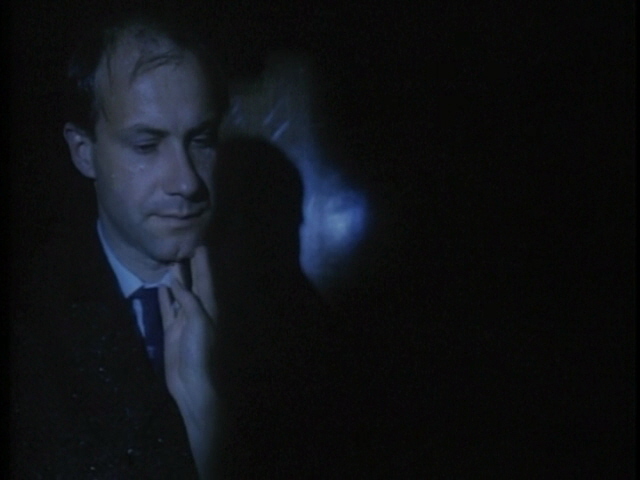
During Julie’s journey from life to death and back to life again, everything in the world seems to be calling out to her, reaching for her in her self-imposed grave, to pull her back toward life, love, and goodness. Of course, the most obvious example of this is the music that breaks into her world all the time, the music that she desperately wants to forget but cannot. But it goes beyond that: chance meetings with strangers and people from the past, a puff of wind blowing her door shut, and a glimpse of herself on the television. Julie is trying to forget, to become like her ailing mother, removed from any reality, any pain, any tears. Everyday is a new day for her mother. For Julie though, in spite of her best efforts, she is painfully aware of the same thing, day in, day out.But it is in this very awareness, in the midst of her pain and suffering that she ultimately finds a kind of grace, resulting in life. Kieslowski’s world is a complicated place, filled with suffering, yet at the same time calling Julie toward new life. Thus, there is this struggle between pushing away and pulling back in. She loves me, she loves me not, indeed. This is both the way of Kieslowski’s world, yet it is also illustrative of Julie’s interaction with her past and those around her – pushing away from her former life, but never for a second being able to resist the urge to reach out for it, to stop the music in her head, to destroy those final mementos of that former life.

What’s interesting about Julie’s choices in the aftermath of the accident is the way in which she ends up cut off from everything and everyone. Even in her extreme moments (most notably the night spent with Olivier), she remains aloof. Her existence after that is very much like a hermit. She speaks as little as possible, goes out rarely, isolates herself from everyone, and descends almost into a kind of nothingness – an attempt to escape memory and thought. It is in her decision (or maybe that’s too active; let’s say experience) of living in this void that she hears and is ultimately able to receive grace.

I cannot help but wonder then, amidst all the noise of normal life, if Julie would even be able to hear the music blasting into her world as she does in the film. Would her surprising encounters with the boy, Olivier, and Lucille have had the kind of impact they did if she had been surrounded by the noise of life? What if she had not been paralyzed by fear of the rat and its babies for days – a fear that eventually pushed her out beyond herself, taking uncertain steps outside her world? What do these questions reveal about her mother, constantly in front of the television, supposedly connected to the world, yet with no idea she’s speaking to her own daughter?

Could it be that Kieslowski is suggesting, with his typical light touch, that Julie’s retreat from the world of the living was somehow necessary to allow the power of grace to pull her back toward life? Had she not done that, instead filling her life with everyday noise and responsibility, what would have become of her? Might she have become her mother, alive, but not really living? It seems that in the end, Kieslowski recognizes the tragedy of suffering, but also its converse: that same suffering works in its own way to bring life. Maybe one will find regret or sadness there. But having walked through such a valley, one also finds a rich and deep appreciation for this life, a belief that things can get better, and a comfort that the world works in such marvelous, life-giving ways.

Army of Shadows (1969)

[I was fortunate enough to catch this on the big screen here in Dallas. I for one am glad to see a recent spate of older films being scheduled at the Angelika. Good for them. I hope they continue it through the fall.]

From its opening printed line, which welcomes bad memories because they are reminders of one’s youth, Jean-Pierre Melville’s 1969 masterpiece, Army of Shadows brings its audience into the horrors and exhilaration of war. These horrors though are not primarily related to physical violence, but rather the violence done to one’s soul.

On its surface, the film tells the story of a segment of the French resistance in WWII, using a stripped down, minimalist style. Philippe Gerbier (Lino Ventura), a former engineer, plays a pivotal role in the resistance as an organizer and liaison to the leader of the anti-Nazi faction. Generally stone faced, but not without his own fears, Gerbier understands that certain things simply must be done, no matter how unpleasant or dangerous. Whether it’s jumping from an airplane, distracting a German soldier, or even killing a man, he continues to influence the resistance for good because of his willingness to act. Not all follow through like Philippe. Not all have his courage. And it isn’t easy to separate the wheat from the chaff.

Melville’s style, which is pulled back, offers most scenes in medium or wide shots, the camera generally keeping multiple characters in the frame at all times. The actors underplay their scenes, only occasionally emoting. By removing these visual and emotional cues, Melville places his audience in the position of these resistance fighters. No one is really sure what anyone else will or won’t do. Neither can the characters be sure of anyone’s trust. This uncertainty is one of the dehumanizing effects of war. The characters become isolated from one another. They may work well together on this mission or that, but the nature of their relationships are skewed because of their circumstances. This is poignantly illustrated in a scene between Philippe and Mathilde, when, after having narrowly avoided disaster, have a quiet moment of connection. After a few brief seconds, they return to their harder, military selves, leaving the moment in a haze behind them.

Another disturbing effect of the war can be seen in the code these resistance fighters are compelled to keep. When a friend gives names to the Nazis, the penalty is death. When captured, the only option is to attempt suicide or escape. When a German stands between you and freedom, they must die. This harsh, tense existence wears on the freedom fighters. Each new friend that is captured, dies, or becomes a traitor is a deeper blow to the cause, and just as significantly, to themselves. Each person they are forced to kill steals a bit more of their humanity from them. Constantly living on the edge of life and death, being forced to place an ultimate trust in people you hardly know, and never being quite sure how much good you are doing leaves these fighters in a constant state of flux, becoming shadows of their former selves.

Finally, while these people are all part of the resistance, Melville significantly never actually shows them at work against the Nazis. Sure, someone delivers an illegal transmitter or provides a safe house for another fighter, but what are they really doing outside of perpetuating their lives? They make rescue attempts for imprisoned fighters, travel to England for aid, and eliminate their own when they betray the group. Thus, this shadow army, at least in terms of action, is invisible to all. And the longer they are part of it, the more they become shadows themselves.

Forgiving Dr. Mengele (2006)

I have found myself in recent years increasingly wary of films that deal with extreme real-life tragedies or genocide, not because I am not interested in such topics or because I fear being overwhelmed by the subject matter. Rather, I am not interested in filmmakers who have little to say about such important subjects, simply using the tragedy to wallow in the heinousness of it all. Neither do I want to become numb to tragedy in the world. Thus, when I first heard about Mengele, a documentary covering the crusade of a holocaust survivor, I noted it and moved on.

Now that I’ve gotten a chance to see it though, I’d suggest this is one of the most important films about the Holocaust (and more broadly about tragedy) I am familiar with. The film gives us little new information about the genocide itself. Rather, it focuses on one woman’s response to her experience at Auschwitz. And if you’ve seen the title, then you can guess Eva Kor’s response to her captors.

At the age of 9, Eva and her twin sister Miriam were sent to Auschwitz, and survived initially simply because they were twins (who were favored for experiments by the Nazis). Mengele’s experiments involved injecting one child with a drug, and then charting the differences in the two children afterward. Eva and Miriam suffered through this for 10 months, with Eva near death at one point. Yet, as she says, she willed her way through the illness, and eventually, walked out of the camp with her sister. She eventually married another Holocaust survivor, moved to Indiana, and got started in real estate. In the early portion of the film, the interspersing of concentration camp footage with Eva’s daily routine evokes the way in which those images must have haunted her over much of her early life in the States.

Yet as her sister struggled and eventually died an early death from a kidney problem associated with their time in the camp, Eva is confronted with a desire to take action and help her. In the process, she meets a Nazi doctor, who was also at Auschwitz concurrent with Eva. She finds he too has nightmares, and struggles with his experiences there just as profoundly as she. This leads her to spontaneously offer forgiveness to him, a decision that eventually results in her forgiving all Nazis, including the head doctor at Auschwitz, Josef Mengele.

Even as Eva does this, she stirs great controversy in the Jewish community, many of whom don’t feel Eva has the right to forgive any Nazi, much less Mengele. Several responses to Eva’s act are interwoven through the film: She has no right to speak for other Jews, her comments could imply she is speaking for the dead, she dishonors her parents who also died in the camp, her decision implies she is willing to forget the evil committed in the Holocaust. Yet Kor fiercely stands by her decision, arguing that forgiveness will “heal your soul and set you free.”

Most interesting about this film is the complexity involved in its portrayal of forgiveness. What is forgiveness? What does invoking it entail? No one seems to know definitively. Everyone seems to have their own perspective. Does it mean one forgets the past? Does it mean one excuses the past? Is it necessary for the perpetrator to be sorry before one can forgive them? If so, how can one ever forgive Mengele, long since dead? Are those who suffered under him or other dead and/or non-repentant Nazis doomed to live as victims the rest of their days? How does forgiveness apply in current conflicts one has with others? Do the rules change? Is it harder or easier to forgive the living?

This film satisfies largely because Kor’s answers to a number of questions above resonate deeply within me. No, forgiveness does not entail forgetting or excusing the evil act. Neither is it dependent on the offender to be sorry. Forgiveness is an act which the victim bestows on another. It is an act they perform. No one can take it from them. All people have the option to forgive, to move beyond victim status and into a fuller life that looks forward in hope, rather than back in pessimism. And yet, in spite of all this, Kor is far from perfect, though she refreshingly recognizes her own limitations, and seems, at least to this eye, to be moving forward, bettering herself, and working out how one forgives, not just for the past, but also for the present. The doggedness and optimism in Kor is a refreshing antidote to the horrors of the genocide she and her people were subjected to.

Decalogue IX (1988)

Decalogue IX begins with Roman receiving some stunning news from his doctor – he is impotent, and will never be with a woman again. Kieslowski takes this simple moment and in light of its consequences, fashions characters that struggle with anger, frustration, loneliness, fear, jealousy, and brokenness. Throughout the Decalogue he places his characters in the midst of ethical dilemmas that challenge their thinking on any number of levels.

Most obvious in this film is the interplay between different kinds of truth and the falsehood that is borne out of that interaction. The first line of the film is the doctor asking what Roman wants to know, to which he answers: “The truth.” He believes that the doctor has reliable information that will determine the rest of his life. Roman, also a doctor, understands this kind of truth, based on observation of physical elements. It makes sense to him. It is objective, and can be trusted.

When he arrives home though, he is confronted by a kind of truth that isn’t scientific, but is rather based on personal commitments to love and be loved. His wife, Hanka, reacts out of love – maybe Roman won’t always have this condition, and it really doesn’t matter anyway, because love is more than, in her words, “what’s between your legs.” So, Roman’s physical and objective truth crashes against that of his wife, an inner, emotional truth. The distinction might be characterized by a rational versus a relational truth. Yet, neither of them is really prepared to deal with the world as seen by their spouse, thus breeding lies, deceit, and mistrust. A change is reached when, on that first night, Roman suggests Hanka find another man to be with. Her reaction that he shouldn’t say such things shows not that she abhors the idea, but simply that certain things should go unsaid. This decision toward infidelity only causes the pain to increase, and their lives to spiral further out of control.

The deceit in their relationship changes their vision of one another. At least three times, Kieslowski uses distortion and darkness to show the limitations of his character’s vision. First, at separate points in the film, the director shoots both Roman and his wife Hanka in their apartment through a glass on a shelf. As they walk past the glass, their image breaks apart. We can still see who they are, but something about their form isn’t quite right. Second, when Roman finally returns home from his trip to the doctor, he and Hanka ride up the elevator together in darkness. The light through the windows alternates, first over her face, then his. They are together, yet separate. We merely see glimpses of them, though never at the same time. Finally, the most famous limiting shot in the film comes when Roman has hidden himself in a cabinet, waiting for the meeting of his wife and her lover. Kieslowski shoots the entire scene through the crack in this cabinet, as the camera sways back and forth, trying to get the best angle on the characters moving around the room. Only at this moment, with his (and our) vision so limited, does Roman begin to really see his wife. And only then does Hanka see what kind of pain Roman has been in.

The lies that limit their vision of each other surface because the couple is trying to deal with an inability to communicate when their lives spin out of their control. Kieslowski uses an interesting visual cue to heighten this reality. Early in the film, as Roman drives home, the glove compartment in his car falls open. Later, when it occurs again, this time with Mariusz’ school papers in it, one might be led to think this was merely a device to move the plot along. Yet it happens a third time, after Roman has spied on his wife and Mariusz during one of their rendezvous’. He has been helplessly sitting on the stairs listening, then had to hide as they each left the apartment. He has no control over them or himself. He can’t stop their meetings; neither can he stop himself from spying. He’s angry, frustrated, knowing he suggested this course of action, but also knowing how wrong it has been. At the height of this, as he climbs back into his car, that compartment falls open, and we see that all along, Roman has had no control over his life. By all appearances he would – successful doctor, beautiful wife, patients who trust and like him. Yet with his diagnosis, his ensuing choices, and now the confirmation that his wife has been with another man all lead to his life spiraling out of control.

And so, in the midst of jealousy, loneliness, and anger, he decides to take control of his life – through suicide. With everything about his life in chaos (at least from his perspective), he takes control the only way he can. Ironically, he doesn’t succeed; he has no control over the end of his own life. Hanka has come back from her trip to try and find him, desperate to repair what’s been broken. And lying in a hospital bed, covered in a body cast, completely at the mercy of doctors, he speaks to his wife on the phone. She says: “You are there. God, you are there.” To which he replies: “I am.” Fade to black with the sacred sounds of Van den Budenmayer playing in the background. Those unfamiliar with the biblical text will miss part of the significance of those final lines. Yes they will be together, yes they want to fix things, but there is more. In a world spinning out of control, Roman utters the name of God from Exodus 3: I am. God is indeed there, and while the situations of life make no sense, there is someone greater in control. Thus Kieslowski, the ever-spiritual director, leaves his characters with the comfort of knowing they are not alone.

Trial of Joan of Arc (1962)

Robert Bresson’s 1962 version of this famous historical event, based entirely on the minutes from the trial, provides a claustrophobic, reverent, and surprisingly brisk walk through significant moments in Joan’s final days. Clocking in at a mere 61 minutes, Bresson’s frequent cuts make the film feel even faster than it is. Constantly the camera cuts away from Joan to those scrutinizing her, and then back again. Some look upon her with sympathetic eyes, though most feel little beyond disdain for her, most often, it seems, for political, rather than exclusively religious reasons. This way of shooting and editing the piece serves to heighten Joan’s alienation from those around her.

The trial tends to focus on religious elements, which makes sense, since Joan was tried by an ecclesiastical court, headed by the Bishop of Beauvais, Pierre Cauchon. However, there was far more in play here beyond a simple theological dispute. Joan, having been involved in what amounts to a civil war in 15th century France, had been captured by the Burgundians and sold to their English allies. It was under these inauspicious circumstances that the trial was conducted. Bresson cleverly highlights the political nature of the trial with brief scenes before and after the day’s proceedings or in and around Joan’s cell. The bulk of the action takes place in the courtroom – a theologically driven question and answer between judges and accused that sees Joan fielding questions from at least three different men who often attempt to trip her up with their adroit queries.

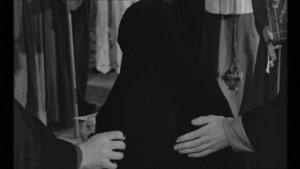
Most interesting about the film is Bresson’s focus on the physicality of his characters. In typical Bresson fashion, he focuses his camera on the bodies of his actors, especially their hands and feet. The opening shot of the film pictures the walking feet of three people (including Joan’s mother), on their way to Joan’s rehabilitation trial some 25 years after her death. Once there, Joan’s mother is held up by the hands of monks on either side of her. As she’s turned away from the camera, reading a prepared piece about Joan, those helping hands are the most notable elements in the shot.

Contrast that opening sequence with the film’s conclusion, as Joan makes the long walk to her place of execution. Bresson refuses to point the camera at her face, preferring instead to show her bare feet, in a continuous shot, walking along the broken stone. In this sequence, the feet of many onlookers stand in the background, one of whom even sticks his foot out to trip her (in case one wondered if they had any pity for her). Then, as Joan is being consumed by flames, Bresson shoots part of the scene from behind, where we see her hands, chained to the post, reach out in pain. Joan’s naked feet and chained hands are quite a contrast from the clothed feet and soft hands of the intro.

Yet, even in that most difficult moment when Joan is so alone, those naked feet are a marked contrast from her chained feet throughout the trial. Consider the first time she is brought back to her room. The guard chains her foot to the immovable beam as Joan weeps at the edge of the bed. She is captive, with no sign it will end. Yet as the film concludes, and Joan makes that long walk over the stony path, her feet, while naked and accompanied only by a dangling cross, are free as they move toward impending death. There is a courage in those bare feet, a courage that evokes the one to whom she serves and entrusts herself.

Masters of Russian Animation, Vol. 1 (2000)

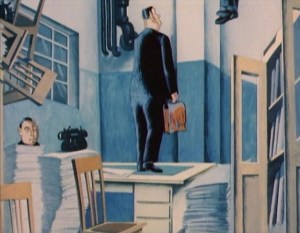
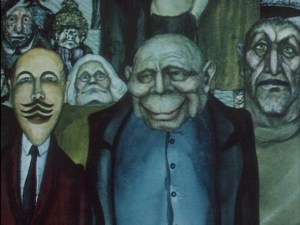
The first volume in this series from Image Entertainment is always interesting and engaging. While containing ten short, animated films, it generally is not aimed at children (though I suspect they might enjoy the fable-like My Green Crocodile or even the silliness of Passion of Spies or Singing Teacher). The films themselves range from funny and satirical on the one hand, to tragic and surreal on the other. The above image comes from There Lived Kozyavin, probably my favorite of the collection. I’ve included comments on three films for your perusal.

Man in the Frame (1966) (dir. Fyodor Khitruk)

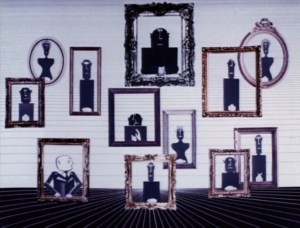
Director Fyodor Khitruk’s second short on this disc is about a single man who spends his days boxed in by a frame, hanging as a picture on the wall of life. The first frame he has is simple and non-descript, but as he gets older and makes his way up the ladder of government bureaucracy, the frame becomes more ornate, yet never really any bigger. Finally, in a critical moment to possibly find meaning at the end of his life, having reached the top of the working world, he ignores a desperate cry for help coming from outside his comfortable dwelling. This immediately leads to a final ascent heavenward, where the man sees objects passing him from earlier in his life – statues collected, papers signed, a woman he once loved, and finally, the playfulness and freedom of a child jumping rope (all images from earlier in the film). The film concludes with this high government official being boxed in by ever smaller frames – a surprisingly tragic ending that is intriguing for its critical perspective of the government, or at least those who work in it.

The animation here varies between traditional hand drawn and actual photographic images. His co-workers sometimes appear to be cut-outs or shadow puppets, a la Lotte Reiniger’s Prince Achmed. The photographs come primarily near the beginning of the film in a sequence that stands out due to its rapid editing of what appear to be disconnected images of life in general. I was reminded of the beginning of Bergman’s Persona in this sequence, though here the images are much more life affirming than those from Bergman. Later, the still image of the girl jumping rope comes back, and the camera dwells on this image of freedom, with a simple up and down motion over the picture to give the sense of movement, something the man in the frame never really experienced.

There Lived Kozyavin (1966) (dir. Andrey Khrzhanovskiy)

This is another favorite, about a man named Kozyavin who does a desk job, shuffling papers (The first moments of this film reminded me of the stacks of papers surrounding the protagonist in Kurosawa’s Ikiru). At the end of the workday, Kozyavin’s boss pulls him aside and asks him to find another employee named Sidorov, pointing in the general direction that he might be found. Kozyavin, the ever-dutiful employee, follows that direction literally. He will not deviate from the path marked out by his boss, which means he quickly exits the building and begins a trek across town. This journey is the bulk of the film, as Kozyavin ends up traveling around the world in search of this employee. His single concern is to find Sidorov, even if that means ignoring a robbery in progress or crushing a stunning archaeological find because it was in his way. As we follow our protagonist, we wonder if he will ever reach his goal, or conversely, if it is within him to give up the journey.

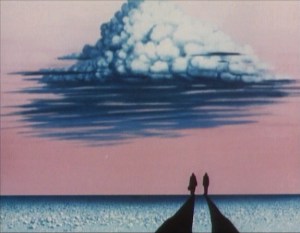
The look of this film is distinct from the other entries in this series. There is a surreal quality to it, at times reminiscent of a Dali painting, what with stairs on the ceiling and vast desert expanses. The characters have a shading that gives a dirty look to them. All kinds of obstacles come across Kozyavin’s path. For a while, we are overwhelmed with images of industry, which at times goes awry, is dangerous, and makes it impossible to communicate with others. Kozyavin goes through an ornate museum, a desert wasteland, and literally around the globe. It’s always an interesting film to look at, and its implicit critique of the government and simple minded employees is surprising due to its timing and country of origin. Clearly much was happening in the Soviet Union at the time beyond what was presented outside the country. This film is a great testament to that.

Glass Harmonica (1968) (dir. Andrey Khrzhanovskiy)

This could qualify for the most unique film of the collection, about a stranger who arrives in a city with a glass harmonica. The instrument appears to have magical powers, and as the man plays it in this city fraught with greed, there is a sense of awakening among the inhabitants. At one point, a flower is formed from the music as it flows through the crowd. However, the evil, black-clad leader of the city breaks up the concert and taps into the people’s greed once again. All that’s left is the single rose; though will anyone set aside their greed to pick it up?

The animation here, in color, takes pieces of classic works of art and mixes them into the action in place of characters. The characters don’t move fluidly as a result, and their faces have a single expression, but the detail of the animation is really something. Once their greed kicks in, they almost appear as cockroaches as they scatter from the harmonica in a wide shot. They are off on another job, this time to dismantle the city clock (everyone takes what he can get). Later, as their greed completely overwhelms them, many people turn into strange creatures. Most of the people were distorted (extremely short, fat, giant heads) to begin with, but this takes things to a new level. This is the richest animation of all the films in this collection. Quite a treat.

Magnolia (1999)

Magnolia is one of the more divisive films to come out in the past decade. Everyone who sees it seems to have an opinion about it, offered in strong terms. It’s often a love it or hate it proposal. This polarized reaction is quite interesting, and seems to be spurred on by the feature of the film that most excites me: its aggressiveness. Director P.T. Anderson leaves no room for middling positions on Magnolia. The varied opening sequence, complete with an homage to silent films, certainly raises an eyebrow for the uninitiated. The confidence and fluidity of his camera cause the viewer to either come along for the ride or bail out quickly. The in your face attitude of characters and dialogue, often so full of vulgarity that it cannot be ignored, leave viewers challenged and at times, reeling. Even the placement of music, with his fearless decision to turn his film into a musical 2/3 of the way through, smells of someone throwing all his cards on the table in an effort to push the viewer into a corner, leaving them nowhere to go and unsure of what might come next. And of course, no one could imagine what would come next, with Anderson leaving his most aggressive move for last.

All of this gets the blood boiling, as these elements contribute in their own ways to imbuing the film with meaning. However, it is chiefly that meaning, varied and expansive, that makes this film memorable and infinitely watchable several years after its release.

Once the characters are introduced, we hear the key line in the film, spoken twice fairly early in the film: ‘And the book says, “We may be through with the past, but the past ain’t through with us.”’ In the film’s early moments, we are introduced to a series of people deeply scarred by their pasts. Lies, drugs, sexual indiscretion, desertion, and theft populate the lives of these characters. This repeated line should resonate in our minds as we watch these people and the mess they’ve made of their lives.

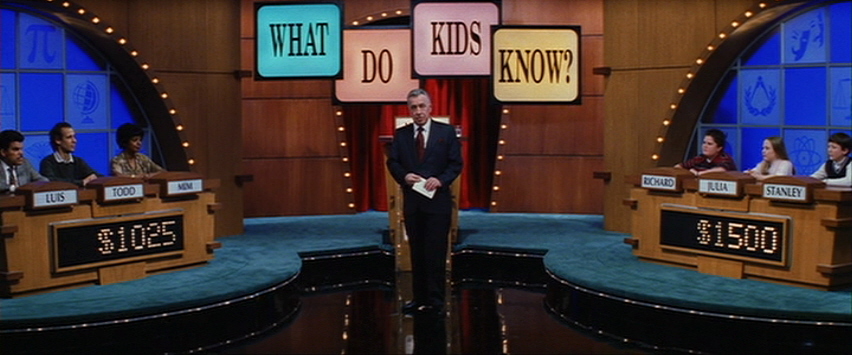
The real centerpiece of the film’s story, it seems to me, is the game show What Do Kids Know? hosted by Jimmy Gator. The title’s double meaning in the context of the film is telling. While the show deals with mindless trivia that either feeds kids’ overenthusiastic sense of pride or places them up on a pedestal only to be knocked down for the sake of entertainment, the mosaic of the film is all about parents and children. As we see both kids and the adults they become scarred by a lifetime of poor decisions their parents made, we wonder if the title of that game show might have been in Earl or Jimmy’s mind some other time in their past. Also, a line that seems to come from almost out of nowhere takes on a much greater significance in this context. After Donnie confesses his love for Brad the bartender, he runs to the bathroom, and while vomiting over the toilet, he can be heard mumbling a verse from the Bible (Exodus 20:5). He says the children are punished for the sin of the fathers. The fact that it comes from a religious text lends transcendence to the proceedings, though Anderson subverts it nicely by having it spoken over a filthy barroom toilet. Big things are indeed happening in the midst of the stench of this world.

This punishment spoken of by Donnie raises its head in the form of suffering and poor choices, and is true of every child in the film: the young African-American boy named Dixon, Stanley, Donnie, Frank Mackey, and Claudia. Each of them carries deep scars and pain from the failure of their parents (usually their fathers). In Dixon’s case, his father is a killer, thus putting his son in harms way. On top of that Officer Jim Kurring fails to listen to his rap, thus denying Dixon an important moment in his life (and bringing further harm on himself). Stanley’s dad is more concerned about money and using his kid to bolster his acting career than he is about caring for the real needs of affection and approval in his son. Donnie’s parents stole his money. Neither does it seem they prepared him well for adulthood. Frank’s father Earl bailed on the family when his wife Lily got sick. Jimmy molested his daughter and even when staring death in the face, refuses to admit it. The cause of all these failures is beautifully summed up in a line from Earl Partridge (father of Frank), when he states: “I’ll tell you the greatest regret of my life: I let my love go.” This heartbreaking commentary on a failed life gets at the heart of the conflict in each relationship. It also provides a link toward the way of reconciling with the past and moving forward in renewed relationships – these people need to find that lost love.

Just after the characters sing Aimee Mann’s Wise Up, a moment at which it seems they will each give up, the rain stops and they seem to be making some changes. Jim and Claudia, Jimmy and Rose, Frank and Earl – all of them are honest with each other, revealing bits of who they are and how they feel about one another. But with that honesty, there is still anger, mistrust, and fear. Then, the frogs come.

They are an announcement, a judgment, and a means of grace rolled into one. They announce for us a second time that something transcendent is going on. There is more going on in this world than meets the eye. These people are not alone (both the biblical references to Exodus 8:2 and the framing segments on coincidences are key in this conclusion). The frogs also come as a judgment on the truly wicked lives these people have led. Earl takes his last breath during the downpour. Jimmy appears as if he will suffer his last months alone. Donnie, recently becoming a thief, is thrown for a hard fall from the ladder.

But what makes this final climactic incident so important is the way it allows for grace in the lives of these lonely people. Jim is able to give a helping hand to Donnie, who desperately needs someone to care for him. Claudia gets to experience the comforting embrace of her mother, this time with all the honesty of their past open before them. Frank and Stanley witness this strange and miraculous occurrence, softening their hard edges and providing them with the courage to strive for a better way once morning comes.

After the narrator repeats the key line: ‘And the book says, “We may be through with the past, but the past ain’t through with us,”’ we get a final monologue from Jim. It’s on the subject of forgiveness. The implication here is that through forgiveness, one can find that lost love Earl spoke of. Jim talks honestly about forgiveness, that it isn’t easy, and at least in his job, not always called for. But he asks the question: “What can we forgive?” In other words, are things ever so far gone that we can’t forgive?

The film leaves us then with people on the road to personal renewal: Frank, his face tear-stained, stumbling through the hospital to visit Linda, Jim helping Donnie to return the money, Stanley telling his dad how their relationship needs to be characterized by kindness, Rose caring for Claudia, and Jim coming to be with Claudia, who, in the famous closing shot, provides us with a glorious (albeit slightly broken) smile after all this madness.

The question remains: What do kids know? Well, maybe they know more than trivia, more than we parents give them credit for. Maybe they know how to forgive, to begin the process of healing their broken relationships, and to move on with their lives. Maybe they can even break the cycle of wickedness, sparing their own kids some of their torturous experience. Maybe…

Sunrise (1927)

Sunrise is considered by many to be one of the greatest silent films of all time. Take out the word “silent” from that last sentence, and you get a more accurate picture of my own feeling on the matter. The story is simple, almost fable-like, as we see a farmer tempted to leave his wife for a “more exciting” woman from the city. An American film, directed by the German F.W. Murnau, Sunrise takes us on this journey with the help of Murnau’s expertise as one of the leading filmmakers of his day. There are three formal elements that stand out for me in Sunrise.

Murnau carefully frames each shot in the film to communicate a maximum of information visually. The economy of each scene is remarkable. The early scenes in Sunrise illustrate this best, both in editing and camera movement. After the travel montage that opens the film, Murnau settles on a boatload of people traveling to a vacation community. It is a sunny day, and the people act as if they know it. Crowds gather to meet the incoming boat, people chatter with excitement, a man climbs the fence to greet friends, and Murnau caps the joyous moment with a sweeping crane shot that captures the charming village at its height – filled with people and hope.

After a brief title card, Murnau introduces us to The Woman from the City (Margaret Livingston), who, in contrast to the other vacationers, dwells in a dark room, by candlelight, and most importantly, alone. Other cues signal our suspicion of her – the way she lights her cigarette at the candle, her half-open robe, her stockings (which Murnau shoots at leg level, making sure we notice them), and the way she makes the old woman polish her shoes.

It is in this scene, when The Woman enters the dining room, that Murnau includes the strangest shot of the entire film. He tilts the camera slightly to the right, with a lamp in the extreme foreground. The old couple eats their soup together at what appears to be a crooked table in the middle of the shot. Finally, the background hides a doorway though which The Woman eventually enters the dining room. The lamp and the crooked table get our attention here, as if to say “Do you see what’s going on here? All is not well.” And after we have had a moment to take in those more obvious elements, the shot answers its own question by producing The Woman through the doorway. She is on her way out, alone of course, in striking contrast to the old couple at the table.

Once outside, Murnau follows her down the village lane with a long tracking shot, beginning at the doorway, with another couple in the extreme foreground. She walks past a second doorway, this time filled with three women, as well as a window filled with smiling people inside a warm home. And in a laugh inducing moment, she even passes a man with his horse. Everyone has someone, it seems. Yet The Woman doesn’t seem to be bothered, either with the scorn of the people she passes or in the fact that she’s alone, and we soon find out why. She knows lonely soul – The Man (George O’Brien). Murnau shoots him almost entirely alone, and for the brief moment his Wife (Janet Gaynor) enters the room, they are faced away from one another. The loneliness in these early scenes is overwhelming, particularly in contrast to the chipper opening.

Murnau also communicates a great deal through his sets. In those early scenes, the stark distinctions between light and darkness, the placement of fences, walls, and doorways all seem to be significant. Note the doorway mentioned above. Also, when The Woman approaches The Man’s house, she encounters a fence and a curtained window, the final battlements to scale before she wins her prize. She has already borne the scorn of the onlooking neighbors as she stalked through the village. She simply whistles, allowing the wind to carry her message to her waiting lover. The Woman simply then need wait a few short moments to receive the object of her affection. At this moment, Murnau uses the curtained window to great effect, showing The Man’s shadow pointing The Woman to their regular meeting place. There’s a foreboding in the image that signals the dark conversation to come.

Likewise, the lamp in the home of The Man and Wife seems almost as if it is fighting off the darkness, much like the candle in The Woman’s room. The darkness in these places points to the moral treachery that is about to take place, as well as the loneliness of these people and the oppression they must all feel as no one seems to have what they want. Contrast that with the great dining/dancing hall later in the film, filled with lights, giant glass walls, and crowds of people everywhere. At that point, the Man and Wife are a part of this world, a world we caught a glimpse of at the beginning of the film with the sunny vacationers. The couple has moved from loneliness, treachery, and despair to joy, peace, and happiness.

Finally, Murnau’s evocative use of sound presents the ringing church bells in varied ways from one scene to the next. When the couple leaves on the boat, the bells ring a sort of warning, maybe of an impending judgment. This happens right on the heels of the dog’s incessant barking and swim toward the boat which adds to the foreboding sense. During the boat ride, just as The Man is going to commit an act of violence, those bells ring again, this time evoking a kind of conviction – he has done wrong and he knows it. He can’t get away from the sound of those bells fast enough. Finally, the bells ring at the city wedding, just as the Man and Wife are repairing their relationship. In this case, the bells become a symbol of joy and hope. They call the couple into the church, where they watch the wedding from afar and no doubt recall their own vows. They are transformed, a new couple, rebuilding a broken trust and recommitted to loving one another. Murnau, then finally shows us the bells that so often ring in our ears, calling out just as this important act of forgiveness and reconciliation takes place.

Sunrise is a beautiful film for a number of reasons, not the least of which are these (and other) formal elements that provide a richness for the presentation too often lacking in other films of its kind or genre. Sunrise has these in abundance, a testament to the genius of such an important filmmaker.

Junebug (2005)

Each year it seems there are a few films that fly under the radar. I might hear some good things about them, but I just don’t get around to seeing them. Junebug was a film like that for me. I had heard a few good things, but until it was recommended by a close friend, I didn’t think much about it. It just kind of looked like the standard, indie, quirky comedy. Now, don’t get me wrong. I like some of those “SIQC’s”. However, in this case, director Phil Morrison, along with his writer and cast, has created a poignant picture of life in the South. Yes, there are some unique characters that one might consider quirky. Yes, the film was independently financed. And yes, there are some rather funny moments (though I’m not sure I’d like to think of it strictly as a comedy). But Junebug should not be qualified as standard, because it captures something too few films even aspire to any longer: reality.

Junebug reminded me at times of films by Bujalski, Tsai, and the Dardenne brothers. Not really in any kind of formal sense, as those filmmakers are rigorously devoted to their own unique senses of style. Morrison presents the elements here in a more straightforward fashion. Rather, each of those filmmakers has a knack for capturing real moments. And while Morrison is more closely tied to his narrative than any of those filmmakers, he still is able to make us feel as if we’re stumbling upon something or someone real.

Several things tune us into this reality: A key aspect of the family in Junebug is their lack of substantive communication with one another. It seems that everyone has something to say, but too often, nothing gets said. This frustrates us from the outset, as we are sort of in the position of Madeleine, the outsider from Chicago who meets her husband’s North Carolina family for the first time. No one speaks to her, except for Ashley, of course (she talks to everyone). And outside of Ashley, when Madeleine is spoken to, it’s often with at least a little edge, usually from Peg or Johnny. And while neither the silence nor the edge ever really let up, the film provides us an opportunity to see their true qualities lurking beneath the silence and occasional hostility. When tragedy strikes or someone is hurt, they have one undeniable virtue: they are there for each other. Even George, who’s been away from home for so long, feels the tug of family at those most crucial moments. Thus, Morrison here holds the tension between this family that doesn’t speak a whole lot about its problems, yet is deeply devoted to one another when the worst comes.

A second element that evokes reality: We learn to know these people by observing their surroundings. In communicating this, Morrison isn’t afraid to let his camera speak for him. Thus, we are allowed observe the quiet town, green front yards, empty rooms throughout the house, all without dialogue. These are people intimately connected to a particular place, and everything about them evokes that place. George, who left years earlier, anxious to get away, may be more connected to this town than any of the others. He exudes a quiet confidence, doesn’t speak a whole lot, and therefore allows his presence to speak for him more often than not. This is what the film often feels like as well: its mere presence does much of the speaking to us. Morrison often shows without telling.

Third, I was impressed with the characterization of these people, particularly the two young couples. There are a number of tensions and moments of connection between these four individuals, but Morrison wisely keeps most of that under wraps. Occasionally, something comes out, a burst of anger, sexual passion, or even tears. Junebug’s best moments are in between these occasional outbursts. Our introduction to Ashley is a great example of this, as words fly from her mouth faster than it seems anyone should be able to get them out. Yet, even in this opening flurry, we can already see the cracks in her relationship with Johnny, and her naïve way of trying to deal with it. It’s these moments, when things are communicated through tone of voice, a downcast eye, or someone quietly leaving a room that Junebug really excels.

All of this adds up to a gentle piece of work in Morrison’s debut feature. In one scene involving an artist with whom Madeleine is trying to sign a contract, he sits down with her and begins to explain his method, and how he communicates through his painting. In that brief conversation, he notes that he is attempting “to make the invisible visible.” I think that’s what Morrison and crew do here in Junebug. With a gentle touch, he shows us truths about these people and this place. This gentleness on the part of the filmmakers evokes an empathy and affection for their subjects, many of whom don’t do anything particularly likable. In this approach to the people who populate this film, we are offered an alternative in dealing with those who might act differently or believe differently than we. Morrison deserves the utmost credit for this gracious approach to his characters.

Red Beard (1965)

Akira Kurosawa’s Red Beard, a story of deep compassion and transformation, made in 1965, marks the end of the most active phase of his career. Kurosawa is at the height of his powers here, combining the two greatest strengths of his career: his exquisite use of the camera, and the powerful presence of his favored star, Toshiro Mifune in the title role. In what would be their final film together, Mifune dominates every moment he is on the screen, and many that he is not. These two elements serve to enhance its story of a young, educated doctor coming to work at a hospital, unwillingly at first, with an old and experienced veteran who is set in his ways

Kurosawa’s strengths are immediately evident in the film’s opening sequence, about eight minutes long, which depicts a tour through a hospital. Dr. Yasumoto has just arrived at the village hospital to pay a call on Dr. Niide (who we find out everyone calls Red Beard, for obvious reasons). The camera follows the young doctor into the hospital, and then through it, as he receives a tour from an outgoing and rather cynical young doctor, Tsugawa. More often than not in this sequence, Kurosawa holds the doctors in a two shot, giving us only a view of the immediate surroundings – enough to see sick patients and workers, but not much else. In this decision, Kurosawa creates a cramped and overcrowded feeling in the hospital. Since Tsugawa is handling the tour, Yasumoto’s picture of this place immediately becomes tainted. And Kurosawa communicates the transference of this attitude beautifully by the amount of time these two spend in the same shot together. It’s as if Tsugawa is passing on his legacy of cynicism and angst to Yasumoto in this rather brief opening sequence. The genius of Kurosawa is that we would probably know that even if we removed the dialogue. He is using his formal decisions to contribute to the narrative.

The most interesting shot during the tour comes after they have passed the poor patients, the pharmacy, and the clinic itself. Kurosawa places the camera at the far end of a darkened hallway leading to the men’s ward. Initially, the camera looks as if it’s at a low angle, so that if the doctors were to venture into the hallway, they would literally be descending into darkness. This of course fits beautifully with their current mindset as they hesitate and gaze down it. Yet when they finally step into the hallway, the camera now behind them, we see an area full of activity and light. It’s at this point the two doctors encounter a room of sick men, and we viewers get the first sense this place may not be as bad as it seems. The sick man Sahachi is devoted to Red Beard, realizing that while his rules may require some extra discomfort, they are always in the best interests of the patients. In an otherwise one-sided presentation of the hospital by Tsugawa, this moment stands out, signaling that all may not be as it seems.

Finally, they arrive. Kurosawa has Red Beard’s back to us as the young doctors enter his room. They kneel before him in a perfectly symmetrical shot, the parties in the room forming a triangle, an arrangement Kurosawa returns to time and again both in this film and in others. Here, with Red Beard at the center of the triangle, the attention is all on him. As he turns though, Kurosawa cuts to a close-up of Mifune, glaring powerfully at the new young doctor. He is in charge of his domain, and he is not to be trifled with. In the next cut, Kurosawa pulls wider and to the right. Dr. Yasumoto is now in the center of the shot, under the gaze and questioning of Red Beard, the pressure and focus is all on him. He eventually breaks away under Red Beard’s piercing gaze, which places him at a disadvantage in the relationship, even if he doesn’t recognize it yet. What’s so great about this whole sequence is the way Kurosawa uses the camera and the framing of the shots to communicate narrative details, significant moments, and the personalities of his characters. That he is able to communicate so much in just the images is one of the things that make his films such rich experiences. The dialogue is only one layer of meaning in the film. The framing is another; the editing another. And so on.

Which leads me the biggest reason why I appreciate this particular film of Kurosawa’s – the images themselves are the most beautifully framed he has ever put to film. I think of that introduction to Red Beard. Or during Yasumoto’s angry period, as he reclines in the garden, near the nurse, Osugi, and they are separated by a twisting tree branch cutting through the middle of the frame. So much is communicated there, in the contrast of her worry and his carefree spirit to her selflessness and his selfishness. They may be together, but they are further apart than one might think. I also think of what could be viewed as a throwaway moment, when Masae comes to visit him at the hospital, and he refuses to see her – she stands alone, outside the hospital, on a lonely stone path. She has made a sacrifice to come, made herself vulnerable to Yasumoto, and he refuses to even acknowledge her presence. Even in this brief moment, we are given a glimpse, sans dialogue, of the character of Masae.

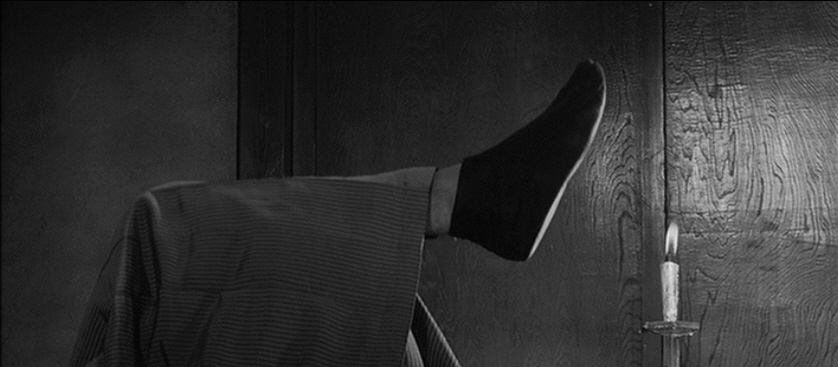
The most striking images in the film as a whole occur when Yasumoto is confronted by an insane patient, called only The Mantis, for she likes to kill the men she’s involved with. We first see a lit candle just below his foot, as he reclines in his typical, lazy fashion. She enters his room meekly, immediately kneeling, hardly taking up any space. He, full of himself as usual, taken in by her humility, and thinking he’ll be able to cure her, seizes the opportunity and faces her, the single candle lit between them. The fire is there lighting the space, providing the opportunity for conversation, yet as he moves closer to her, and the candle, we sense the fire taking on a more dangerous, even menacing character. When he finds himself virtually on top of it, we know for sure he has entered into a terrible situation, merely waiting for what must surely be a tragic conclusion.

It is these kinds of images I love in Red Beard. Of course, the film itself isn’t half bad either. The clash of personalities between young and old, inexperienced and experienced, arrogant and compassionate, takes on a complexity not unlike Kurosawa’s previous film, High and Low. In Red Beard, you have two people who both have a kind of “highness” and “lowness” about them and it is for us to sort out just who is who and what is what. No doubt if we look closely, Kurosawa’s beautifully framed images will offer many riches to that end.