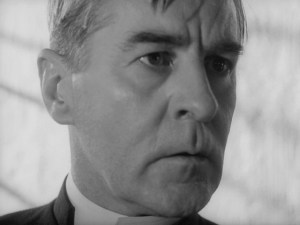
Steamboat Round the Bend (1935)

John Ford’s collaborations with Will Rogers are some of the more rewarding of the director’s work, particularly his work in the 1930’s. Light and airy with a touch of the poetic, they always remain profoundly humanist in the central character’s love for his neighbors—often in spite of them. The third and final film Ford and Rogers made together, Steamboat Round the Bend, is a wonderful illustration of this humanism in the sectarian South of the 1890s. It reveals the distinctive virtues that help Dr. John Pearly (Rogers) survive and find success in his attempt to save his nephew, Duke, from the gallows.

The two key characters in the film are Pearly and the self-proclaimed prophet against “the drink,” New Moses. Certain similarities unite these two men, yet their relationship is ultimately punctuated by a striking contrast. Both serve others. They both speak to crowds that gather to hear their message of healing. And they both have a set of followers. However, the key difference between them is in the type of service they provide. While Pearly offers his “neighbors” direct and tangible assistance, New Moses offers only “eternal” rewards. Because of this, New Moses comes off looking like a shyster, needing only the raised hand of a drunkard to dispense his “healing” gifts. No “real” or tangible help is necessary. No long nights spent with a man trying to kick a habit—only a sermon, a ribbon, and a passing of the hat to the sympathetic listeners. And when Pearly and his crew have a comedic encounter with “New Elijah” on the riverside, our suspicion of New Moses is confirmed.

Pearly on the other hand, dispenses tangible “medicine” in the form of rum. However, while that is played for comedy, Pearly proves himself over and again as he helps others throughout the film. He makes Duke turn himself in, even though the boy only acted in self-defense. He saves Duke’s young girlfriend from her abusive family. He earns money for Duke’s defense. He steams up and down the river looking for an eyewitness to Duke’s alleged crime. He tries to help Duke escape from prison when all looks lost. And of course, he competes in the race in a last ditch effort to save his nephew. As is made explicit near the end of the film, Pearly’s concern is saving a life, while Moses has been concerned only with saving souls.

Dr. Pearly wears various hats throughout the film—medicine salesman, museum entrepreneur, law-abiding citizen, and steamboat captain, to name a few. While several of the other characters possess their own shifting identities, Pearly has something else that helps him to transcend both New Moses and the other characters. He possesses good will toward others to such a degree that he will put himself out on their behalf. His service to others is tangible and observable. Pearly’s ability to shift to the changing needs of the moment helps him to survive. But his ability to do so while being guided by his care for others allows him to save a man’s life and earn the admiration of many.

The Informer (1935)

John Ford’s The Informer might best be thought of as a silent film. Or better yet, as a film that relies on its images and sounds, rather than its dialogue, to provide story elements, atmosphere, or character development. The dialogue is fine, but the brilliance of the film lies elsewhere. Ford and his cinematographer Joe August are able to ground the film’s characters (especially its central character, Gypo Nolan) and narrative solidly in the images.

For example, in the opening sequence, Ford sets the mood, the narrative, and the characterization with a series of nearly dialogue-free scenes in the streets of Dublin. The film opens on the shadowy image of Gypo, backlit and walking toward the camera through the foggy Irish night. At this point, his surroundings are impossible to determine. He seems almost not a part of the world, a ghost of a man. A series of these shots continues throughout the opening credit sequence, and already we have a sense that Gypo, the informer, is a man without a home.

A title card just after the credits makes reference to the story of the betrayer Judas. Then the film moves from shadow to reality, as Gypo’s shadow gets smaller and smaller on a nearby wall as he finally enters the frame from the left. His lessening image only contrasts with the man himself, who towers over passing pedestrians. Already the camera hints toward Gypo’s contradictory persona—strong or weak, lies or truths.

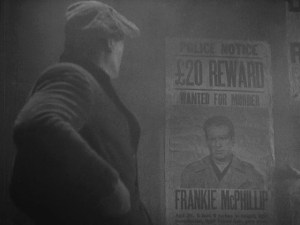
Ford’s camera follows Gypo down a Dublin street, where he encounters a wanted poster featuring a man called Frankie McPhillip. Gypo, shrouded in fog, stares long and hard at the poster. As Ford superimposes a happy memory of Frankie and Gypo over the mug shot, we not only get the distinct sense that Gypo knows the pictured criminal, but that he is struggling, like Judas, with whether or not to betray a friend. As he tears down the poster in anger, we perhaps can see this isn’t the first time Gypo has pondered this course.

The film then moves to three consecutive sequences, each of which is punctuated with that same wanted poster blowing into the frame. In the first, Gypo continues down the street, stopping only to listen to a young man singing an Irish ballad on the corner. As the man sings about the beauty of the Irish night and sea, Gypo stands removed from his countrymen, alone in the gloomy night. The camera’s focus turns to the poster, which, as if following Gypo, blows right on to his leg, sticking there and causing him some effort to remove it. But Gypo is no friend of the British either, quickly scurrying into the fog as a squad of “tans” rounds the corner. This all sets up the tragedy of Gypo Nolan beautifully, without words, save the song—a man without a home, lost in a moral fog, and even when surrounded by people, stands apart from all.

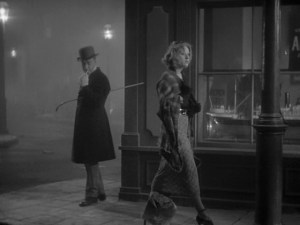
In the next sequence, a woman with covered head looks toward a rich man. Removing the shawl from her golden hair, she offers herself to the man with noting more than a look. As she walks by, Frankie’s poster catches on her feet, signaling her impending role in the Frankie McPhillip business, as well as indicating Gypo’s impending arrival. Just as the rich man approaches her, Gypo arrives. Perceiving the situation, he runs in to protect his female friend, throwing the man into the street. Here we get the only spoken dialogue of this sequence, as Gypo and Katie lament their poverty, speak of going to America for the required twenty pounds, and then break as Katie’s guilt causes her to ridicule Gypo’s reaction to her selling herself.

Finally, we see one final set of feet, those of Frankie McPhillip himself. As he walks down the city street, the poster blows up to him. Frankie picks it up, sees how much reward is being offered, and then quickly runs away to hide from another squad of “tans.” He is in the city, and the stage is set. The conflict is clear, though the night is anything but.

Ford accomplishes this set up in under ten minutes with only a minimum of dialogue. This aids the inherent suspense in the situation because it allows the viewer the freedom to make the connections of the narrative himself. And it makes clear the foggy moral morass that will imbue the film throughout.

Winter Light (1962)

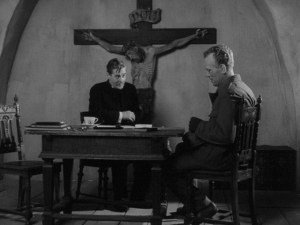
Bergman’s Winter Light contains a wonderful sequence of shots that reveal much about Pastor Tomas and his struggle to (dis)believe. As Pastor Tomas battles with his health and his faith, he meets with Jonas Persson, who finds himself in a deep depression and fear over the possibility of a nuclear attack. Bergman’s framing of the scene, his cutting, the lighting, and the dialogue that occurs between the two all unite to create one of the more stunning scenes of the film.

This first frame is a wide shot. As you can see, Jonas and Tomas sit at the table, both men framed under an arch with Christ. The Pastor attempts to make eye contact but the shame Jonas feels causes him to drop his eyes in a distinctly similar way to Christ on the crucifix in the background. Note also that von Sydow’s sharp features mirror those of the suffering man behind. Yet while von Sydow’s downturned gaze causes him to look away from Tomas, the same gaze from Christ looks directly at him. This leaves an impression not of shame, but of a silent questioning.

Bergman then briefly cuts away to von Sydow, still with his eyes burning a hole in the ground. Then he comes back to Tomas. Here Bergman underlines the angles from the opening wide shot. Von Sydow still shares the turned down head with Christ, while Tomas becomes even larger in comparison to the crucified man behind him. This comes as Tomas draws ever nearer to his proclamation of atheism.

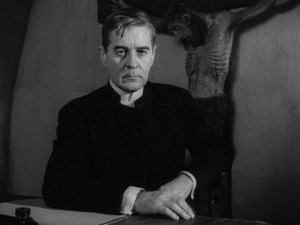
When Bergman cuts back to Tomas, Jonas is outside the frame. Now the focus is solely on the pastor, who looks defiant in the sight of Christ. The attitude hardens, and the dialogue becomes more and more focused on his own struggles with doubt, rather than those of his parishioner. Note also that the sign above Christ’s head proclaiming his kingship has now been removed from the frame.

As Bergman frames Tomas’s head more tightly, the pastor grows in the frame while Christ fades into the background, both getting smaller and sliding slightly out of focus.

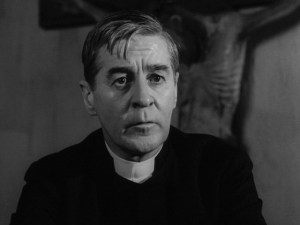
Bergman cuts back to Tomas, so much tighter that the face of Christ is obscured from view. Tomas is now fully given over to himself and his own suffering. Rather than counsel Jonas off the suicidal ledge, Tomas gives Jonas every reason to die. However, because Tomas believes in his move to atheism, he sees this as a move to freedom, thus the desire to keep Jonas in the office and convince him of this new faith. Here it becomes clear that Tomas is actually advocating for a kind of anti-faith.

In this final image of the scene, after Jonas has left having received none of the counsel and comfort he came for, note how Tomas has moved away from the gaze of the suffering Christ. He now stands where Jonas stood, against a blank wall, criss-crossed with what look like shadows of bars. The light has just brightened the room, signaling some kind of illumination. And Tomas, now separated from his God, utters a line that, ironically, identifies him profoundly with Christ: “My God, why have you forsaken me?”

In this scene, Bergman’s camera and lighting move in unison with the burgeoning atheism of the film’s central character to produce a sequence that crystallizes the tension of faith present throughout the film.

Just Pals (1920)

At any rate he was generous, never mean, like others in the village I could mention if I chose. –Graham Greene, The Second Death

John Ford’s career at Fox began with this charming short feature starring Buck Jones as the likable, but lazy town bum, Bim. The film opens with a series of short, introductory vignettes, beginning with the elderly town sheriff looking out for trouble and a group of rowdy young boys who admire Bim, albeit to their parent’s chagrin. These two scenes serve as a perfect and effortless lead in to Bim, “the idol of youth and the bane of elders.” Already, in a few short scenes, Ford’s sequencing allows the viewer to almost intuitively grasp Bim’s situation in the town and the sources of conflict to come—Bim is an outsider, looked down upon by “responsible” adults for his idle (and thereby destructive) ways.

This outsider mentality is typical of many of Ford’s films, including his well-known later films—Wayne’s characters in Stagecoach, The Searchers, and The Man Who Shot Liberty Valance, not to mention Fonda’s Wyatt Earp in My Darling Clementine. These “good bad men,” as Bogdanovich calls them, all find some kinship with Bim, only able to observe the established community from afar.

But in Just Pals, optimism rules the day. Sure, the townspeople are against him. But Ford presents Bim’s faults in a more whimsical fashion. He’s lackadaisical, but without anyone to support, he only really hurts himself. And underneath the veneer of laziness, he possesses a strong moral code. He protects helpless women and children. For instance, when Bill takes a thrashing from the railroad man, Bim jumps to his defense. With Mary at risk of public ridicule and shame, Bim protects her secret, even at his own peril.

So while Bim is an outsider, he is not completely alone. The helpless and the hungry, the defenseless and the defeated, all find Bim. Bill, the boy hobo, finds Bim. Mary, the compassionate schoolteacher, finds Bim. On the other hand, the established and hard-working townspeople not only look down on Bim, but rush to judgment against him, even to the point of death. Their calloused ways even encourage the use of orphaned children for their own financial gain.

Ford’s humanism is at work in this duality—better to be sitting with the outsiders of the world than conform to the prideful established community that can’t be bothered by stooping below their station to help a fellow human being. But there is a strain of individualism in addition to the humanism. Despite the intimations of the title and the fact that Bim has found companions in Bill and Mary by the end of the film, he would not have found these friends had he not struck out on his own and distinguished himself from the townspeople.

This resulting community of outsiders defines the optimism of this early Ford picture. Nobody’s truly alone. There’s always another “pal” to be had.

2007 in Review

2007 saw the onset of a new job, the purchase of our first home, the birth of our second child, and the completion of the first draft of a dissertation. Obstacles right and left, with nothing to do but appreciate the blessings and struggle through the results. Translation: 2007 offered its own difficulties and adjustments, but as such, ended up a year of significant growth personally. When it came to the movies though, the increasing limitations cramped my opportunities for viewing more than ever before.

The limitations are apparent not only in my viewing schedule, but also in the films themselves: barriers erected, barriers redirecting, barriers transgressed, and barriers overcome. Such limitations can be both negative obstacles that inhibit freedom or prevent engagement, and positive opportunities for change, growth, protection, or victory. For me then, both personally and cinematically, 2007 is the year of the limitation.

True to form, listing my favorite films of 2007 requires an immediate subtraction from the traditional “top ten”: Having only actually seen ten new films, something of the exclusive or unique nature of such a traditional list would be lost if I just listed all ten. So I’ve limited myself to five, each of which illustrate or present limitations in their own way.

The Lives of Others pictures the limits imposed on East German society before the wall came down, and the power of art to cross traditional bounds regardless of walls and guards.

Zodiac recognizes the limits of technology through a retelling of the investigation surrounding the Zodiac killings in San Francisco three decades ago. While the film defies narrative expectations, it cleverly presents a supposedly “connected” world of people frustrated in their investigative efforts by their inability to communicate.

Killer of Sheep, made in 1977 but released for the first time this year, takes place in South Central Los Angeles, where people live lives that have largely been cordoned off from the popular imagination. Stan, struggling to get by and provide for his family, finds poverty at every turn. Even still, Burnett finds the beauty amid the difficulties.
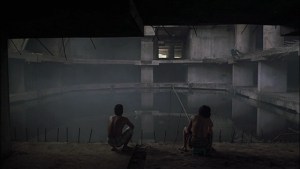
I Don’t Want to Sleep Alone, Tsai Ming-liang’s latest, follows three solitary figures through the urban environs of Kuala Lampur, struggling to connect, but with little idea of how to do it. Tsai’s dialogue is more limited than ever, which only serves to enhance the barriers between these people.

Offside, easily my favorite theatrical viewing experience of the year, places several women inside the qualifying soccer match against Bahrain in the summer of 2005. However, because Iranian law doesn’t allow women to view such events, the film offers what turns out to be a slyly ironic take on the state of the country in the midst of Iran’s great victory.

With my decreasing ability to take in films during their theatrical release, my favorite discoveries of the year encapsulate my year in film more than anything. The greater variety offered through rentals means that the choices are more personal and more likely to connect with my own sensibilities. Like my favorite films of this year, each of these contains its own comment on limitations—financial, spiritual, or societal; limitations related to knowledge, addiction, health or gender.

Danielson: A Family Movie chronicles the history and life of the indie band(s) led by Daniel Smith, who creates unique and strangely engaging music, mostly on a shoestring budget out of the small studio space in his basement.

Requiem offers an unsettling portrait of demon possession or madness, depending on one’s perspective. Schmid’s use of subtlety in his portrayal of the affected teen and the simple ways in which common relationships are expressed make this film a refreshing antidote to what would no doubt be an overwrought melodrama in a US film.

Monsieur Verdoux is often noted as Chaplin’s first failure from a box office perspective. Thankfully box office numbers fade into oblivion sixty years on, and we are left to assess the film on its merits. Its scathing critique of modern society doesn’t let up once in its 124 minutes.
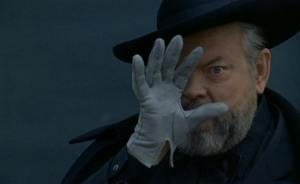
F for Fake finds Orson Welles in fine form, creating a masterful reflection on truth, certainty, value, and illusion. The editing here is worth the price of admission, as Welles uses it to great effect in destabilizing the viewers understanding of specific circumstances. What really happened and who was fooled? Well, I’d need to see it again to be sure (or not).

Flowers of Shanghai takes place in several brothels in late 19th century China. Hou’s shots linger on his subjects, rarely emphasizing an individual in the midst of others. Instead, we are left with the full scene unfolding before us, left to decide which characters and actions are worth noting. Hou trusts his audience—I love this kind of filmmaking.

Mouchette finds Bresson meditating on the trials of a young teenage girl who lacks love, companionship, and hope. Mouchette’s story is tragic, but the empathy Bresson creates for other human beings remains unmatched.

The House is Black is Forugh Farrokhzad’s poetic chronicle of a leper colony in Iran. Only twenty minutes long, the film remains deeply affecting throughout, as its diseased subjects eat, pray, and play, their humanity shining out through the disfigurement of their broken bodies.

Le Notti Bianche portrays a lonely young dreamer and several encounters he has with a mysterious, troubled, and attractive woman on a bridge. Based on a short story by Dostoevsky (White Nights), Visconti’s film possesses a dreamy quality that only serves to heighten the unreality of the world despite the vibrancy of the man’s encounters.

Half Nelson tells the story of a drug-addicted history teacher in an urban school. It deconstructs the myth of the liberal white savior while creating compelling drama around a budding relationship between the teacher and one of his students, a twelve year-old African-American girl.

Ten. Kiarostami’s film consists of ten dialogues on a variety of issues: sex, marriage, and parenting, to name a few. Yet while Kiarostami keeps our vision limited to a dashboard camera pointed at the front seat of a woman’s car, his film allows us to cross Middle Eastern societal boundaries and hear of life through the eyes of Iranian women and children. Brilliant. Hands down, the best film I’ve seen this year.

Other discoveries I enjoyed: Ace in the Hole (1951), Big Animal (2000), Crimson Gold (2003), Ivan’s Childhood (1962), Limelight (1952), A Moment of Innocence (1996), Shut Up & Sing (2006), Stranger than Fiction (2006), Volver (2006)
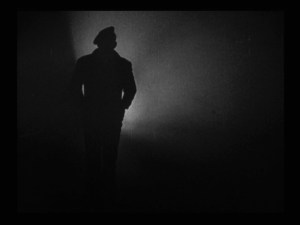
The Emperor’s Naked Army Marches On (1987)

Kenzo Okuzaki is angry. And this isn’t just your run-of-the-mill anger. No, his has been simmering on low heat for forty years, with an occasional flare up in the form of a murder or firing a few lead balls at Japanese Emperor Hirohito’s head. His cause? Justice and truth. He wants offenders exposed. He demands they admit their crimes. He hopes to console those dead souls who fell victim to heartless men.

Okuzaki was a soldier in a Japanese regiment stationed in New Guinea near the end of WWII. Few returned, primarily due to starvation. However, two soldiers died nearly a month after the war ended, apparently executed for desertion, which if true, would be murder. Okuzaki believes these were unjust killings, and that he is on a divine mission to extract the truth from the few surviving officers responsible for the crime.

The film follows him on his travels criss-crossing Japan, and with a minimum of contextualization. A few title cards occasionally serve as transitions, but the film simply plunges the viewer into this man’s journey. We know him only through his interaction with these former officers, and a brief sketch of his prior criminal record.

Two things stand out about his mission. First, his methods of extracting information: Okuzaki peppers the former officers with an intense line of questioning. If the men are uncooperative, he uses violence as an inducement, beating on them until they are ready to talk. Interestingly, in the final interrogation scene, we hear three times that the purpose of his visits is to get information out so people will learn the horrors of war and never do it again. Using violence to prevent (potential) violence? A dubious strategy for sure, but one to whose effects he seems oblivious.

Second: his lies. Okuzaki wants to get the truth out about what happened in New Guinea. However, to do so, in the latter half of the film, he uses “actors” to pose as the siblings of dead soldiers in an effort to persuade the officers to talk. The only confessions of any real substance are with these actors, rather than the actual siblings. Telling a lie to get the truth? Again, a deeply problematic strategy.

Filled with contradictions, the film also leaves me conflicted. On the one hand, the formal and aesthetic issues it raises through Okuzaki’s inner conflicts stimulate my inner film-lover. He is one of the supremely contradictory “characters” I’ve ever seen on film, ripe for interesting discussion of the issues surrounding his journey.

Of further interest: how much of this journey was Okuzaki’s idea? Did the filmmaker place him in situations he knew would be explosive, in a sense capitalizing on Okuzaki’s relational shortcomings? These questions go unanswered in the film, but make for engaging conversation about the ethics of documentary filmmaking, of the impact making a film has on people’s actions, and for the audience as we voyeuristically participate in these problematic encounters.

At the same time, Okuzaki’s single-minded pursuit garners little sympathy, primarily because he is so clearly driven by his rage and thirst for vengeance. He is more than willing to transgress the boundaries of justice and truth in his pursuit of those same ideals. Because the film identifies so closely with him and his journey, and because he is so utterly unlikable, it serves to distance the viewer from his cause.

A great companion piece to Naked Army would be Forgiving Dr. Mengele, a film which features Eva Kor on a journey to forgive her Nazi captors. Both individuals are single-minded. Both have a tough exterior that rarely, if ever, cracks. Yet Kor’s journey is so distinctly different from Okuzaki’s in its refreshing embrace of forgiveness for wrongs done. Her recognition that she has no control over whether criminals are dealt with justly frees her to forgive and move on. Sadly, Okuzaki’s blind pursuit of “justice” at all costs and his need to control the situation keep him stuck in the wrongs and misdeeds nearly half a century old. In this context, Naked Army serves as a cautionary tale to those so deeply angered and embittered by the injustices of the world.

Killer of Sheep (1977)

Director Charles Burnett made this film in the 70’s, but not, as he says, for general release. Therefore, Killer of Sheep is only seeing a general theatrical release for the first time, some thirty years after its completion. It’s in Dallas this week, as was Mr. Burnett, who presented his film at the Angelika Theater and was kind enough to offer a lengthy Q & A afterward. More on that in a bit—first, the film.

Killer of Sheep is quietly, heartbreakingly beautiful, even from its first few frames. The complexity of certain scenes emerges largely out of silence and observations. There doesn’t appear to be a perceptible pattern to the placement of the camera, except that it focuses on various elements of the characters–sometimes heads, sometimes bodies, other times hands.

This way of seeing the parts allows the viewer a unique way to ultimately consider the whole of someone like Stan. As the film is a slice of life, to use Burnett’s phrase, it presents “slices of Stan”—both of his body and his deeds. Stan works, eats, talks, and sits. But it’s not a narrative film, so these elements of his life evoke a certain kind of disconnect from one another.

Such divisions between the individual scenes provide an opportunity for the viewer to piece various elements together in unique ways, without the dominance of plot forcing us into a narrow wedge of interpretation. Instead, much like life, we meet strangers, and while we slowly get to know them, the film’s structure prods us to engage and understand, rather than telling us who’s who and what’s what.

Several scenes linger in the mind, but I really appreciated a sequence late in the film when Stan’s wife leaves the dinner table in frustration, then watches from the couch as their young daughter helps her dad relax by rubbing his shoulders. Stan’s joy in this moment stands in stark contrast to the feeling of Stan’s wife (and in contrast to Stan’s demeanor throughout much of the film).

We know Stan’s wife has been frustrated by his detachment, knowledge which helps us understand why she leaves the table so abruptly. Yet the scene serves to deepen the emotional distance between them, not through a verbose and didactic argument or narration, but by focusing on the physical placement of the family in the room. Such moments populate the entire film, creating one of the most engrossing and engaging experiences I’ve had in the theater this year.

The Q&A (which I found out about the morning of) was well attended for being at 5PM on a weekday. The theater ended up about 80% full by the end. Mr. Burnett was soft-spoken and gracious. His answers were especially informative and detailed. Having been to a few of these director Q & A’s in the past, this last quality was most impressive.

Some highlights from the Q&A:

– Burnett names Jean Renoir as an influential filmmaker for him (along with Joris Ivens and Basil Wright). He spoke about Renoir’s The Southerner (a film I’ve not yet seen), specifically about the differences between American and European views of life in the South.

– Burnett was asked a couple of times about the influence of the Italian neo-realists on this film, and while he wanted to move away from claiming them as any kind of direct influence, he did eventually acknowledge that he shared some of their concerns. Notably, he was looking for truth and honesty in his portrayal of this part of the world. He, like the neo-realists, saw the film as an attempt to separate reality from illusion.

– In commenting on documentary film today, Burnett raised the debate about portraying real suffering on screen. How much is too much? He had always been of the mindset that if people could just see what was going on in certain dark corners of the world, they’d be appalled and do something about it. His test case was a recent doc called Empire in Africa, about the war in Sierra Leone. It apparently contains some actual footage of graphic violence (limbs being hacked off and the like), which has caused him to raise this question again for himself. How much is too much? Would seeing such terrible things actually have the opposite effect than what was intended, by turning people off the issue?

– When recently re-watching Sheep as it was being graded for DVD, he found in it a kind of nostalgia, a feeling of warmth for a simpler time, even if it was still terribly difficult for these people to get by. He was asked about making a film on the poor of today, and indicated he’d probably do something less lyrical than Sheep, more factual, focusing on the failure of educational and political institutions, along with probable causes for the troubles.

– As an introduction to the film, Burnett spoke about a question he hoped viewers would ask themselves after seeing it. He wanted us to ask “How can we help these people?” The film was made on the back end of the Civil Rights movement in America, and as such, is directly informed by its concerns. Yet Burnett wasn’t so interested in being didactic with this film. Rather, he hoped that by presenting a vision of the lives of the working poor, viewers would be moved to act on their behalf.

Many thanks go out to Mr. Burnett for coming to Dallas and offering such thoughtful commentary on his film. And kudos to the Angelika for hosting the evening and being willing to run an important film like this in a city that doesn’t always embrace such things. Here’s hoping we see more of this in the future!

Half Nelson (2006)

Black and white. Male and female. Young and old. Rich and poor. Teacher and student. Addict and dealer. Parent and child. Ryan Fleck’s debut fictional feature, Half Nelson, details the shifts and transformations that come when two “opposites” collide. The film’s central character, a Junior High history teacher named Dan Dunne (Ryan Gosling), frames his lectures around this concept, bringing it to his students through a variety of images. Calling his framework “dialectics” (referencing Hegel, and, probably even more, Marx), he teaches the idea that all of history is change, resulting from a collision of different objects. These collisions are always grounded in the real world, one person or group crashing into another.

The film’s characters embody the characteristics of Dunne’s philosophy of history. Their encounters are largely defined by the tensions and contrasts between them. Take the film’s central relationship between Dunne and his thirteen year-old female student, Drey (Shareeka Epps). On the surface, it’s easy to ask what a young, urban, African-American female and an older, (raised) suburban, male white teacher might have in common. They come from different worlds, his one of privilege, hers of need. His upbringing was safe, hers littered with the potholes of dealers and prisons. Yet his weakness (drug addiction) and her strength bring them together in a way that allows the dialectic to work itself out.

Fleck’s choice of shots in two sequences heightens our awareness of this dialectic in a formal sense. In the first, immediately following a basketball game (in which Dunne coached), Drey discovers him getting high in the girls restroom. The scene unfolds with handheld shots in extreme close-up. It begins with Dunne in a stall getting high, the camera going in and out of focus. Fleck cuts several times here, evoking the passage of time, which allows the drug to take root in Dunne’s system. Next comes several shots looking out from within the stall as Dunne hears someone in the restroom. When Drey finally opens the door, a second perspective is finally available, one beyond the drug-influenced vision of Dunne. Fleck cuts back and forth between these two perspectives as Drey helps Dunne by getting him some water, all the while staying in close-up.

The limits created by the use of close-ups in this sequence allow us to identify with each character’s perspective, even as they see different things in different ways (the shot often blurs as Dunne gets high). And just as the intensity dies down a bit, just as we get comfortable with our two distinct views of the action, Fleck pulls back for a wide shot, young Drey leaning over her prone teacher. The beauty of that cut lies in the fact that it serves to heighten a difference we already thought was fully distinct. Seeing this young girl thrust into such a position of fear and responsibility serves to illustrate the distance between these two characters.

In the film’s final minutes, several visual cues lead to a more complex view of this relationship. Indeed, they are not just opposites by film’s end. After Dunne has left everything, even his students, for a drug-filled night with prostitutes and other shady characters, Drey comes to get him. When she enters his hotel room, we see them in a wide shot sitting on opposite beds, facing one another. Here we find a visual moment that evokes both distinction and identification. That they face one another, that she’s black and he’s white, she a student, he a teacher, she poor and he from money—all these things lead us to see them as opposites. Yet, she sits there on equal ground with him. After all she’s been through, she too has fallen from innocence. She too has something to be guilty about. She too knows something of his addiction. And Dunne knows this. He knows she comes to him as an equal. In this way, they identify with each other.

All this leads to the final image, as she and Dunne sit in a long shot facing the camera on a couch back at his apartment. They are still terribly different people, yet their common direction and posture indicate that they’ve forged some connection. They’ve each been changed by the encounter with the other. She’s experienced a little more of the world, resulting in a chastened innocence. He’s been encouraged by a thirteen year-old girl who pursues him in the depths of his struggle. These two opposites have collided, leaving a synthesis in the midst of their pain and trials.

A Moment of Innocence (1996)

A Moment of Innocence begins with two sets of images: one set of a clapboard interspersed with another set depicting a man walking toward the camera along train tracks. The former is a series of undeniably self-aware images, as a young girl reads the titles written on the slate, each shot reminding viewers that we are watching a film. The latter shows us a man on a journey. And while we can’t be sure where he’s going, we know he’s headed in our direction. Yet the key in this opening sequence is the constant interchange between clapboard and man, between fact and fiction. Like something out of a Kiarostami film, Makhmalbaf means to play with the lines between the two, offering us a “false” portrait of “facts” and a “truthful” portrait of “fiction.” The lines remain distinct in this sequence, but become increasingly blurred as the film progresses.

We enter the narrative of the film through this man on a journey, a man acquainted with Makhmalbaf some twenty years earlier. Now that Makhmalbaf has become a famous director in Iran, this man seeks him out, hoping for a part in a film. Their encounter decades earlier was brief, albeit violent. Makhmalbaf, the young militant, attacked this man, then a policeman, stabbing him in the leg while trying to disarm him. Now that they’ve been reacquainted, Makhmalbaf decides to make a film about their earlier encounter, and after a comical scene of casting actors to play their younger selves, Makhmalbaf pairs the young actors with himself and the policeman. The two pairs of participants separate so the young men can get a sense of the parts they’ll be playing. They agree to meet back in a day or two for shooting the past encounter.

As the older men direct their younger selves, we come to see that all those on screen presumably play themselves. So as the suspense builds toward the final filmed encounter, a sense of documentary realism is always at hand. One begins to wonder just how much of this is a real experience for the “actors” and how much of it is staged. While they are ostensibly making a drama based on real events, the actor’s (and our own) constant awareness of the camera leaves the viewer wondering about the reality of these moments. Are they really “real” or just pretending to be “real”?

This line between fact and fiction (undeniably present in all films), rises to the surface here, particularly as we draw nearer to the penultimate attack. Does the film become more or less truthful if the actors aren’t just acting, but actually experiencing the emotions and circumstances on screen? Are there any films where an actor isn’t really experiencing those things on some level? Does that mean all films are recording reality, more or less? I think Makhmalbaf answers this final question with a resounding yes. There is something false in the filming of any image, but Makhmalbaf attempts to drive at the truthful portrayal of his actors even as they exist in the midst of this false environment.

To illustrate these questions rising to the surface, the actors will look at the camera, or Makhmalbaf will give verbal direction from behind it. In one scene, the young Makhmalbaf breaks down and cries, prompting the director to stop the scene and try to get the boy to regain his composure. He eventually does, but we are left wondering about the “truth” of the moment. Was it scripted or impromptu? Because the lines between fact and fiction have been sufficiently blurred so as to raise this question, it becomes clear that the truth of the moment is less about whether the boy really broke down, and more about what is being evoked through the portrayal of the breakdown.

As they shoot the final scene, we enter into the most “cinematic” section of the film. Finally, all pretense is gone; there are no references to the camera or specific directions. The adults remain off camera, “invisible” to the world of the film. The scene plays out in a more traditional filmic style, thus moving away from the self-awareness that has framed the experience thus far.

Without the visible camera just over the actor’s shoulders, the film is given over to the kind of acting so familiar to us. Yet this final scene, in its straightforward way, offers both the height of falsehood as well as a direct line toward truth and meaning. The direction of the older men falls into the background and presumably places the turn of events solely in the hand of its actors. As they are younger people, they remain largely unpredictable. They’ve no loyalties to the tradition or the political ideals of their directors. They only know the world as they’ve experienced it, and as such, act in ways that sometimes completely diverge from their elders. Yet we’ve been conditioned by the self-awareness of previous events to remember that all this occurs in the context of a film. So even though the directors are absent from the screen, what we see before us is still, at some level, false.

As they reach the brilliant and climactic moment of the attack, the film ends on a striking image of hope that the past can indeed be redeemed. And it suggests that maybe art is one means of bringing communion to people long separated by division and strife. This final moment is at once both obviously staged but at the same time deeply meaningful and true. So as the film begins with fact and fiction clearly separated, eventually they are united within a single image. We are left in the knowledge that truth and meaning come to us, even in the midst of a false vessel.

Ten (2002)

Abbas Kiarostami’s Ten has been a highlight of my ongoing and extremely rewarding mini-Iranian film fest. For the uninitiated, in Ten, Kiarostami films ten conversations, each of which takes place in the front seat of a single car over an undefined period of days or weeks. The driver of the car, a woman, appears in every scene. She converses with her son, her sister, a friend, and even a couple of strangers. Kiarostami films the action by placing two digital cameras on the dash, one facing the driver’s seat, the other the passenger’s. The film’s formal conceits and socio-political commentary provide ample opportunities for discussion.

With the film located entirely within the front seat of a single automobile driven by a woman, the director creates a space to relate with those “lesser” or “forgotten” members of Middle Eastern society: women and children. This gives viewers a unique opportunity to enter into the world of Middle Eastern women, so often covered up by patriarchal society. Kiarostami presents them as a diverse group, with differing views and reactions to any number of societal issues: sex, marriage, divorce, prayer, parenting, and beauty.

Yet while their diversity is apparent, the formal constraints of the single camera placement go beyond opportunities for interesting and occasionally mundane conversation. The single camera placement presents a confined and constricted space, mirrored in a way through the traditional head scarves the women wear. Of interest here is not simply that the car proves restrictive in some sense, but that by its very nature, it allows greater freedom through the ability to travel greater distances. No doubt these women travel to a variety of places quickly, but in the context of the film, we only ever see them inside or connected with this moving metal box. Such a move on Kiarostami’s part offers a unique portrait of contemporary Iranian society: greater freedom, albeit with continued and constant restraint.

Playing off this idea, when the driver picks up two different strangers, one a devout worshipper, the other a prostitute, Kiarostami appears to notice the peculiarity of the two women, both of whom appear on camera only as they are outside the car. In this way they avoid the constraints the vehicle provides. One is devoted to religion, the other to sex, one to the spiritual life, the other to the fleshly. Yet at each of these extremes, these women find a kind of freedom from the social restrictions that bind most middle-of-the-road women. This is further solidified in a dramatic scene near the end when the driver’s friend and fellow worshipper reveals her own extreme reaction to a loss in her life. At least for these women, it appears freedom comes only at the fringes of society.