A few years ago, Quentin Tarantino offered this blunt assessment of Irish-American (not Anglo-Saxon) John Ford:
One of my American Western heroes is not John Ford, obviously. To say the least, I hate him. Forget about faceless Indians he killed like zombies. It really is people like that that kept alive this idea of Anglo-Saxon humanity compared to everybody else’s humanity—and the idea that that’s hogwash is a very new idea in relative terms. And you can see it in the cinema in the Thirties and Forties—it’s still there. And even in the Fifties.[1]
John Ford’s Revolutionary War-era drama Drums Along the Mohawk—made in 1939—is among his films that include “faceless Indians” and in this way serves as one helpful means of examining Tarantino’s view regarding Ford’s racism.[2] Tarantino isn’t alone in his assessment of Ford’s work, but I find Ford’s films, including his Westerns, to contain a rich and varied portrait of figures of all kinds, colors, and genders.
When it comes to uncomfortable scenes with racial overtones, I won’t deny there are several in Ford’s oeuvre. Drums contains one especially egregious scene recently examined by Mike D’Angelo, where two drunken natives mean to burn down a house, and end up rescuing a bed inside when an old woman protests their actions. Ford’s comic sensibilities don’t always land near my own—he tends toward the broad and the slapstick—and this scene certainly illustrates that tendency well.
However, Ford does something else in this film that complicates the picture of Tarantino’s vision of Anglo-Saxon superiority. And this more complicated picture better reflects the American experience of race through my own lenses—a mixture of good and bad, of outreach and insensitivity, of helping hands and murderous ones.
The film opens with a Northeastern U.S. wedding among colonists of some means. The house, the décor, and the dress all highlight the fact that these people expect to live according to certain standards. The people have gathered to witness the nuptials of Gil Martin (Henry Fonda), who recently built a home on the frontier of Mohawk Valley, and Lana (Claudette Colbert), daughter of high colonial society.
The film follows the Martins through their early years as settlers in the Mohawk Valley. More importantly, however, Ford proceeds to throw obstacles at the naively haughty Lana throughout the course of the film. It turns out that “wonderful” Anglo-Saxon upbringing yielded Lana few frontier survival skills, with all its emphasis on obtaining the elemental things of life—food and shelter most importantly. While Gil puts his back into his work, Lana loses her expensive and impractical possessions and discovers that there’s more to life than the latest fashions from Europe. When Lana stoops to nurse soldiers injured in a Revolutionary War battle, we get the sense that her transformation nears completion.
The final sequence of the film completes an excellent bookend with the opening wedding scene. The European settlers have to fight off a band of Native Americans (led by a pro-British European no less). Lana is among the group of settlers in the local fort, and during the fight, she even picks up a weapon and shoots a man. Not only has she lost all outward claims to gentility that she brought to the frontier, she has lived with the settlers through their darkest moments, where all become equals in the face of imminent death.
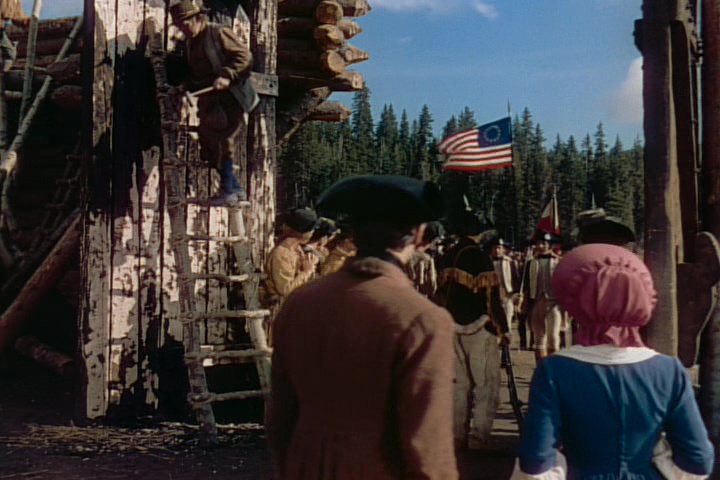
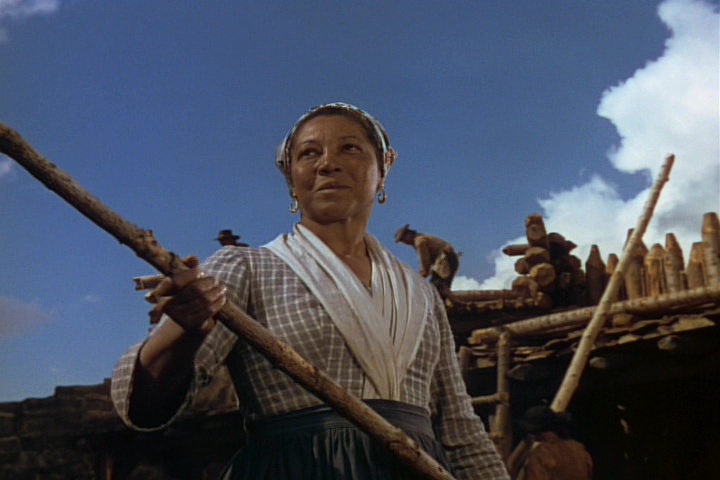
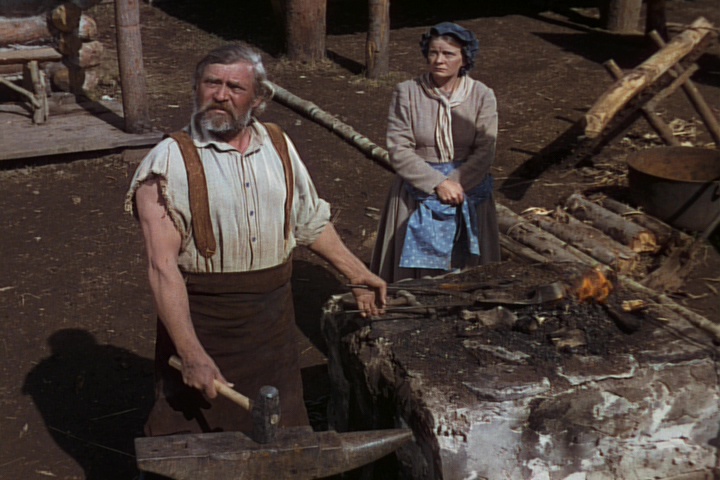
Soon after this battle, Gil and Lana visit the fort, which the settlers have set to repair. Here they discover that the Revolutionary War has ended, and someone mounts the flag atop the church steeple (the highest point within the fort). As this occurs, Ford cuts to four separate, still shots of people gazing upon the flag that stands for newfound freedom: a black woman, a blacksmith and his wife, a Native American, and finally, Gil and Lana.


Interestingly, Ford shoots both the black woman and the Native American from below, attributing to them something like hero status. With the camera pointed upward, Ford makes these people seem larger than life, emphasizing their place in this land of freedom. Of course, these two shots aren’t without irony—as these people would have had nothing like the freedom enjoyed by the blacksmith and by Gil and Lana. In this way, this final montage has a multivalent effect—it celebrates the victory for freedom; it chides the victors for their unbalanced or incomplete views of freedom; and it reveals a yearning for something more, seeing as winning the revolution most certainly did not mean freedom for all. There’s a poignancy to these images that the Tarantino’s of the world don’t seem to count in their reckoning of Ford on race.
The last of the four shots, the one of Gil and Lana, closes the film. It also includes the only lines in this brief sequence, and in it we see the final transformation of the elite as they take on the qualities of the everyman. Gil turns from the flag to his wife and says, “I reckon we’d better be getting back to work. There’s going to be a heap to do from now on.” They no longer have the luxury of leisure. Work beckons, just as it does to many, many others who hope to have a roof over their heads or food on their plates. In the end, Ford presents Gil and Lana as equals with everyone else under the new American flag, an equality borne out of shared suffering, shared surviving, and shared needs.
[1] You can find the original interview here.
[2] Kent Jones has already offered a cogent response to Tarantino, though Jones doesn’t consider Drums. See also Richard Brody’s recent introduction to a Ford retrospective playing this summer.



 Gladsome Morning