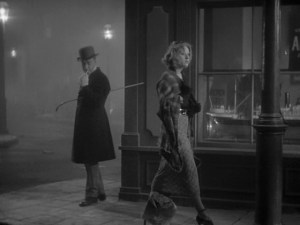
Steamboat Round the Bend (1935)

John Ford’s collaborations with Will Rogers are some of the more rewarding of the director’s work, particularly his work in the 1930’s. Light and airy with a touch of the poetic, they always remain profoundly humanist in the central character’s love for his neighbors—often in spite of them. The third and final film Ford and Rogers made together, Steamboat Round the Bend, is a wonderful illustration of this humanism in the sectarian South of the 1890s. It reveals the distinctive virtues that help Dr. John Pearly (Rogers) survive and find success in his attempt to save his nephew, Duke, from the gallows.

The two key characters in the film are Pearly and the self-proclaimed prophet against “the drink,” New Moses. Certain similarities unite these two men, yet their relationship is ultimately punctuated by a striking contrast. Both serve others. They both speak to crowds that gather to hear their message of healing. And they both have a set of followers. However, the key difference between them is in the type of service they provide. While Pearly offers his “neighbors” direct and tangible assistance, New Moses offers only “eternal” rewards. Because of this, New Moses comes off looking like a shyster, needing only the raised hand of a drunkard to dispense his “healing” gifts. No “real” or tangible help is necessary. No long nights spent with a man trying to kick a habit—only a sermon, a ribbon, and a passing of the hat to the sympathetic listeners. And when Pearly and his crew have a comedic encounter with “New Elijah” on the riverside, our suspicion of New Moses is confirmed.

Pearly on the other hand, dispenses tangible “medicine” in the form of rum. However, while that is played for comedy, Pearly proves himself over and again as he helps others throughout the film. He makes Duke turn himself in, even though the boy only acted in self-defense. He saves Duke’s young girlfriend from her abusive family. He earns money for Duke’s defense. He steams up and down the river looking for an eyewitness to Duke’s alleged crime. He tries to help Duke escape from prison when all looks lost. And of course, he competes in the race in a last ditch effort to save his nephew. As is made explicit near the end of the film, Pearly’s concern is saving a life, while Moses has been concerned only with saving souls.

Dr. Pearly wears various hats throughout the film—medicine salesman, museum entrepreneur, law-abiding citizen, and steamboat captain, to name a few. While several of the other characters possess their own shifting identities, Pearly has something else that helps him to transcend both New Moses and the other characters. He possesses good will toward others to such a degree that he will put himself out on their behalf. His service to others is tangible and observable. Pearly’s ability to shift to the changing needs of the moment helps him to survive. But his ability to do so while being guided by his care for others allows him to save a man’s life and earn the admiration of many.
The Informer (1935)

John Ford’s The Informer might best be thought of as a silent film. Or better yet, as a film that relies on its images and sounds, rather than its dialogue, to provide story elements, atmosphere, or character development. The dialogue is fine, but the brilliance of the film lies elsewhere. Ford and his cinematographer Joe August are able to ground the film’s characters (especially its central character, Gypo Nolan) and narrative solidly in the images.

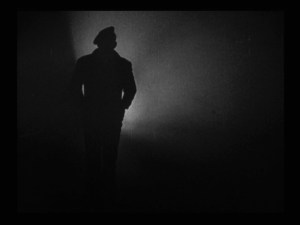
For example, in the opening sequence, Ford sets the mood, the narrative, and the characterization with a series of nearly dialogue-free scenes in the streets of Dublin. The film opens on the shadowy image of Gypo, backlit and walking toward the camera through the foggy Irish night. At this point, his surroundings are impossible to determine. He seems almost not a part of the world, a ghost of a man. A series of these shots continues throughout the opening credit sequence, and already we have a sense that Gypo, the informer, is a man without a home.

A title card just after the credits makes reference to the story of the betrayer Judas. Then the film moves from shadow to reality, as Gypo’s shadow gets smaller and smaller on a nearby wall as he finally enters the frame from the left. His lessening image only contrasts with the man himself, who towers over passing pedestrians. Already the camera hints toward Gypo’s contradictory persona—strong or weak, lies or truths.

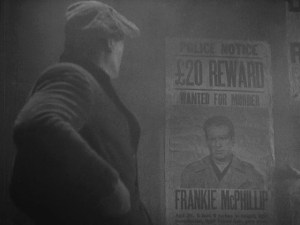
Ford’s camera follows Gypo down a Dublin street, where he encounters a wanted poster featuring a man called Frankie McPhillip. Gypo, shrouded in fog, stares long and hard at the poster. As Ford superimposes a happy memory of Frankie and Gypo over the mug shot, we not only get the distinct sense that Gypo knows the pictured criminal, but that he is struggling, like Judas, with whether or not to betray a friend. As he tears down the poster in anger, we perhaps can see this isn’t the first time Gypo has pondered this course.

The film then moves to three consecutive sequences, each of which is punctuated with that same wanted poster blowing into the frame. In the first, Gypo continues down the street, stopping only to listen to a young man singing an Irish ballad on the corner. As the man sings about the beauty of the Irish night and sea, Gypo stands removed from his countrymen, alone in the gloomy night. The camera’s focus turns to the poster, which, as if following Gypo, blows right on to his leg, sticking there and causing him some effort to remove it. But Gypo is no friend of the British either, quickly scurrying into the fog as a squad of “tans” rounds the corner. This all sets up the tragedy of Gypo Nolan beautifully, without words, save the song—a man without a home, lost in a moral fog, and even when surrounded by people, stands apart from all.

In the next sequence, a woman with covered head looks toward a rich man. Removing the shawl from her golden hair, she offers herself to the man with noting more than a look. As she walks by, Frankie’s poster catches on her feet, signaling her impending role in the Frankie McPhillip business, as well as indicating Gypo’s impending arrival. Just as the rich man approaches her, Gypo arrives. Perceiving the situation, he runs in to protect his female friend, throwing the man into the street. Here we get the only spoken dialogue of this sequence, as Gypo and Katie lament their poverty, speak of going to America for the required twenty pounds, and then break as Katie’s guilt causes her to ridicule Gypo’s reaction to her selling herself.

Finally, we see one final set of feet, those of Frankie McPhillip himself. As he walks down the city street, the poster blows up to him. Frankie picks it up, sees how much reward is being offered, and then quickly runs away to hide from another squad of “tans.” He is in the city, and the stage is set. The conflict is clear, though the night is anything but.

Ford accomplishes this set up in under ten minutes with only a minimum of dialogue. This aids the inherent suspense in the situation because it allows the viewer the freedom to make the connections of the narrative himself. And it makes clear the foggy moral morass that will imbue the film throughout.